LLM Evaluation Monitoring
Evals are a hot topic in generative AI right now. Let’s talk about what these are and go through some eval strategies.
This Lesson Will Cover
- 📊 Understanding LLM Evaluations
- 📈 Business Metrics Monitoring
- 🗣️ User Feedback Collection and Analysis
- 🔍 Qualitative Evaluation Methods
- 🚨 Monitoring for Inappropriate Content
What are LLM Evals?
LLM Evals (short for evaluations) are systematic methods for assessing and monitoring LLMs in production environments. The goal of monitoring these evals is to ensure that LLMs meet business requirements and maintain quality over time.
Business Metrics Monitoring
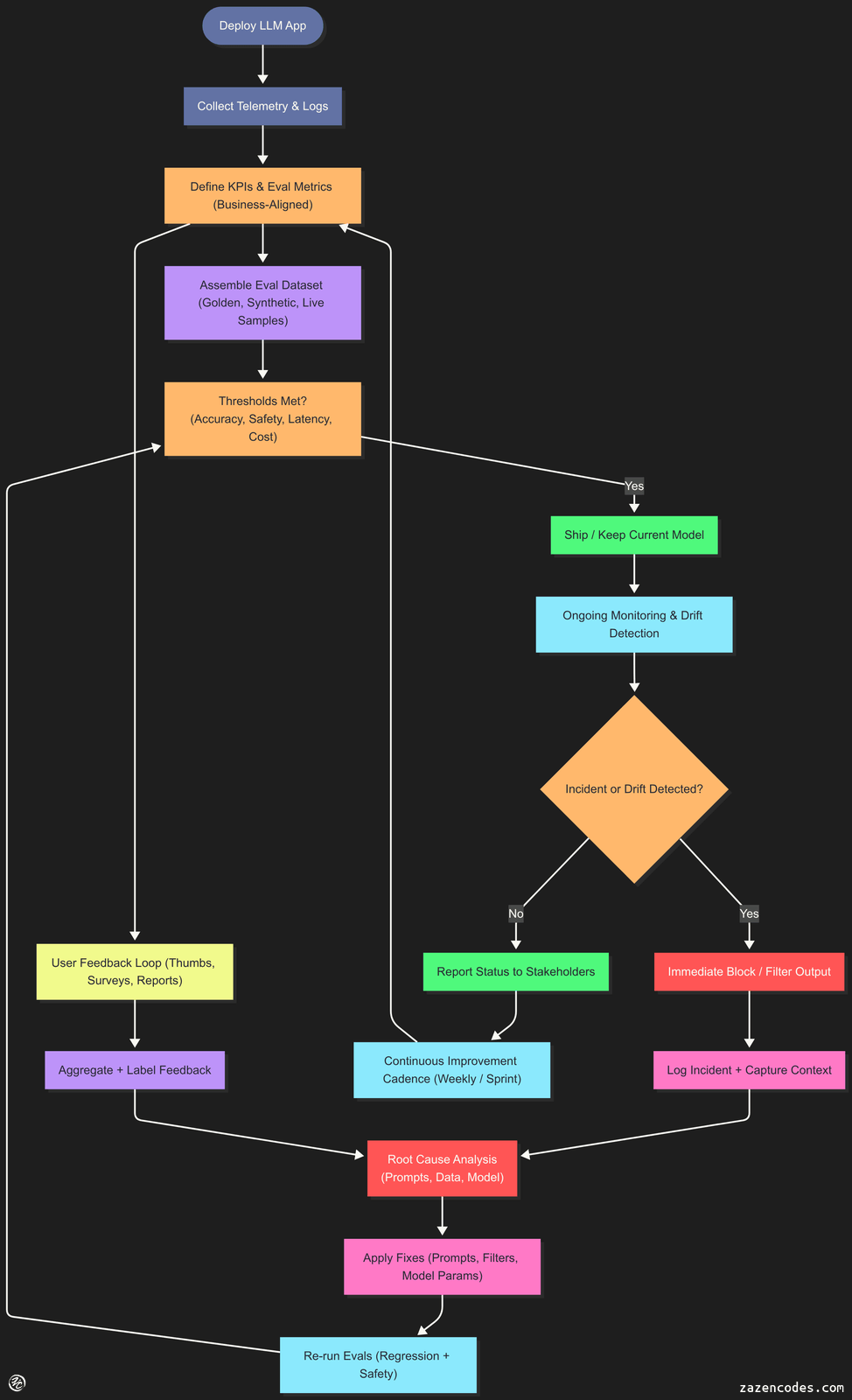
LLM evals should be closely tied to business goals and KPIs (Key Performance Indicators). This alignment ensures that model performance directly translates to business value.
For example, here are some common business goals with relevant LLM evals:
| Business Goal/KPI | LLM Evaluation | Monitoring Strategy |
|---|---|---|
| Customer Support Resolution Rate | Response Accuracy & Completeness | • Compare LLM responses against known good answers • Track follow-up question rates |
| Content Generation Efficiency | Output Quality & Relevance | • Measure editor acceptance rates and revision counts • Monitor content engagement metrics |
| Code Documentation Quality | Technical Accuracy & Clarity | • Validate against code structure • Track developer feedback and usage statistics |
| Sales Lead Qualification | Response Relevance & Conversion Impact | • Monitor lead qualification accuracy • Track conversion rates of LLM-qualified leads |
| Translation Accuracy | Language Preservation & Cultural Fit | • Use automated BLEU scores • Collect native speaker ratings |
| Search Result Relevance | Query Understanding & Result Ranking | • Track click-through rates • Measure search refinement frequency |
User Feedback Monitoring
User feedback provides direct insights into how well our LLM applications are serving their intended purpose. By systematically collecting and analyzing user feedback, we can identify areas for improvement and validate that the model meets user needs.
Collecting User Feedback
Continuous user feedback helps track:
- User satisfaction levels
- Common failure modes
- Feature requests
- Usage patterns
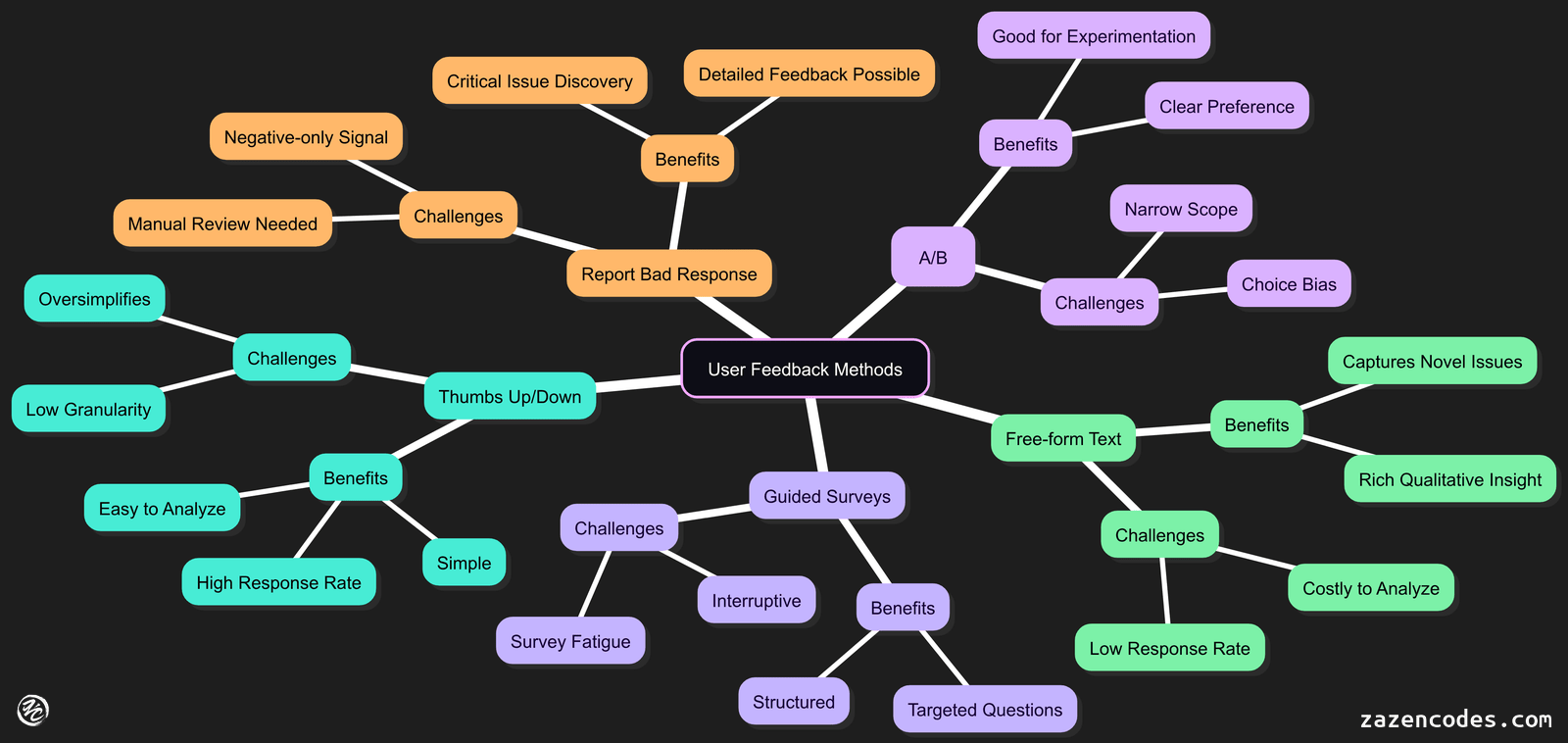
Here are some common ways of collecting user feedback for an LLM application in production:
| Feedback Method | Benefits | Challenges |
|---|---|---|
| Thumbs Up/Down | • Simple and intuitive • High response rate • Easy to analyze |
• Limited granularity • Lacks specific details on issues • Binary feedback may oversimplify |
| Report Bad Response | • Helps identify critical issues • Focused on problem areas • Can include detailed feedback |
• Only captures negative feedback • Lower response rate • May need manual review |
| Select Between Choices | • Direct comparison data • Clear user preference • Good for A/B testing |
• Limited to comparing specific options • May introduce choice bias • Higher complexity |
| Free-form Text Comments | • Rich, detailed feedback • Captures unexpected issues • Qualitative insights |
• Time-consuming to analyze • Lower response rate • Requires text processing |
| Guided Survey Questions | • Structured data collection • Targeted feedback areas • Comprehensive insights |
• Survey fatigue • Lower completion rate • May interrupt user flow |
Other Qualitative Evals
While user feedback may provide the most helpful qualitative insights into LLM performance, organizations should also implement structured manual review processes to proactively evaluate LLM outputs.
These help to discover:
- Hallucinations, e.g.
- Model confidently stating incorrect facts
- Making up fictional references or citations
- Inventing non-existent features or capabilities
- Inconsistencies, e.g.
- Providing different answers to the same question
- Contradicting previous statements
- Mixing up details between different contexts
- Other unintended outputs, e.g.
- Producing malformed or incomplete responses
- Generating off-topic content
- Leaking prompt instructions
A high-quality manual review process will go a long way in reassuring the business that its LLM application is safe. It’s an important consideration for encouraging adoption.
Manual Review Implementation
Here’s what a manual review process might look like:
-
Establish Clear Review Criteria
- Define specific evaluation strategies
- Informed by typical use cases observed
- Attempt to cover edge cases
- Adapt over time
-
Maintain Consistent Review Schedules
- Regular evaluation cycles
- LLM outputs change over time
- Record results in structured output
-
Review Process Integration
- Share insights across teams
- Connect findings to prompt/model improvements
Monitoring for Inappropriate Content
As we’ve discussed many times in this course, the ability of LLMs to produce inappropriate content, biases, and ethically questionable responses is a major concern for businesses and a limitation to adoption.
Keeping these in check is necessary for providing safe and responsible AI applications.
A multi-layered approach combining automated detection, user feedback, and manual review provides the most comprehensive protection.
Types of Inappropriate Content
Common areas requiring monitoring:
- Harmful or dangerous content
- Offensive language or hate speech
- Personal or sensitive information
- Biased or discriminatory responses
- Misleading or false information
- Malicious code or instructions
Here are some automated detection ideas, along with the qualitative measures discussed above.
| Strategy | Implementation | Benefits |
|---|---|---|
| Automated Scanning | • Regex patterns • Keyword lists • Content classifiers |
• Real-time detection • Scalable • Consistent |
| Sentiment Analysis | • Toxicity scoring • Bias-detection models |
• Catches subtle issues • Context-aware |
| User Feedback | Discussed above | • Identifies missed issues • Human context |
| Manual Review | Discussed above | • Deep analysis • Nuanced understanding |
Response Framework
Monitoring for inappropriate content is pointless if we don’t have a process for reviewing and taking action on the results.
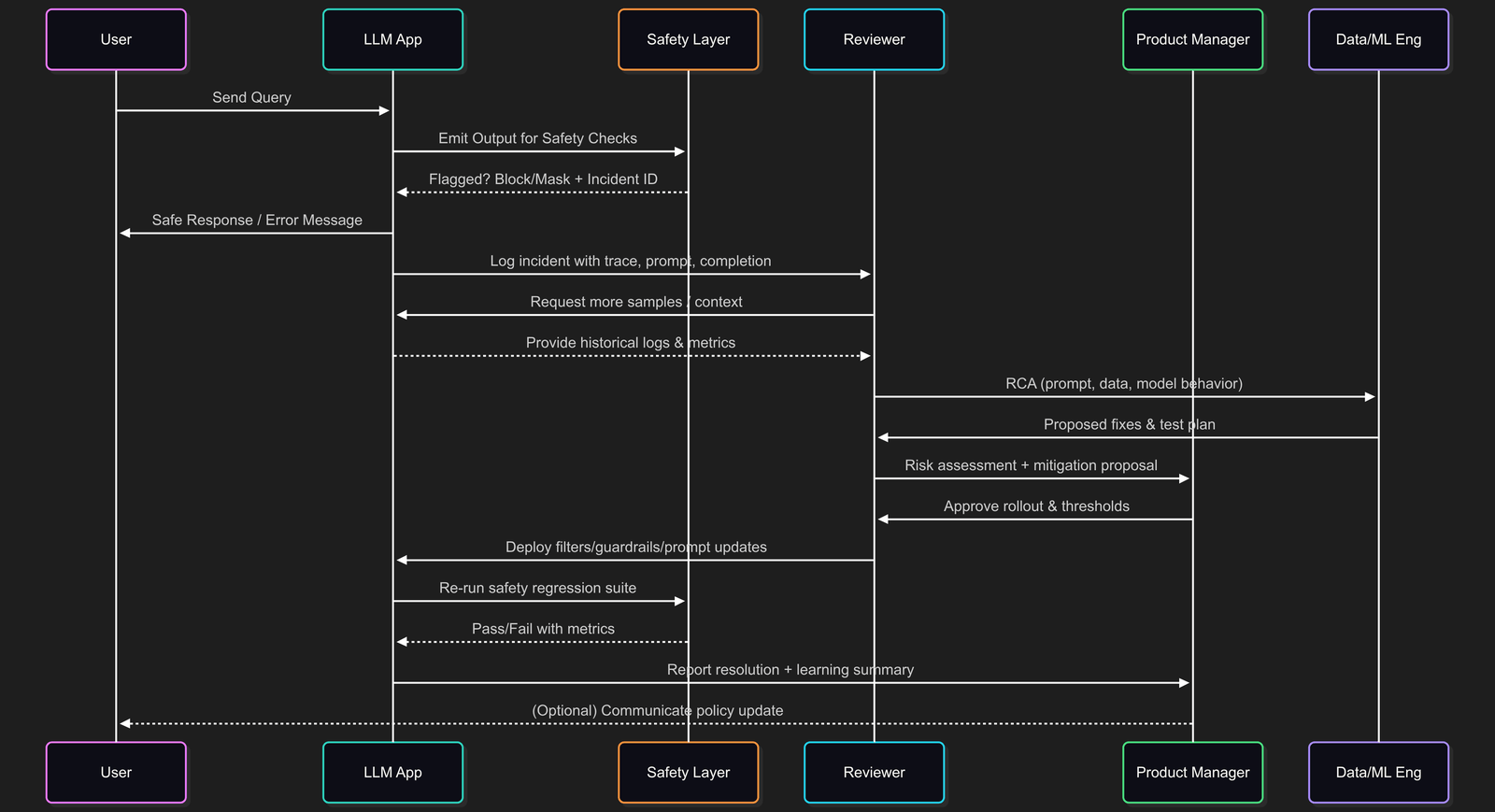
When inappropriate content is detected:
-
Immediate Actions
- Block or filter problematic outputs
- Log incidents for review
- Notify relevant stakeholders
- Collect context for analysis
-
Root Cause Analysis
- Review prompt engineering
- Analyze model behavior patterns
- Identify potential triggers
- Document findings
-
Preventive Measures
- Update content filters
- Refine prompt guardrails
- Adjust model parameters
- Enhance monitoring rules
Continuous Improvement
The mindset is one of continuous improvement of our prompts and/or models in order to prevent future occurrences.
Considerations for a proactive safety system:
-
Regular Updates
- Maintain blocklists and filters
- Update detection patterns
- Refine monitoring thresholds
- Incorporate new safety features
-
Feedback Integration
- Track incident patterns
- Update training data
- Improve prompt strategies
- Enhance safety measures
-
Documentation and Reporting
- Track safety metrics
- Document mitigation steps
- Share learnings across teams
- Report on effectiveness
Conclusion
Keeping an eye on LLMs isn’t easy, but it’s important. Nobody wants a chatbot to start giving their users instructions for doing illegal and/or immoral things.
Like I mentioned, evals are a hot topic right now in AI. But rather than present you with some hot new research or open-source tooling, I wanted to present evals from a simple and practical point of view.
Ian Webster has a great talk[1] with practical advice on evals, based on his experience building LLM applications at Discord. He also shared some outputs from an evals tool that his team at Discord open-sourced developed called promptfoo[2]. It looks very developer-focused, and I’m keen to try it out.
Key Takeaways
📊 LLM Evals are systematic methods for assessing and monitoring LLMs in production.
📈 Business metrics monitoring should align model performance with business value and KPIs.
🗣️ User feedback provides critical insights through various collection methods like ratings and surveys.
🔍 Qualitative evaluations help identify issues like hallucinations and inconsistencies.
⚠️ Monitoring for inappropriate content requires a multi-layered approach.
🔄 Continuous improvement is essential for maintaining LLM safety and quality.
Next: Infrastructure Management
Next up, we’ll continue talking about AI-system deployments and shift our focus to infrastructure management.
Footnotes
Iterating on LLM apps at scale Learnings from Discord talk on YouTube. ↩︎
promptfooon GitHub, a dev tool to help “Test your prompts, agents, and RAGs”. ↩︎
Comments (0)
No comments yet.