Interview Preparation
Getting hired as an AI engineer will likely require a strong performance in the interview process. This section outlines a modular approach to interview preparation.
Please don’t use the topics and advice from this lesson as your only resource to guide your study. It’s worth doing additional research into job interviews in the AI/ML space to ensure you’re studying relevant topics.
Also, when going through an interview process, make sure that you are clear about what topics will be tested in your technical rounds. You can ask about this during the first interview or over email before your first technical interview. Having this knowledge will allow you to study exactly what you’re going to be tested on.
This Lesson Will Cover
- 📋 Interview Process Overview
- 🤖 AI/ML Fundamentals Review
- 🏗️ Data Structures and Algorithms
- 🏛️ System Design for AI/ML
- 🎯 Interview Preparation Tips
What to Expect
The technical interview process for an AI Engineer role will aim to assess your knowledge of AI/ML concepts, data structures, algorithms, and system design.
Preparation is key to confidently demonstrate your skills.
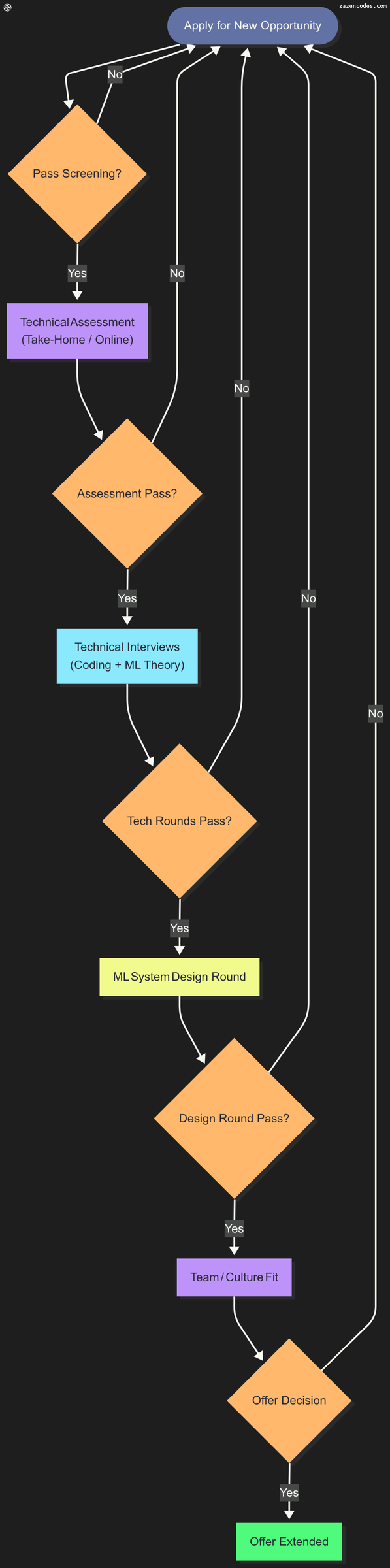
The process might look something like this:
-
Initial Screening
- Phone or video call with HR/recruiter
- Basic technical questions
- Discussion of experience and background
-
Technical Assessment
- Take-home coding challenge
- Online programming assessment
- ML/AI problem-solving tasks
-
Technical Interviews
- Coding interviews (1-2 rounds)
- Machine learning theory and implementation
- Algorithm and data structure problems
- System design discussions
-
ML System Design Round
- End-to-end ML system architecture
- Model deployment and scaling considerations
- Real-world problem-solving scenarios
-
Team/Culture Fit
- Meeting with potential team members
- Discussion of past projects
- Behavioral questions
Each company may have variations in their process, but most will cover these core assessment areas to evaluate both technical expertise and collaborative potential.
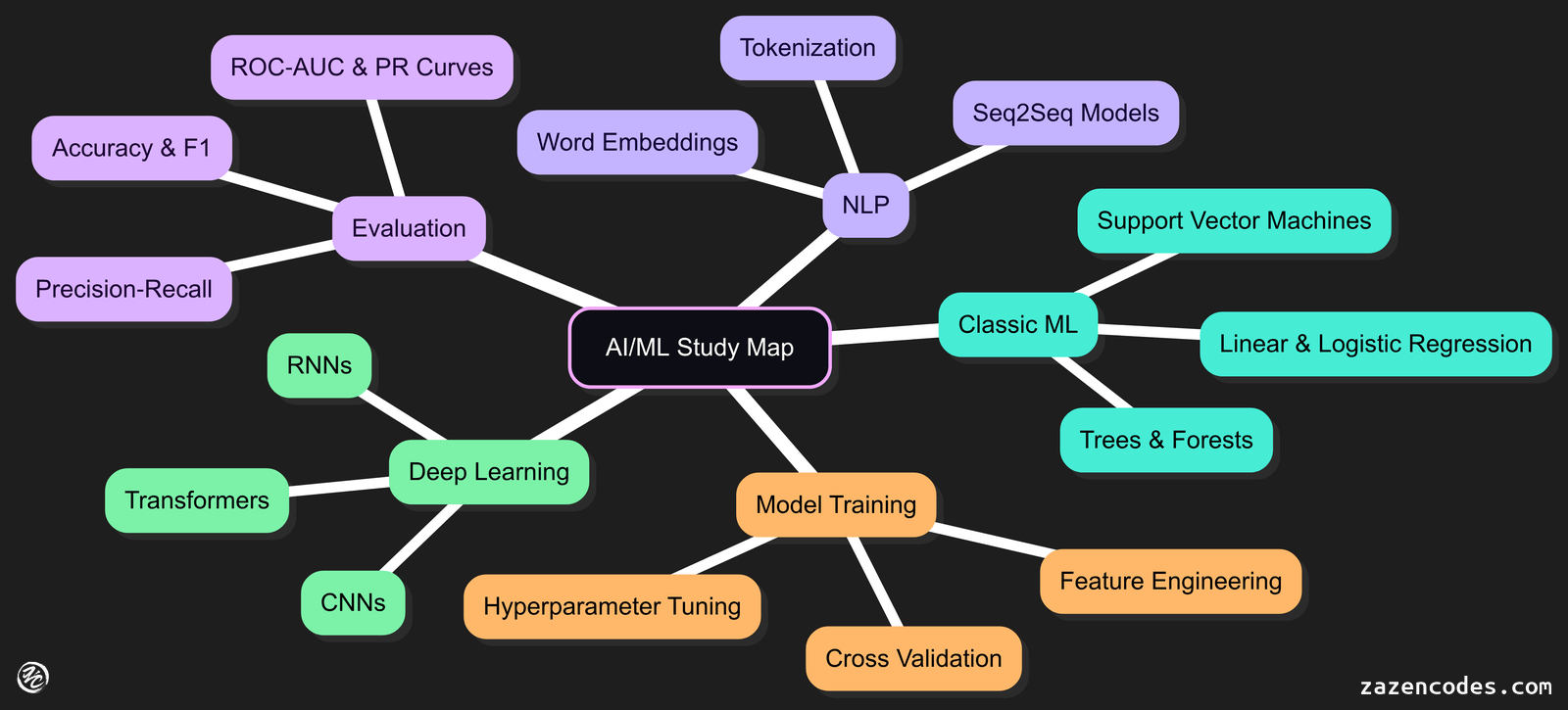
AI/ML Fundamentals
Requirement: Foundational knowledge in AI and machine learning.
-
Topics to Study:
- Classic ML: Linear/logistic regression, decision trees, random forests, SVMs, and gradient boosting.
- Model Training: Cross-validation, hyperparameter tuning, bias-variance tradeoff, and feature engineering.
- Model Evaluation: Metrics (accuracy, precision, recall, F1), ROC curves, and confusion matrices.
- Deep Learning Models: Transformers, BERT, GPT architectures.
- NLP Fundamentals: Tokenization, embeddings, and sequence-to-sequence models.
-
Tips:
- Understand the trade-offs between different ML algorithms and when to use each.
- Be prepared to explain model selection criteria and evaluation metrics.
- Practice implementing ML pipelines from data preprocessing to model deployment.
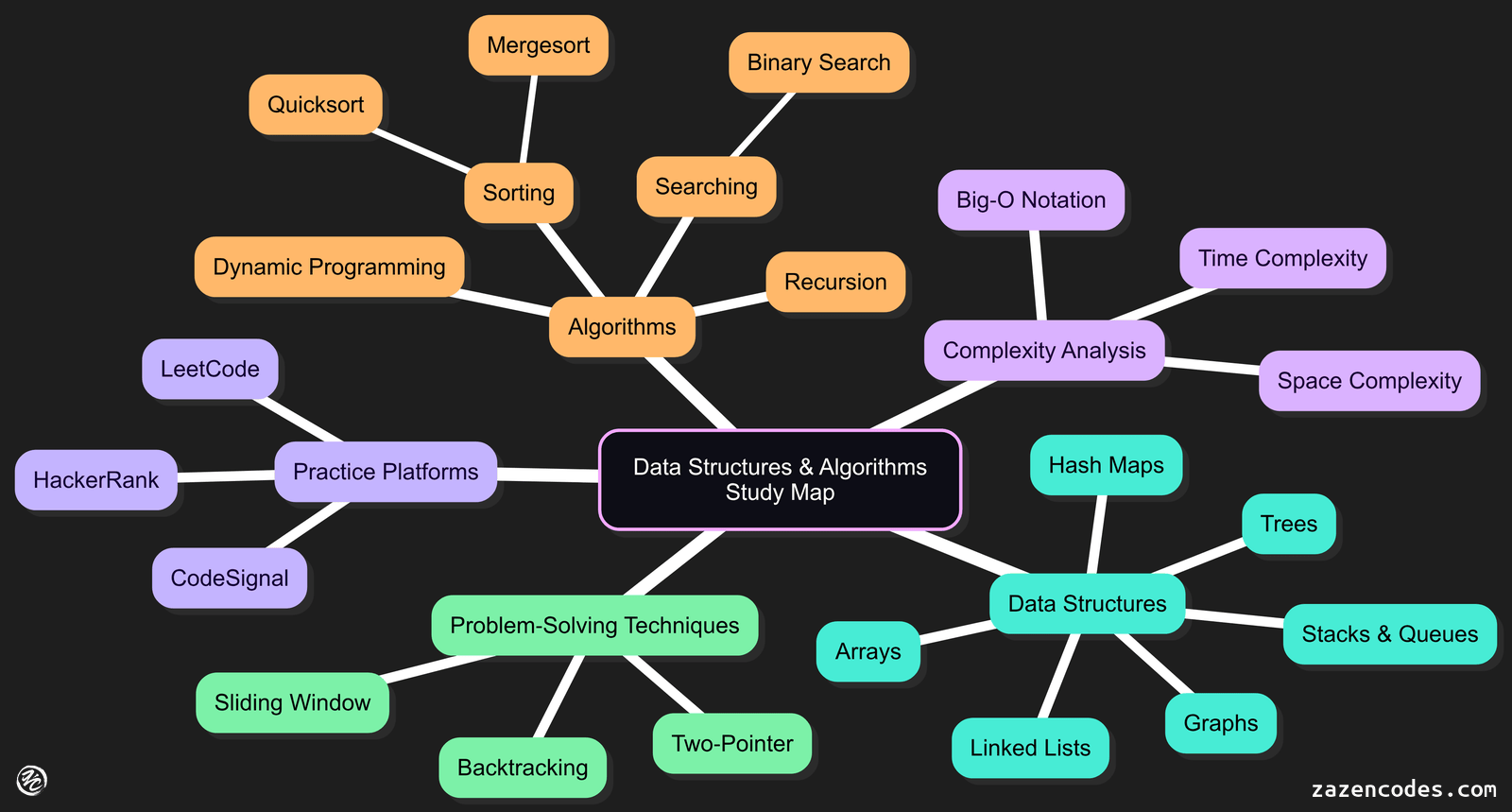
Data Structures and Algorithms
Requirement: Proficiency in algorithmic problem-solving using data structures.
-
Topics to Study:
- Data Structures: Arrays, linked lists, stacks, queues, hash maps, trees, and graphs.
- Algorithms: Sorting (e.g., quicksort, mergesort), searching (e.g., binary search), dynamic programming, and recursion.
- Big-O Notation: Time and space complexity analysis for algorithms and data structures.
- Problem-Solving Techniques: Sliding window, two-pointer approach, and backtracking.
-
Practice Platforms:
- LeetCode, HackerRank, or CodeSignal offer targeted practice problems.
-
Tips:
- Practice timed problems to simulate interview conditions and improve performance under pressure.
- Focus on explaining your thought process clearly while solving problems.
- Learn common problem-solving patterns and when to apply them.
- Review your solutions and learn from mistakes.
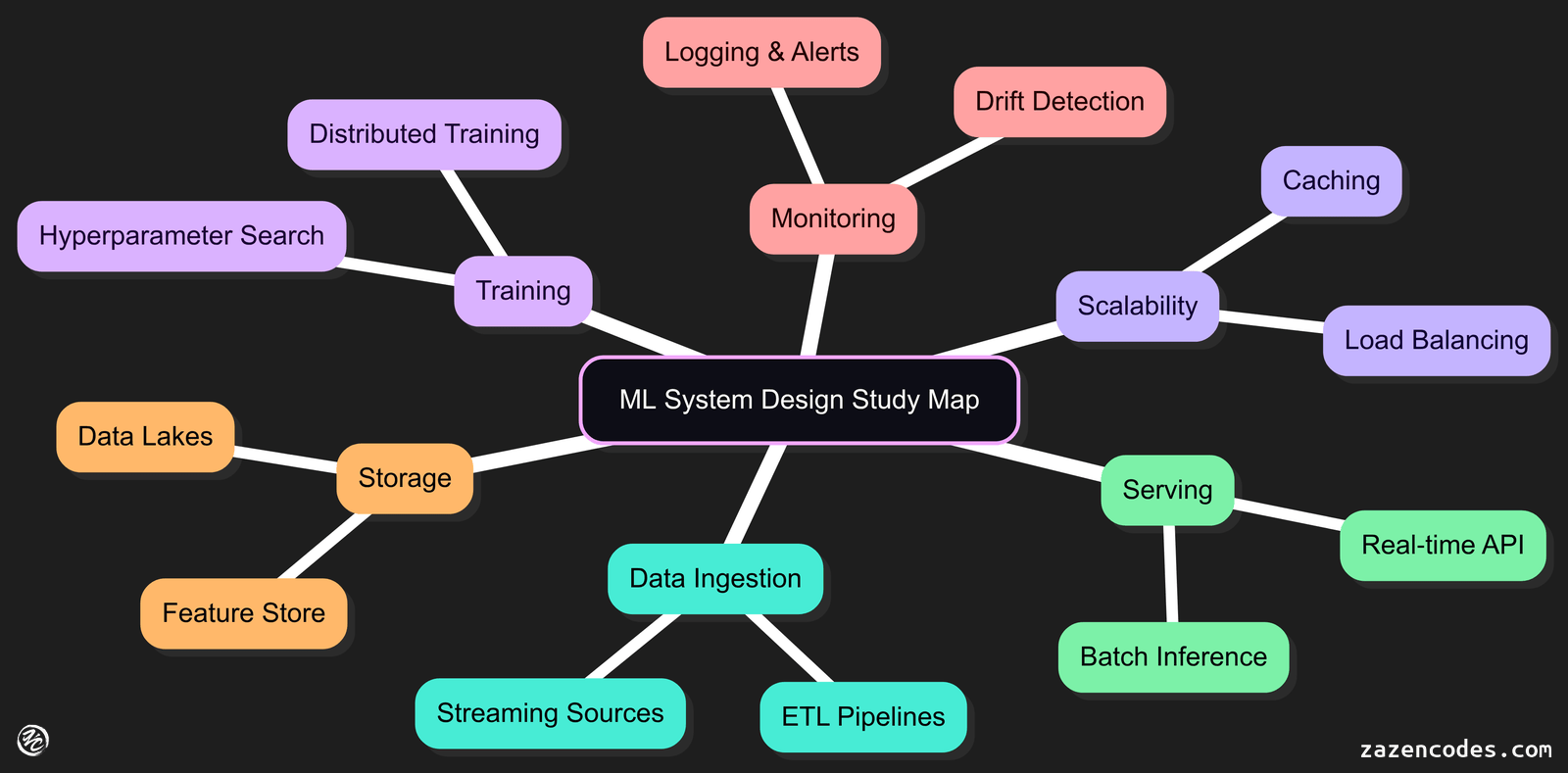
System Design
Requirement: Understanding of distributed systems and scalable ML architectures.
-
Topics to Study:
- Scalability: How to handle large datasets or high user traffic.
- Distributed Systems: Concepts like load balancing, caching, and data partitioning.
- AI-Specific Design: Architecting pipelines for data preprocessing, training, and serving ML models.
- Back-of-envelope Calculations: Common numbers like latencies (memory access, network calls), data sizes, and throughput estimations for quick system sizing.
-
Example Questions:
- “Design a recommendation system for an e-commerce platform.”
- “How would you scale a machine learning model to handle millions of users?”
-
Tips:
- Use diagrams and clearly articulate trade-offs during system design discussions.
- Ask clarifying questions to define the scope of the problem and verify your assumptions.
- Consider non-functional requirements like latency, throughput, and reliability.
- Break down complex problems into smaller, manageable components.
Conclusion
I’m relieved to be through that one. Frankly speaking, interviews suck. Getting hired can be really difficult, and it’s an emotionally challenging process.
For what it’s worth, here’s what I’ve learned from many failed interviews:
- You have to be all in on the job. 100% commitment. “It’s your dream job” type energy. (This is easy, but important).
- Signal your confidence in being able to do the job. (This can be difficult).
- Ask thoughtful questions about the business and try to offer valuable advice or ideas.
- Study for technical interviews.
Key Takeaways
🎯 Prepare systematically for different interview stages: screening, technical assessment, coding interviews, ML system design, and team fit.
❓ Always clarify interview expectations and topics to be tested so you can focus your preparation effectively.
🧠 Study core AI/ML fundamentals including classic ML algorithms, model training, evaluation metrics, and deep learning architectures.
🔢 Practice data structures and algorithms before your technical interview using platforms like LeetCode.
🏗️ Lean system design with an emphasis on scalable ML architectures, distributed systems, and real-world implementation considerations.
Next: Kaizen
Life works in strange ways, and by seeking continual improvement, we set ourselves up for long-term success. That’s what the next lesson is about.
Comments (0)
No comments yet.