Kaizen
Having reached the final lesson of this course, I’d like to thank you for joining me on this epic journey. If you’ve completed everything up to this point, then you know what I’m talking about.
We’ve gone from the bits and bytes of low-level computer architecture up to multimodal AI applications on Mars.
I hope that reading about practical examples and seeing actual code implementations helped you understand all the concepts we walked through.
Again, thank you. I’m grateful for your support in purchasing this course, and (more importantly) investing your valuable time into my content. I can’t wait to see the ROI (please share your success stories and on my ZazenCodes Discord!)
Kaizen is a Japanese philosophy of continuous improvement.
It’s an important mindset for any technical profession related to data and software: Web Dev, Software Engineer, Data Analyst, and so on.
In fact, it’s so important that I think this is the most valuable lesson of the course.
This Lesson Will Cover
- ⛩️ Kaizen and the mindset of continuous improvement
- 📚 Strategies for continual learning and development
- 🎯 Setting learning goals and tracking progress
- 🧐 Adapting to feedback and staying curious
- 🚀 Career development in AI Engineering
Mindset for AI Engineers
The mindset of continual improvement is particularly important for the field of AI Engineering.
Consider the following:
- The role of an AI Engineer is still evolving and not clearly defined, requiring adaptability and continuous skill development.
- AI technology and tools are advancing at an unprecedented pace, with new frameworks, models, and methodologies emerging regularly.
- The field combines multiple disciplines (software engineering, data science, machine learning) that are themselves rapidly evolving.
- New opportunities and specializations frequently emerge as AI capabilities expand into different industries and applications.
As we can see, the need for continuous improvement is not just beneficial, but essential for long-term success.
Strategies for Continual Improvement
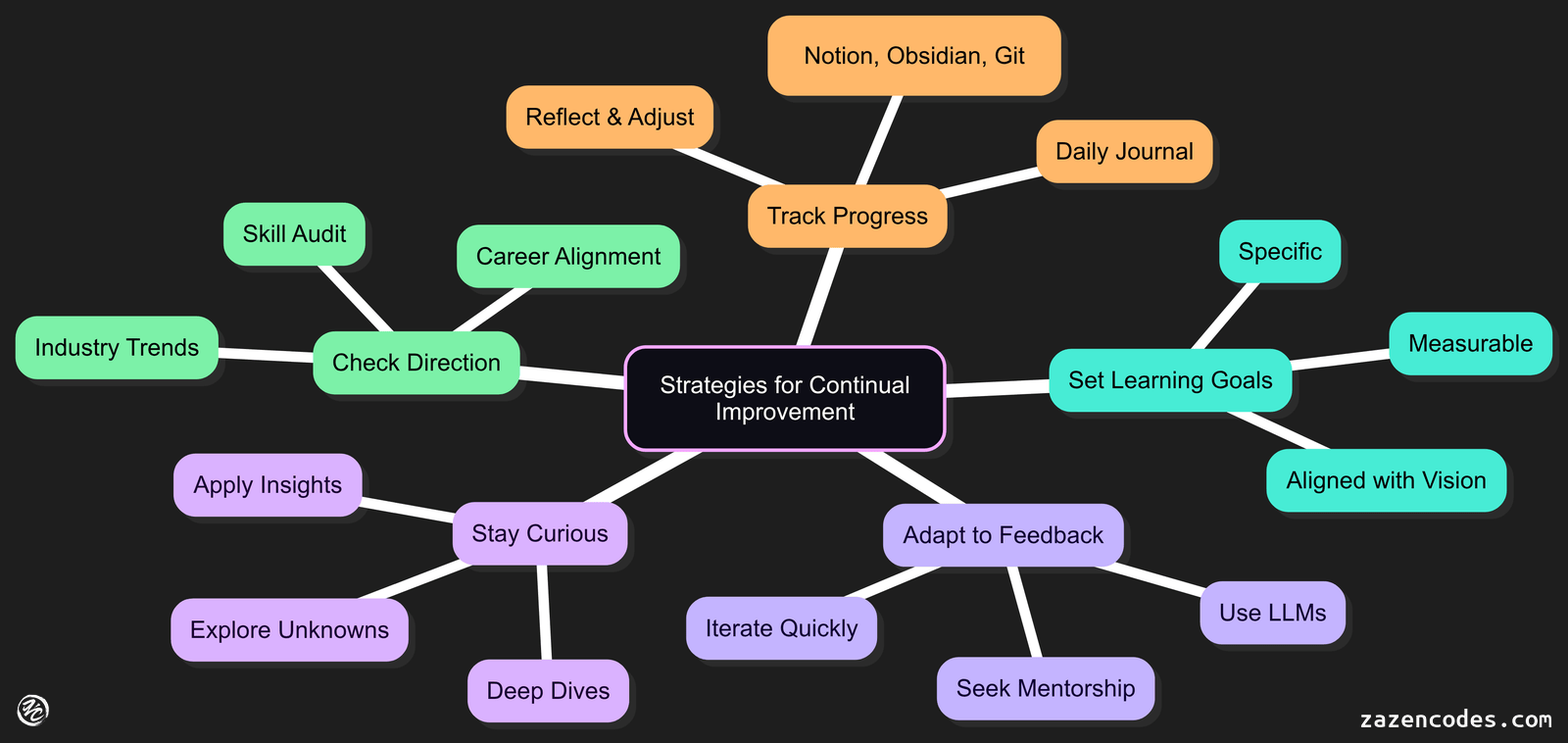
Here are some strategies that might be helpful.
Set Learning Goals
Identifying specific areas to improve or learn can be helpful in order to focus our attention and ensure that we’re making meaningful, consistent progress towards our goals.
Track Progress
By tracking our progress each day, we can reflect on our work and learnings. This can also be helpful for maintaining momentum.
A simple journal entry after a dedicated bout of work (on a project, a task at work, a learning session, etc…) allows us to recognize the work we’ve done that day and can have the effect of making us more willing to follow that up with another work effort tomorrow.
Tools like Notion or Obsidian are good for this. So is a simple Markdown file committed to GitHub. The only thing that matters is that you are able to create a habit around a system that works for you.
Checking Your Direction
Periodically assessing direction is important to make sure that we’re headed the right way.
We can ask questions like:
- Am I moving closer to my long-term career goals?
- What skills have I gained in the last 3-6 months?
- Are my current learning activities aligned with industry trends?
- Are there emerging technologies I should explore?
- Which areas of my knowledge need strengthening?
- How can I apply what I’ve learned in practical ways?
Adapting to Feedback
In order to adapt to feedback, we first need to get some feedback. By putting ourselves and our work out there, we can learn from people who have come before us.
We can also use generative AI to get personalized and private feedback on anything we do with the click of a few buttons.
Adapting our work to feedback is one of the best ways to grow as a technical professional.
Staying Curious
I’ve saved my favorite piece of advice for last.
In staying curious about how things work, we are naturally interested in seeking a deeper understanding of software and technology.
Every day I encounter things that I don’t understand (concepts, tools, frameworks, etc). In these moments, I will stop and take a minute to learn more (often with the help of an LLM). In this way, I’m consistently expanding my knowledge and skills - making progress towards mastery (if even by the tiniest step).
In seeking out a deep understanding of our work, we may also feel compelled to engineer more beautiful solutions, which often result in more efficient and maintainable systems.
Conclusion
Key Takeaways
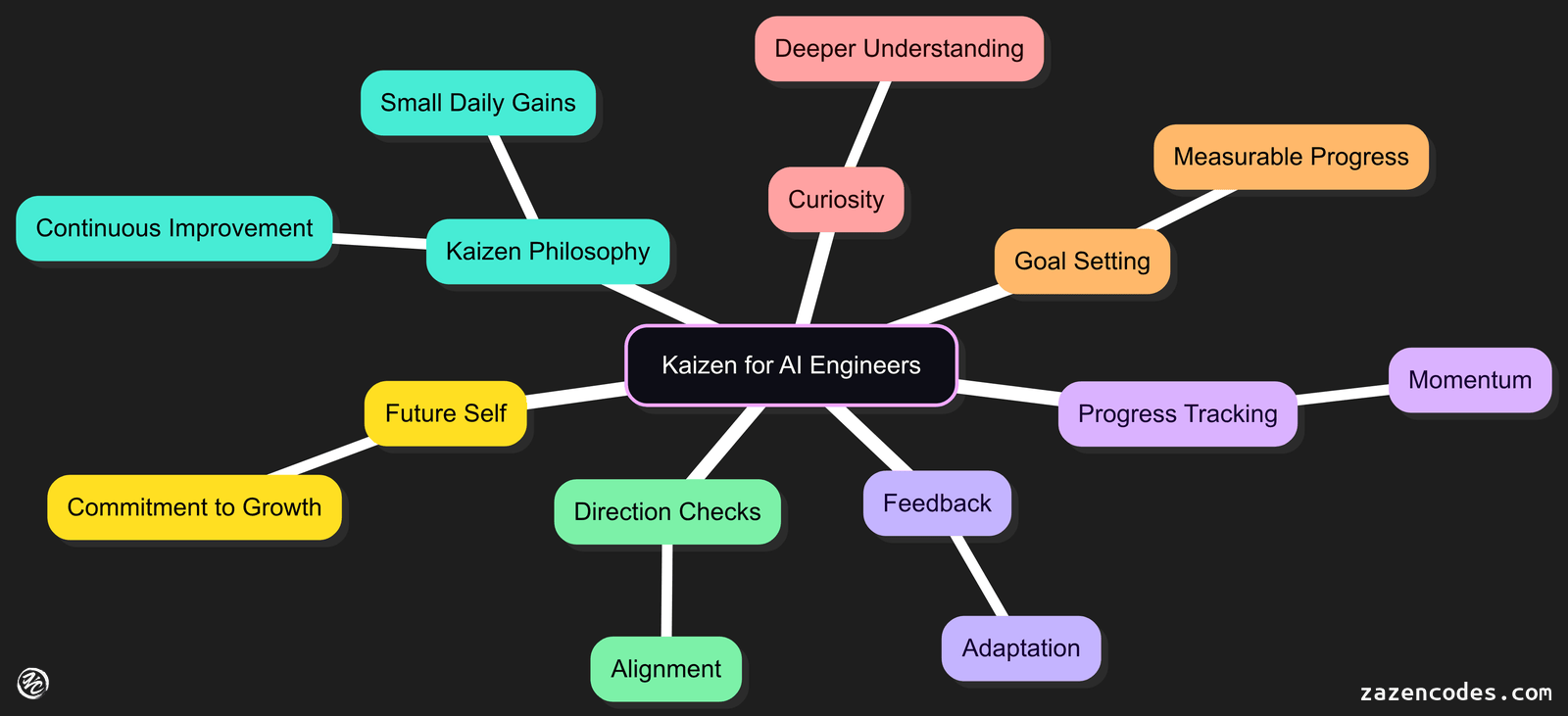
⛩️ Kaizen philosophy emphasizes continuous improvement, essential for AI Engineering.
🎯 Setting specific learning goals helps focus our development efforts.
📊 Tracking progress daily maintains momentum and motivation.
🧭 Regular direction checks ensure alignment with career goals and industry trends.
💡 Seeking and adapting to feedback accelerates professional growth.
🔍 Maintaining curiosity drives deeper understanding and better solutions.
Next: Keep Learning
The mindset I’m advocating for here is simple, but living it is difficult.
It’s a desire to learn difficult things, even if they won’t help us get our job done today, or build our app faster this week.
It’s a commitment to our future selves and an understanding that we’re growing into a new person who can think and execute on a completely different level than we can today.
Each act of learning, no matter how small, is a drop in the bucket. We fill up our bucket, drop by drop, one day at a time.
Namaste.
Comments (0)
No comments yet.