Technical Portfolio Building
There is no formal track to success in software engineering. Unlike other careers, with standardized training and testing (e.g., lawyer, doctor, accountant), the developer path is not well defined.
Of course, there’s a computer science degree, and any number of certifications that can be pursued, but none of these are compulsory.
In this section, we’ll talk about practical strategies to develop a career in AI engineering, focusing on portfolio building, interview preparation, and continuous improvement.
Unlike most of the content in this course, this section is opinionated. I’m sharing my advice based on what worked for me and what I look for when hiring.
The purpose of a portfolio is to showcase skills, projects, and contributions. It should demonstrate (a) expertise, (b) work ethic, and © passion for AI engineering.
This Lesson Will Cover
- 🚀 Building in Public
- 🛠️ Personal Project Development
- ✍️ Technical Blog Writing
- 🏆 Open Source Contributions
- 🎤 Conference Presentations
Here are some strategies to create an impactful portfolio:
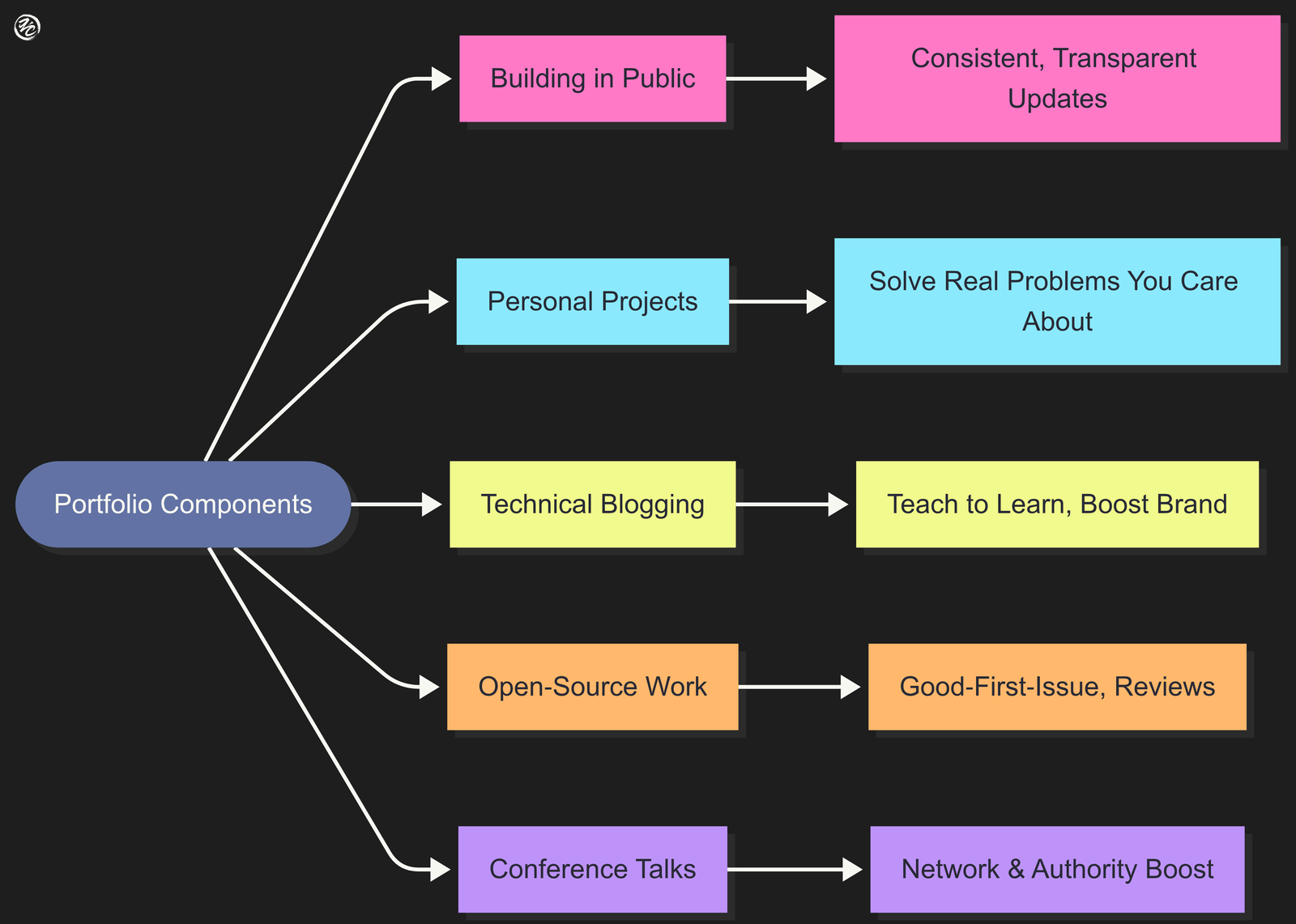
Building in Public
Sharing progress publicly helps with accountability and also opens opportunities for feedback and collaboration. It’s a signal to employers that you are passionate about what you do.
- Example: Document your project milestones on platforms like Twitter, LinkedIn, or GitHub. Regular updates show your problem-solving process and commitment to growth.
- Tip: Share not just successes but also challenges and how you overcame them. Transparency builds credibility.
If this doesn’t come naturally, don’t worry. Like anything - the more we do it, the better we get. There’s a great book called Show Your Work! that I would recommend if you’re looking for motivation to share in public[1].
Keep in mind that it’s easy to get overwhelmed. There’s no “optimal strategy” or “right amount” to post, or at least not that I’ve found. I suggest picking a goal for sharing that you can stick with. Maybe it’s three LinkedIn posts a week - that’s great!
Personal Project Development
Personal projects serve a few purposes:
- Demonstrate your ability to apply AI concepts to real-world problems.
- Prove that you are deeply interested in AI engineering.
- Allow you to build whatever you want!
Anything that excites you—this is your chance to bring it to life. We don’t get as many chances as we might think to build the things we dream about making. Think carefully about how you want to apply AI to a real-world problem before you get started.
A personal project is an opportunity to create something you’re passionate about — without monetary concern. It doesn’t have to be revenue-generating. The one thing I would suggest is to pick something that other people will care about as well.
Technical Blog Writing
Writing technical articles builds your personal brand while helping you solidify your understanding of AI topics. It’s a great way to practice the Feynman learning technique: learning by teaching.
- What to Write:
- Tutorials (e.g., “How to Build a Simple Neural Network”, “Agentic AI with Python: 101 Guide”).
- Insights from your projects (e.g., “Lessons Learned from Building a Sentiment Analysis Model”).
- Where to Publish:
- Medium, Dev.to, or your own website.
I started writing blogs on a free WordPress website and then moved to Medium. If I could start again, I would have done them all on my own domain.
There are benefits to writing on blogging sites, like Medium, or Dev.to:
- Ease of publication
- Writing tools
- Builtin likes and comments
- Distribution (this is probably the biggest benefit)
In my opinion, owning your own content online outweighs these benefits. But you can make your own decision about this. Perhaps try both if you’re not sure.
Open Source Contributions
Contributing to open-source projects improves your technical skills and establishes a reputation in the AI community.
- How to Get Started:
- Find projects on GitHub tagged as “good first issue.”
- Submit code contributions, improve documentation, or suggest optimizations.
- Impact: Your contributions are public, allowing potential employers to see your coding skills and collaborative mindset.
I can’t provide any personal experience here because my open-source contributions are embarrassingly lacking. However, I have huge respect and appreciation for open-source contributors because I love using open-source tools. In fact, I pretty much owe my career to these people (Python, Scikit-learn, Postgres, Vue.js, etc.).
Conference Presentations
Presenting your work at industry events or meetups can significantly boost your credibility and networking opportunities.
- Getting Started:
- Propose a talk, tutorial or poster presentation for a AI-related conference (including Python, Data Science, etc…) or local tech meetup.
- Selecting a Topic:
- Think about what is new and interesting right now and fits with the theme of the conference.
- Look at talks from previous years for inspiration.
- Ideally, pick something that you are thinking about often and actively working on, i.e. a topic that you are uniquely positioned to present.
- Tip: Look for a mix of small events and larger-scale conferences. Small meetups still offer valuable networking opportunities, and the big stages are competitive.
In my opinion, this is the ultimate form of sharing your work and putting yourself out there. It can be scary, but the ROI on your time is huge. I highly recommend getting involved in your local communities and connecting with other individuals who are passionate about the same tools, technologies, or industries that you are.
Conclusion
I hope this lesson has motivated you to build, share, and connect with people.
Key Takeaways
💼 Building a strong portfolio takes consistent effort across multiple channels.
📢 Sharing your work publicly helps demonstrate passion and build credibility.
🔧 Personal projects should align with your interests while solving real problems.
✍️ Writing about technical topics solidifies your knowledge and establishes expertise.
🛠️ Open-source contributions showcase your ability to collaborate and improve projects.
🎤 Speaking at conferences and meetups can enhance your authority and professional network.
⭐ Quality matters more than quantity when developing your portfolio.
Next: Interview Preparation
Up next, we’re going to talk about an important topic that I really don’t like: preparing for interviews.
Footnotes
This fantastic little book, “Show Your Work!”, by Austin Kleon, changed how I think about creating content and positioning myself online—specifically, for me, on LinkedIn. It’s the type of book that speaks to everyone and tells all of us something different. ↩︎
Comments (0)
No comments yet.