AI for Efficiency
Artificial Intelligence is revolutionizing how businesses operate, dramatically improving efficiency, productivity, and customer satisfaction across industries. Let’s see some examples of what this revolution looks like today.
This Lesson Will Cover
- 🚀 How AI improves business efficiency and productivity
- 🏭 Applications of AI in manufacturing and automation
- 🤖 Customer service automation and improvements
- 🌍 AI applications across various industries like real estate, healthcare, and education
Workplace Automation in Business
The productivity benefits that we’re seeing from AI in business are absolutely insane, and the people who know how to take advantage of them are able to produce more value from their time than ever before.
Consider these examples:
Content Creation and Marketing
- Using AI writing assistants to draft blog posts, social media content, and marketing copy faster
- Generating custom images and graphics with AI art tools for presentations and marketing materials
- Creating video content with AI-powered editing and translation tools
- Automating social media scheduling and content distribution
Research and Analysis
- Summarizing long documents and research papers using AI tools
- Analyzing market trends and competitor data with AI-powered analytics
- Extracting key insights from customer feedback and survey responses
- Processing and visualizing large datasets quickly
Administrative Tasks
- Automating email responses and calendar scheduling
- Transcribing meetings and generating action items automatically
- Managing and categorizing documents using AI-powered organization tools
- Streamlining expense reports and documentation processes
Project Management
- Using AI to estimate project timelines and resource requirements
- Automating task assignments and progress tracking
- Identifying potential project risks and bottlenecks
- Generating project status reports and updates automatically
Sales and Customer Relations
- Automating lead qualification and scoring
- Generating personalized sales proposals and follow-ups
- Creating custom client presentations quickly
- Analyzing customer interaction patterns for better engagement
Manufacturing Applications
Manufacturing industries are using AI for efficiency, precision, and predictive capabilities. Here are key areas of impact:
-
Predictive Maintenance with IoT
- Sensors on equipment collect real-time data, which AI analyzes to predict potential failures.
- For instance, a factory could prevent downtime by identifying early signs of motor wear and scheduling maintenance accordingly.
-
Supply Chain Optimization
- AI optimizes logistics by predicting demand and reducing bottlenecks in distribution.
- Example: AI systems might reroute shipments dynamically based on weather conditions or port congestion.
-
Robotics and Automation Systems
- Collaborative robots (cobots) equipped with AI work alongside humans, improving productivity and safety.
- Use case: Robots in assembly lines handle precision tasks like welding or quality inspection.
These applications reduce waste, increase efficiency, and make manufacturing more resilient.
Customer Service Automation
AI is changing what customer service means - both for businesses and customers. Better AI is enabling faster and more accurate responses to customer queries while reducing operational costs.
Consider a few examples:
-
Automated Response Systems
- AI chatbots, like those on e-commerce websites, handle routine queries, such as order tracking or product availability.
- Example: A telecom company uses a chatbot to troubleshoot common issues like resetting a router.
-
Complaint Handling
- AI systems triage complaints, categorize them by severity, and escalate urgent cases to human agents.
- This approach ensures that customer issues are resolved faster and more effectively.
-
Question Answering Systems
- Advanced models like OpenAI’s GPT or Google’s Bard provide precise answers to complex queries by leveraging natural language understanding.
By automating customer service workflows, businesses can enhance the customer experience while freeing up human agents for more nuanced tasks. Obviously, these AI solutions have a long way to go. We’ve all experienced the pain of dealing with an automated agent who can’t help us. But this experience is undergoing rapid change.
Other Industries
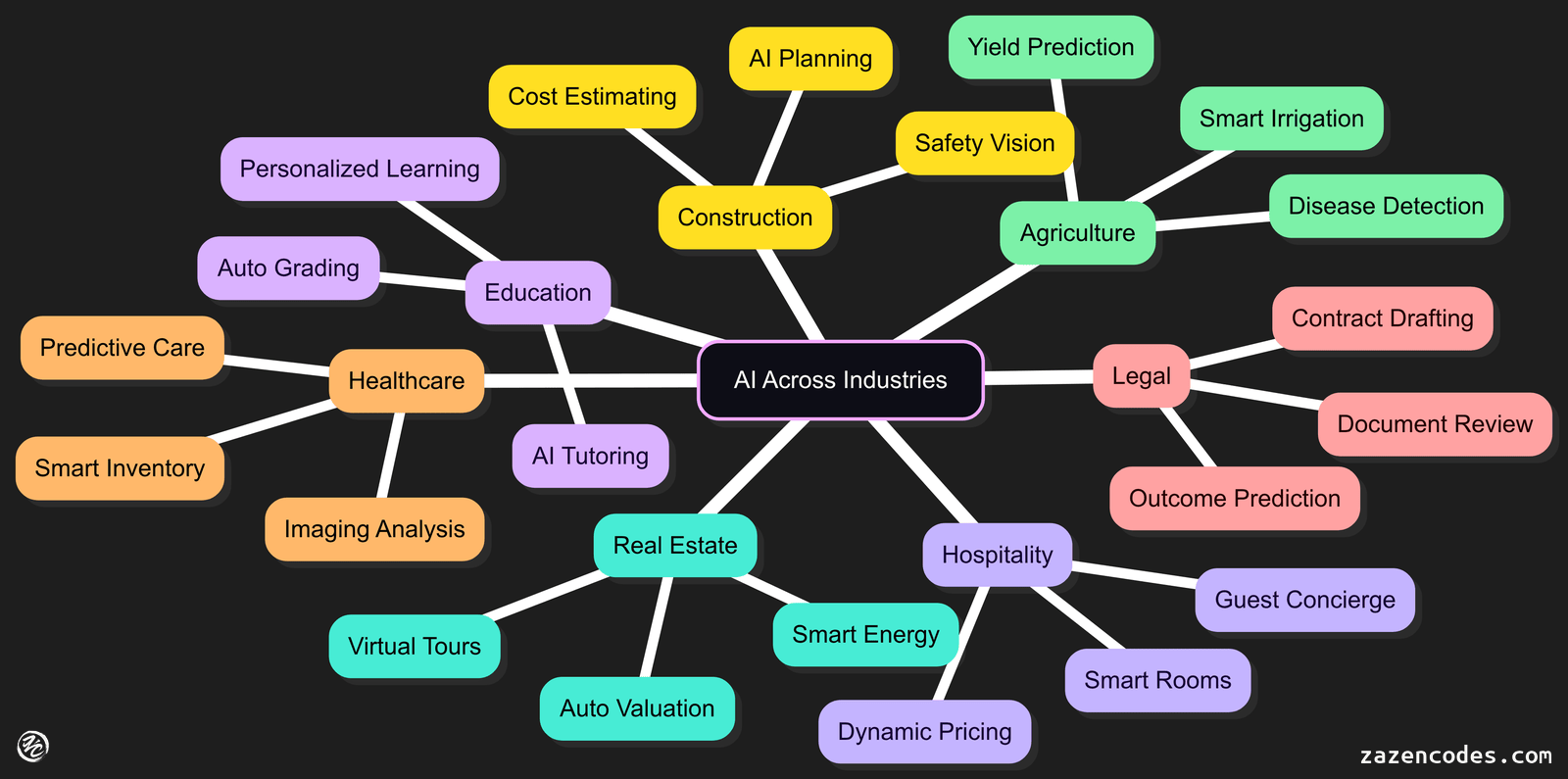
These examples are just scratching the surface of how AI is transforming business operations. The same principles can be applied across countless other industries:
Real Estate
- Virtual property tours enhanced by AI-generated staging
- Automated property valuation and market analysis
- Smart building systems that optimize energy usage
- AI-powered property matching for buyers and renters
Healthcare
- Automated appointment scheduling and patient follow-ups
- AI analysis of medical imaging and test results
- Predictive analytics for patient care and resource allocation
- Smart inventory management for medical supplies
Education
- Personalized learning paths for students
- Automated grading and feedback systems
- Predictive analytics for student performance
- AI-powered tutoring and study assistance
Agriculture
- Crop yield prediction and optimization
- Automated irrigation and fertilization systems
- Disease detection in plants using image recognition
- Smart harvesting schedules based on market demand
Hospitality
- Dynamic pricing based on demand prediction
- Automated guest service and concierge systems
- Smart room controls and energy management
- Personalized travel recommendations
Legal Services
- Automated document review and analysis
- Case outcome prediction
- Contract generation and validation
- Legal research assistance
Construction
- AI-powered project planning and scheduling
- Safety monitoring using computer vision
- Material usage optimization
- Automated cost estimation and bidding
The possibilities are endless, and new applications are being developed daily. Any process that involves data, decision-making, or repetitive tasks can potentially be enhanced or automated using AI technology.
Conclusion
If you were still feeling the “doom and gloom” vibes from the Generative AI lesson, then I hope this one has you feeling more optimistic. In fact, I’m confident that there are dozens of successful business ideas hiding in plain sight right here in this lesson.
Key Takeaways
🤖 AI is revolutionizing business operations across industries by improving efficiency and productivity.
🏭 Manufacturing benefits from AI through predictive maintenance, supply chain optimization, and robotics.
💬 Customer service automation is evolving with chatbots and AI-powered response systems.
🌍 AI applications are transforming diverse sectors including real estate, healthcare, education, and more.
🎯 The key to success is identifying where AI can add value in existing business processes.
🚀 Organizations that effectively implement AI solutions gain significant competitive advantages.
Next: Multimodal AI Applications
Next up we’ll talk about an application of AI that was probably the major theme of 2024: multimodal systems.
Comments (0)
No comments yet.