What Data Engineers Do
Data engineers are responsible for creating and maintaining the systems that provide analytics data for a business, including the data required for ML/AI.
They build and implement data pipelines and monitor data sources for data quality and accessibility.
Their work often encompasses many aspects of the data lifecycle, including collection, storage, processing, and delivery.
If none of that sounds interesting or important, then feel free to skip this section ;)
This Lesson Will Cover
- 🏗️ Data Engineer Responsibilities
- ⚙️ ML/AI Pipeline Components
- ✅ Data Quality Management
- 📊 Scaling Large Datasets
- ⏳ Real-Time vs Batch Processing
Role in ML/AI Pipelines
Most production ML/AI systems are backed by at least one data pipeline.
Generally speaking, a data pipeline:
- Gets data from some source
- Processes it
- Puts it somewhere else
The processing step could include tasks like filtering, validation, and transformation.
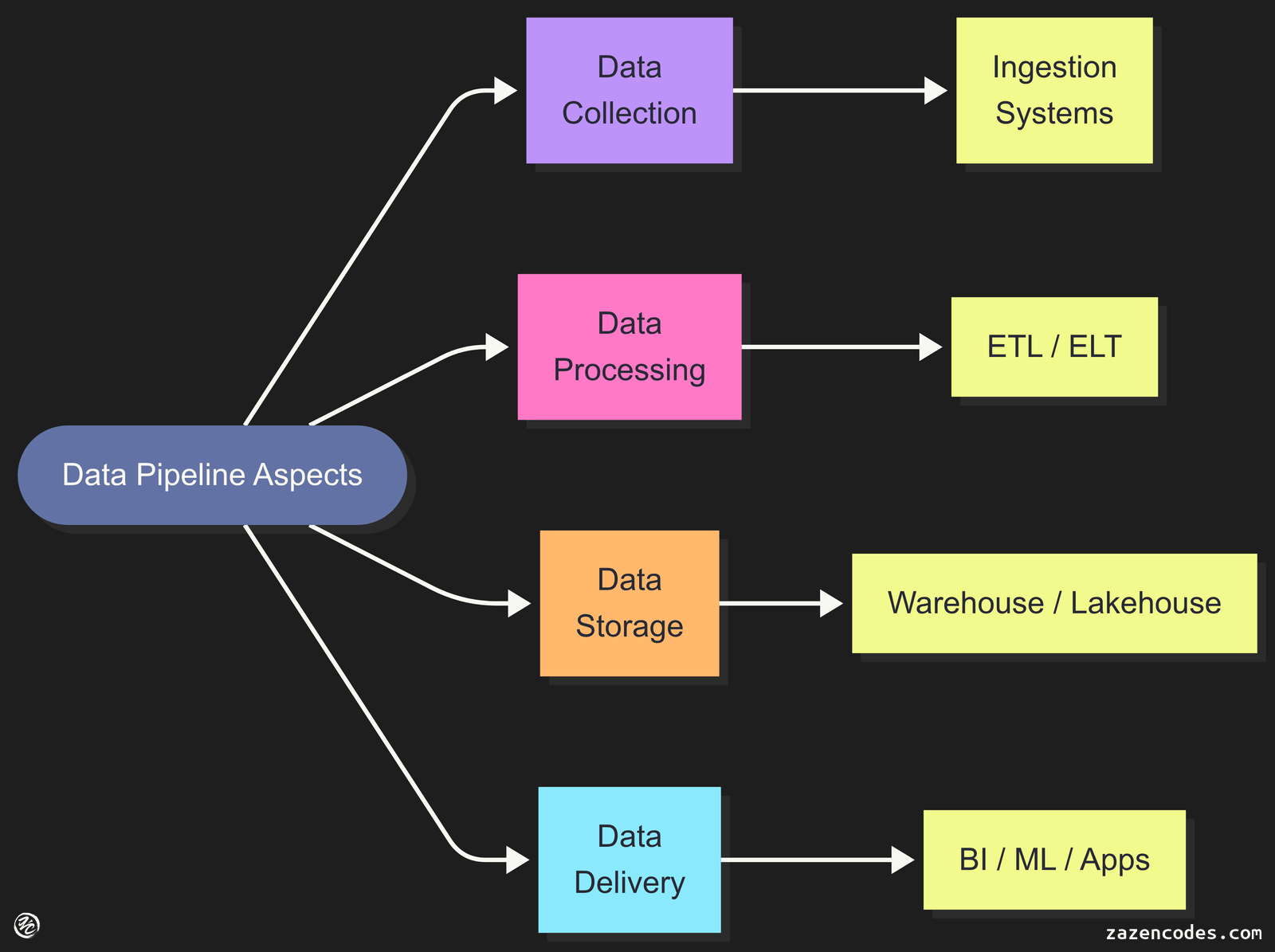
Consider these aspects of a data pipeline:
-
Data Collection:
- Gathering data from diverse sources like databases, APIs, IoT devices, and third-party platforms.
- Example: Pulling real-time stock market data from financial APIs.
-
Data Transformation:
- Cleaning, normalizing, and enriching data to ensure consistency and usability.
- Example: Removing duplicates, filling missing values, and standardizing formats.
-
Data Storage:
- Designing storage solutions that scale with the needs of the application.
- Example: Choosing between a data lake for flexibility or a data warehouse for structured queries.
-
Data Delivery:
- Ensuring that processed data is readily available to ML engineers, analysts, and applications.
- Example: Making a dataset accessible for model training or real-time inference.
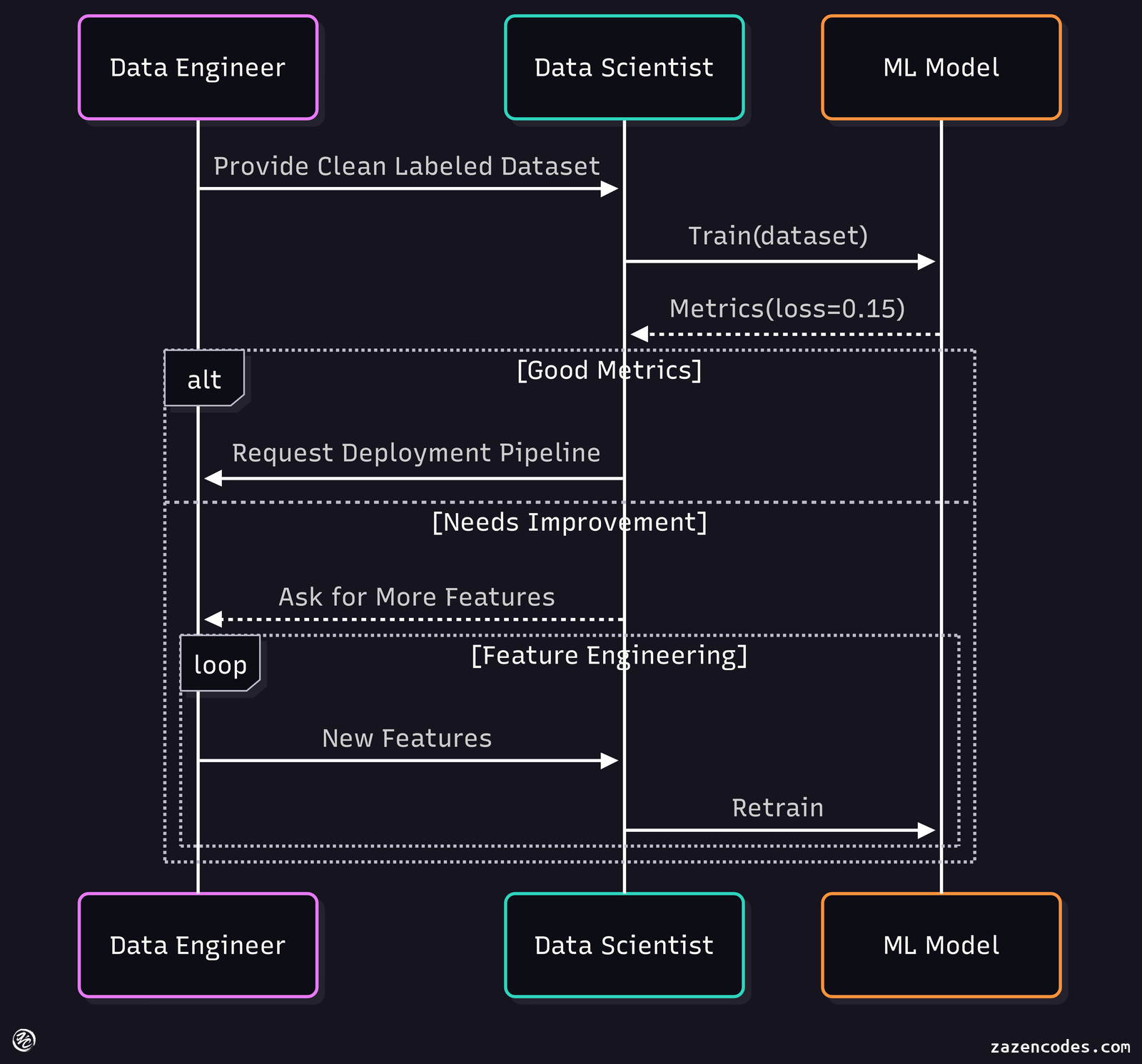
Data Quality Impact on Model Performance
Data engineers ensure data quality by addressing common issues like missing values, inconsistencies, and outdated information.
This can directly impact how well ML/AI models perform.
SQL Example: Identify Missing Dates
For example, to identify missing dates in a time series dataset transactions (i.e., days with no data), you might use SQL like this:
WITH date_range AS (
    SELECT generate_series(
        (SELECT MIN(date)::date FROM transactions),
        (SELECT MAX(date)::date FROM transactions),
        '1 day'::interval
    )::date as date
)
SELECT dr.date
FROM date_range dr
LEFT JOIN transactions t ON dr.date = t.date
WHERE t.date IS NULL;
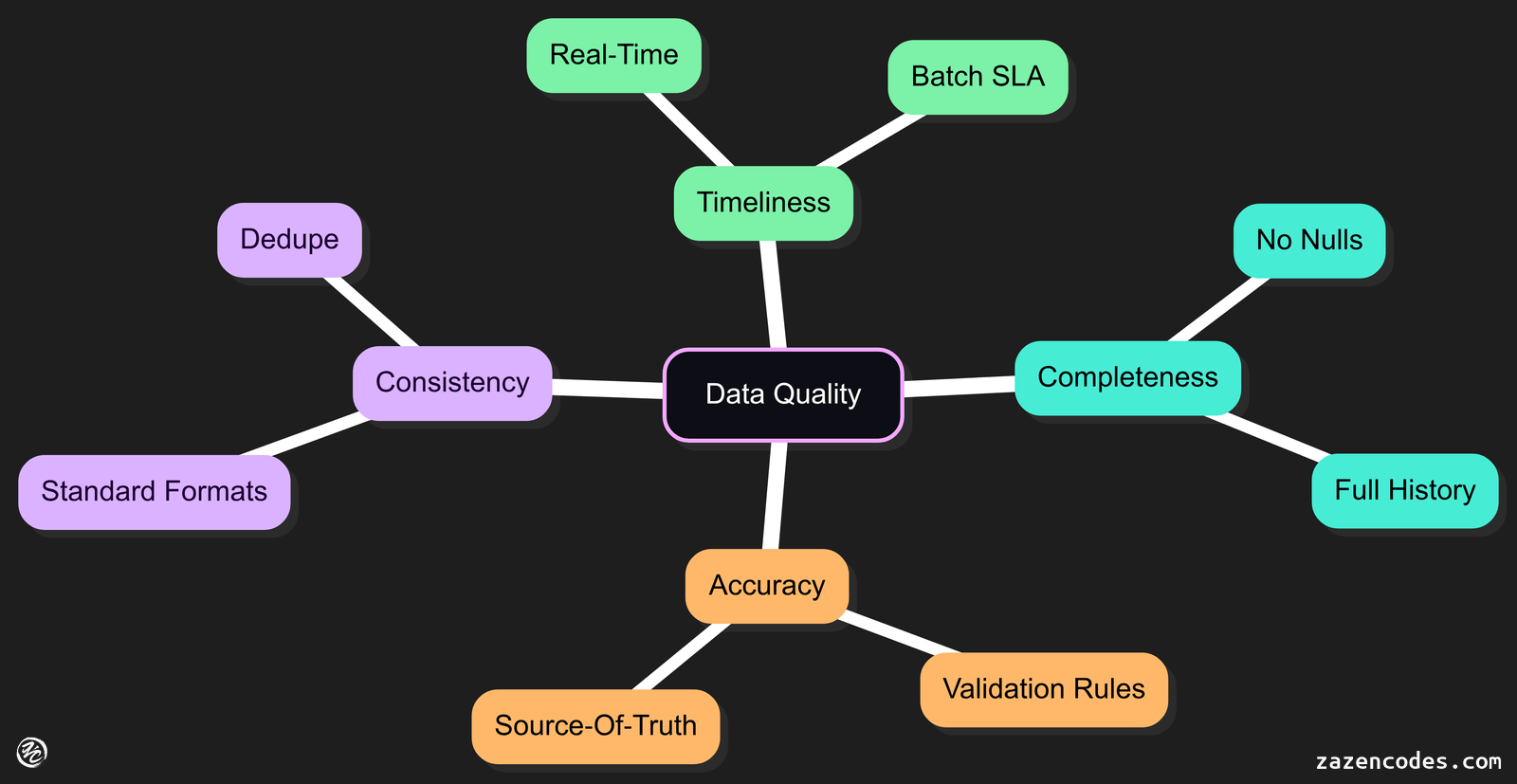
Key Aspects of Data Quality:
- Completeness: Ensuring all necessary fields are populated.
- Consistency: Standardizing data formats and resolving discrepancies.
- Accuracy: Validating the correctness of input data.
- Timeliness: Making sure the data is up-to-date for current applications.
Scaling Challenges with Large Datasets
Modern AI systems often require massive datasets for training and inference.
Data engineers are tasked with solving scaling challenges, such as:
- Storage: How to efficiently store and organize petabytes of data.
- Solution: Using cloud storage like Amazon S3 or distributed systems like HDFS (Hadoop Distributed File System).
- Processing: How to process large datasets in a reasonable timeframe.
- Solution: Leveraging distributed frameworks like Apache Spark.
- Distribution: How to share data across multiple systems or regions for parallel processing.
- Solution: Employing tools like Apache Kafka for real-time streaming.
Example: Processing Large Data with Spark
Here’s a simple example of using Spark to process a large dataset:
from pyspark.sql import SparkSession
from pyspark.sql.functions import avg, count

# Initialize Spark session
spark = SparkSession.builder.appName("LargeDatasetProcessing").getOrCreate()

# Load a large dataset
df = spark.read.csv("large_dataset.csv", header=True, inferSchema=True)

# Group by category and calculate aggregates
# (this operation benefits from Spark's distributed processing)
grouped_df = df.groupBy("category").agg(
    avg("amount").alias("avg_amount"),
    count("*").alias("transaction_count")
)
grouped_df.show()
This can be run in a distributed environment like EMR/Databricks with multiple worker nodes where Spark parallelizes this expensive groupBy operation across the cluster, making it much faster than single-machine processing for large datasets.
Real-Time vs Batch Requirements
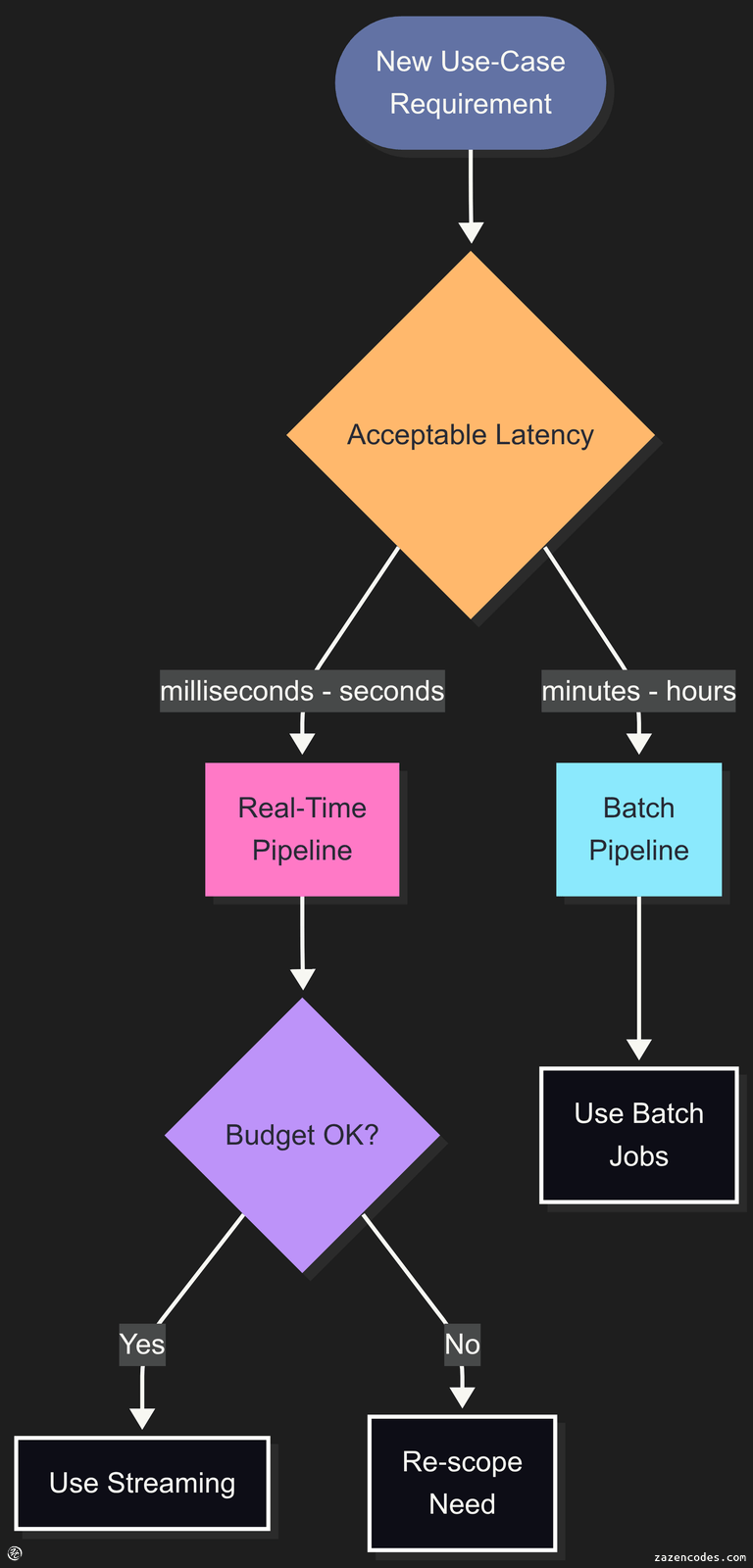
Data engineers design systems to handle both real-time and batch data processing, depending on the needs of the ML/AI application.
Real-time data processing tends to be much more difficult and expensive, so it’s often hard to justify as a requirement over batch systems.
Real-Time Processing:
- Purpose: Handle data as it arrives, enabling immediate actions.
- Use Cases: Fraud detection, IoT monitoring, dynamic pricing.
- Example: Streaming customer clicks on an e-commerce website to a product recommendation system.
Batch Processing:
- Purpose: Process large volumes of data in scheduled intervals.
- Use Cases: Model training, nightly ETL jobs, historical trend analysis.
- Example: Running a daily job to aggregate sales data for training a forecasting model.
Real-Time vs Batch Comparison:
| Feature | Real-Time Processing | Batch Processing |
|---|---|---|
| Latency | Milliseconds to seconds | Minutes to hours |
| Data Volume | Continuous small chunks | Large datasets |
| Technology | Apache Kafka, Flink | Apache Spark, Airflow |
Conclusion
You might know that I myself am a Data Engineer. (Or at least, that’s been my job for the last while.)
In any case, this is a subject that I’m particularly keen to share my perspective on. I also happen to believe that data engineering is going to be one of the most in-demand software-related skills going into the future.
Key Takeaways
🏗️ Data engineers are critical to ML/AI systems by building and maintaining the data pipelines that power them.
✅ Data quality management includes ensuring completeness, consistency, accuracy, and timeliness.
⚙️ Scaling challenges require specific tools like Apache Spark for processing and distributed storage systems for large datasets.
⏳ The choice between real-time and batch processing depends on use case requirements, with real-time being more complex but enabling immediate actions.
🎯 Data engineers must balance technical requirements with business needs when designing data infrastructure.
Next: Data Formats
Now that we’ve explored what data engineers do at a high level, it’s time to start drilling down.
In fact, we’re going way back to basics here with data formats and storage, something that every software engineer needs to understand.
Comments (0)
No comments yet.