Real-world Data Scenarios
In this section of the course, we’ll get familiar with data pipelines, starting with some real-world examples.
Real-world data rarely exists in a ready-to-use format; integration and preprocessing are always needed behind the scenes to extract value from data.
This Lesson Will Cover
- 🌍 Real-world data integration scenarios
- 🏢 Enterprise data pipeline examples
- 📡 IoT and sensor data processing
- 🚧 Common data pipeline challenges and solutions
Enterprise Data Integration
The Challenge
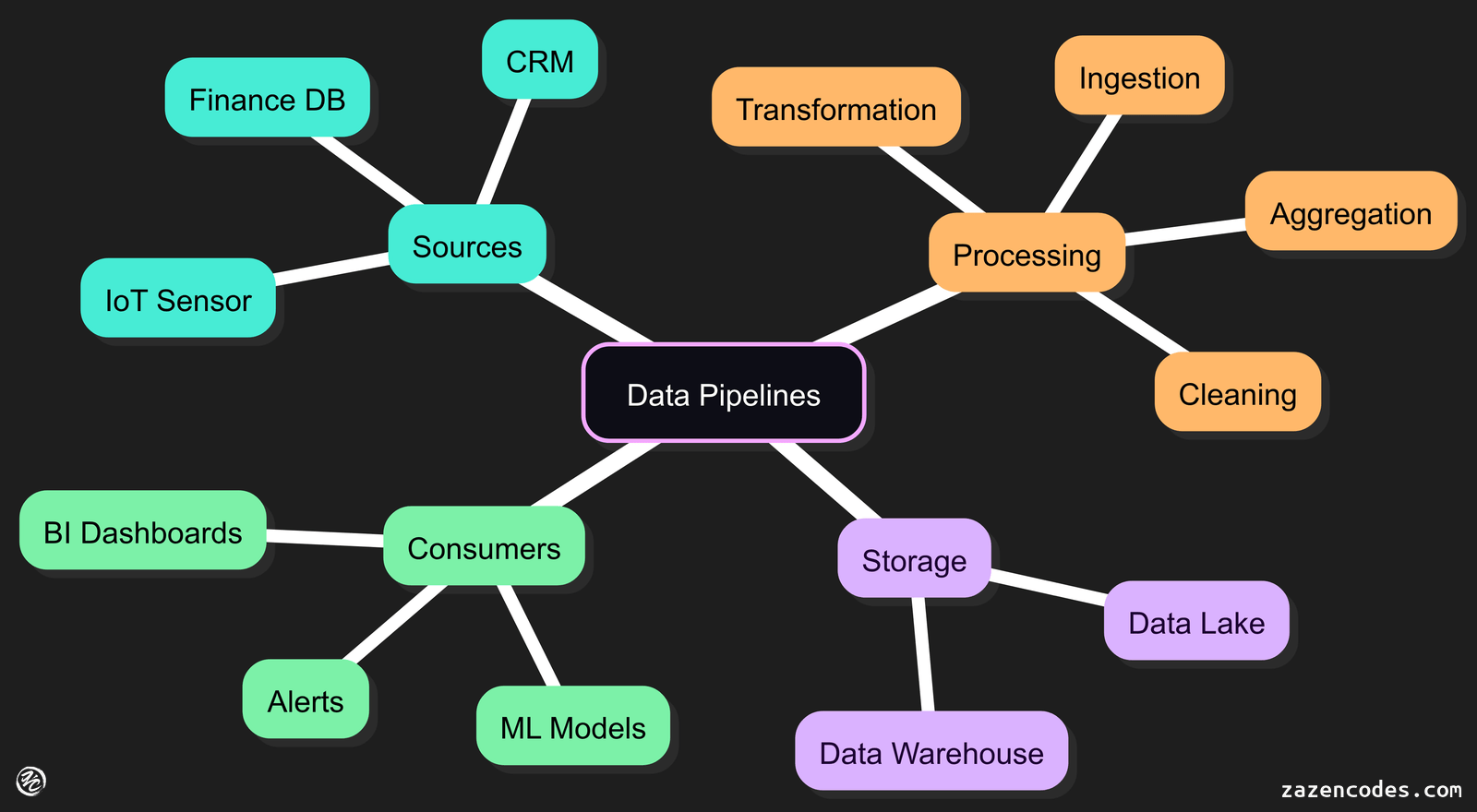
Modern enterprises have a ton of data from so many different sources, like CRMs (Customer Relationship Management systems), financial databases, web analytics platforms, and so on. To better understand and extract value from this data, it can be beneficial to create merged and enriched data sources.
Related Concepts
- Data Silos: Departments or tools often generate their own data but fail to share it effectively. Silos make it difficult to get a holistic view of the business.
- Data Warehouses and Data Lakes help break down these silos by providing centralized repositories where data from different sources can be consolidated, standardized, and made accessible across the organization.
Example Use Case: Customer 360
Imagine a company building an AI model to predict customer churn. To make accurate predictions, the prerequisite data pipeline will:
- Combine data from a CRM (e.g., customer profiles and purchase history) and a support system (e.g., customer complaints or queries).
- Clean the data to remove duplicates (e.g., if a customer exists in both systems with slightly different names).
- Enrich the data by adding external datasets, like social media activity.
- Store: Save processed data in a database for model training or prediction.
The result is a “Customer 360” view—a unified profile that can be used for training models or making predictions.

IoT and Sensor Data
The Challenge
IoT (Internet of Things) is transforming all kinds of industries, from manufacturing to healthcare.
IoT devices generate enormous amounts of data, but the sheer volume, velocity, and variety pose unique challenges for data pipelines.
Related Concepts
- Streaming Data: Unlike traditional batch systems, IoT devices often transmit data continuously (e.g., a smart thermostat sending temperature readings every second).
- Time-Series Data: Sensor data is usually time-stamped, requiring specialized storage and analysis tools like time-series databases.
- Edge Computing: Some data processing happens near the device (on the “edge”) to reduce latency and bandwidth usage.
Example Use Case: Predictive Maintenance
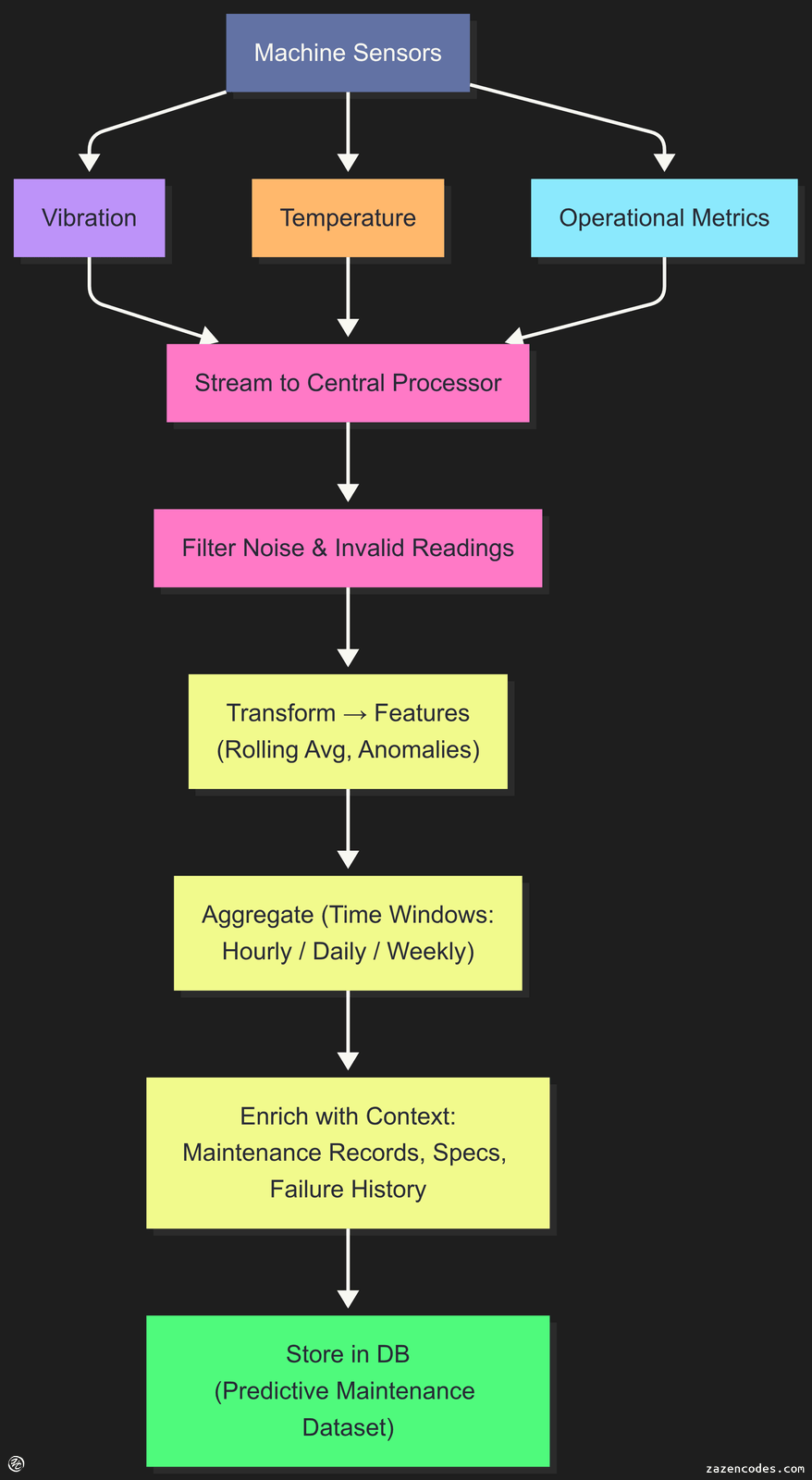
Consider a factory with IoT-enabled machinery. Each machine has sensors that monitor vibration, temperature, and operational metrics.
An AI model predicts when a machine is likely to fail based on these inputs.
Steps in the data pipeline:
- Collect: Sensor data is streamed to a central processing system.
- Filter: Remove noise and invalid readings from the sensor data.
- Transform: Convert raw sensor data into meaningful features (e.g., calculate rolling averages, detect anomalies).
- Aggregate: Combine readings across different time windows (hourly, daily, weekly patterns).
- Enrich: Add contextual data like maintenance records, machine specifications, and historical failure data.
- Store: Save processed data in a database for model training or prediction.
Conclusion
These were just a couple of examples of ways that businesses might want to extract value from data.
Every business has unique problems, opportunities, and data available to them, resulting in a wide variety of solutions and huge variation in data pipelines.
The variation in problems that we get to solve might be the aspect of this industry that I enjoy most.
Key Takeaways
🛠️ Real-world data requires significant preprocessing and integration before it can be used effectively.
🏢 Enterprise data often exists in silos and needs to be combined for maximum value.
📡 IoT and sensor data present unique challenges due to volume, velocity, and streaming nature.
🔄 Data pipelines vary widely based on business needs but often include steps like collection, cleaning, transformation, and storage.
🎯 Successful data integration requires understanding both technical requirements and business context.
Next: Modern Pipelines
Next up, we’ll talk about broad data pipeline architectures.
Comments (0)
No comments yet.