Database Types
Different types of databases serve different purposes, and understanding their characteristics helps in making informed architectural decisions.
This Lesson Will Cover
- 🗄️ SQL Databases: Structure, features, and use cases
- 📦 NoSQL Databases: Types, benefits, and applications
- 🧠 Vector Databases: AI/ML optimized storage and retrieval
- 🤔 Database Selection: How to choose the right database for your needs
Database Trade-Offs
Everything in computer science is a trade-off, and this is quite evident when it comes to databases.
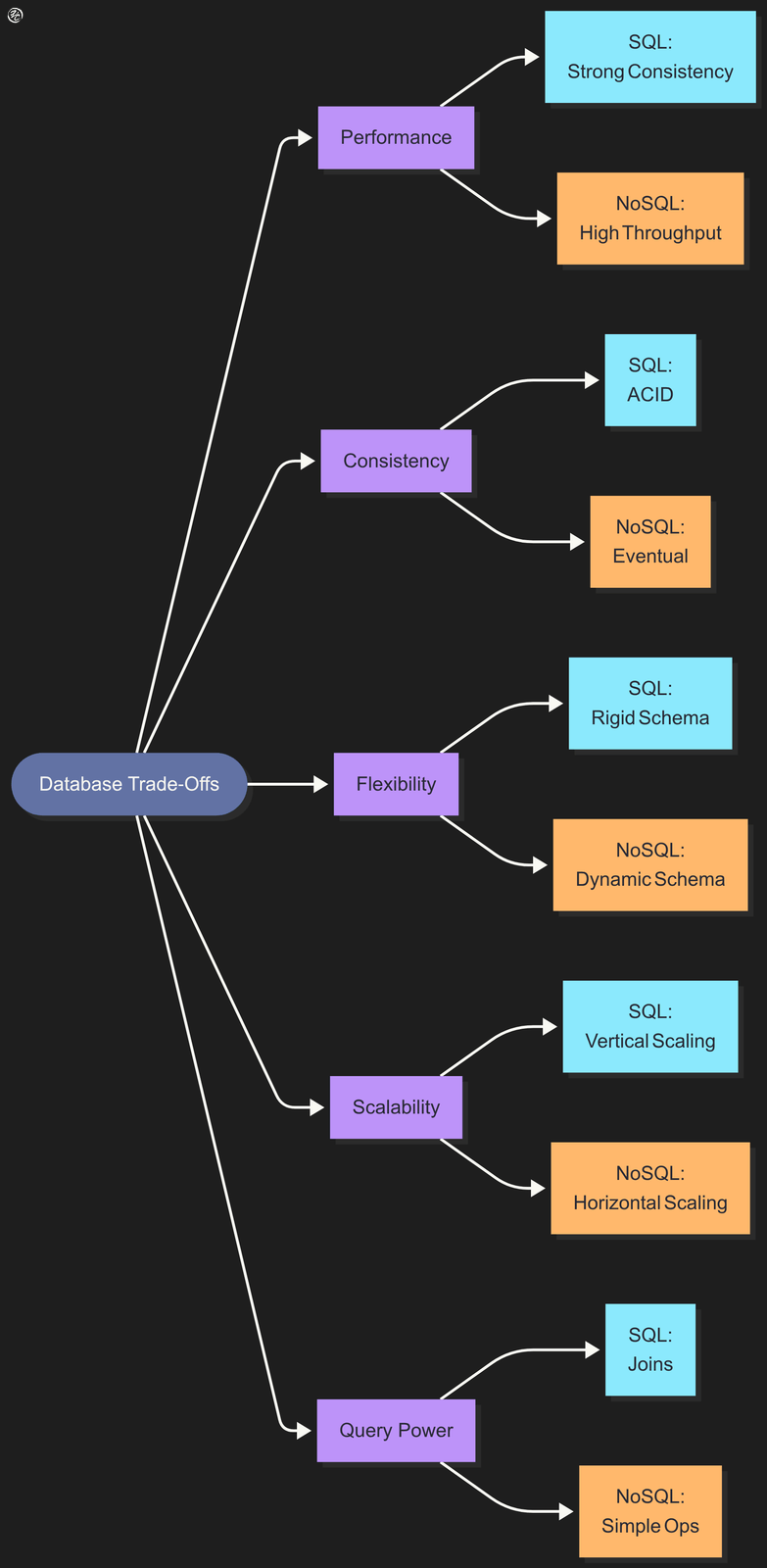
For example, consider these trade-offs when it comes to modeling data with a typical SQL vs. NoSQL database:
Performance vs. Consistency
- Strong Consistency: SQL databases prioritize data consistency but may sacrifice some performance
- Eventual Consistency: NoSQL databases often favor performance and availability over immediate consistency
Flexibility vs. Structure
- Rigid Schema: SQL databases provide data integrity but less flexibility for changes
- Dynamic Schema: NoSQL databases offer easier schema evolution but less guaranteed structure
Scalability vs. Complexity
- Vertical Scaling: SQL databases typically scale up, requiring more powerful hardware
- Horizontal Scaling: NoSQL databases scale out across machines but add operational complexity
Query Power vs. Speed
- Complex Queries: SQL databases excel at complex joins and transactions
- Simple Queries: NoSQL databases optimize for simple, high-speed operations
Storage Efficiency vs. Access Speed
- Normalized Data: SQL databases reduce redundancy but require joins
- Denormalized Data: NoSQL databases may duplicate data for faster access
SQL Databases
SQL (Structured Query Language) databases are relational databases that organize data into tables with rows and columns. They are ideal for structured data where relationships between entities matter.
Think of SQL databases as tightly organized filing cabinets where every piece of data fits into a predefined schema.
Key Features
- Schema-Based: Tables must follow a defined structure (e.g., name, age, email).
- ACID Compliance: Guarantees data consistency and reliability.
- Powerful Query Language: SQL provides a robust and standardized way to query data.
Use Cases
- Transactional Systems: Applications that require high data integrity, like banking systems.
- Reporting and BI: Scenarios needing complex joins and aggregations for analysis.
Popular SQL Databases
- MySQL
- PostgreSQL
- Microsoft SQL Server
Here’s an example SQL query:
SELECT name, email
FROM users
WHERE last_login > '2023-01-01';
NoSQL Databases
NoSQL (Not Only SQL) databases handle unstructured or semi-structured data with flexibility and scalability.
They forgo the rigid schema of SQL databases, making them a better fit for diverse and evolving datasets.
Key Features
- Schema Flexibility: You can store JSON-like objects without predefined structure.
- Horizontal Scalability: Designed to handle massive datasets across distributed systems.
- Varied Models: Document stores, key-value stores, wide-column stores, and graph databases.
Use Cases
- Real-Time Applications: E.g., messaging apps or recommendation engines.
- Data with Changing Schemas: E.g., IoT sensor data or social media feeds.
Popular NoSQL Databases
- MongoDB (Document Store)
- Cassandra (Wide-Column Store)
- DynamoDB (Key-Value Store)
Here’s a MongoDB query example:
db.users.find({ "lastLogin": { $gt: "2023-01-01" } });
Vector Databases
Vector databases are purpose-built for AI and ML applications that rely on high-dimensional data, such as embeddings from machine learning models.
These embeddings represent complex entities (e.g., images, documents) as numerical vectors.
Key Features
- Optimized for Similarity Search: Quickly find the closest matches to a given vector.
- AI/ML Integration: Designed to work seamlessly with embedding-generating models.
- Scalable Storage: Can handle billions of vectors for large-scale AI applications.
Use Cases
- Recommendation Systems: Find similar products based on user preferences.
- Natural Language Processing: Semantic search for documents or text.
- Computer Vision: Image or video similarity search.
Popular Vector Databases
- Pinecone
- Weaviate
- Milvus
Here’s an example of querying a vector database:
# Example using Pinecone
index.query(vector=embedding, top_k=5)
Key Differences at a Glance
| Feature | SQL | NoSQL | Vector Databases |
|---|---|---|---|
| Schema | Fixed | Flexible | N/A (Embeddings) |
| Scaling | Vertical (mostly) | Horizontal | Horizontal |
| Optimized For | Structured Data | Unstructured Data | High-Dimensional Vector Search |
| Use Cases | Transactions, BI | Real-Time Applications | AI/ML Applications |
Other Types of Databases
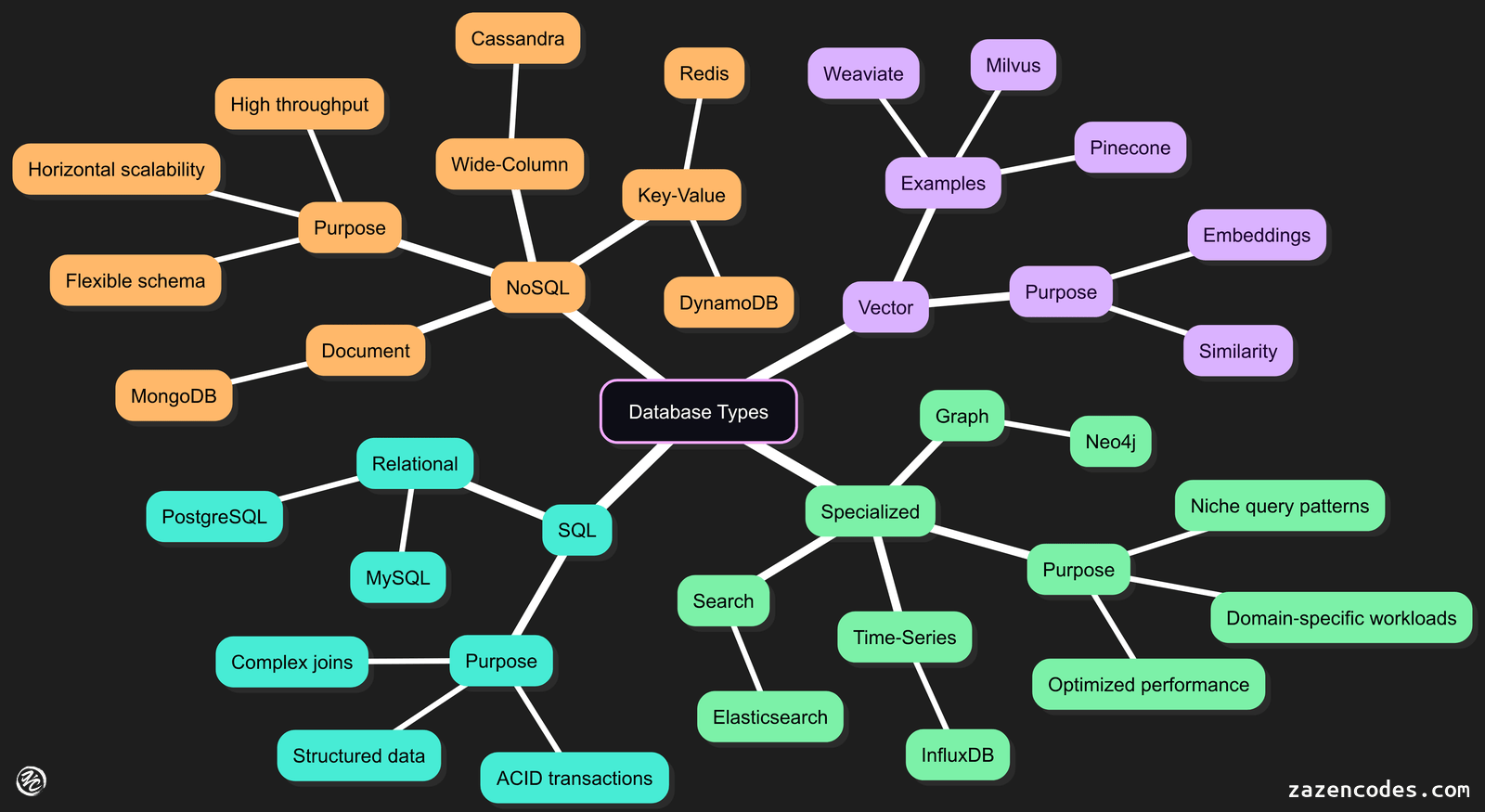
There are many specialized types of databases out there.
We talked about SQL and NoSQL because they are the two fundamental types of databases, and we talked about vector databases because of our focus on AI applications, but here’s a table showing some other database classifications:
| Database Type | Description | Examples |
|---|---|---|
| Time-Series | Optimized for storing and querying time-stamped data | InfluxDB |
| Graph | Store and query data in terms of nodes, edges, and relationships | Neo4j |
| In-Memory | Store data in RAM for ultra-fast access | Redis, Memcached |
| Column-Oriented | Store data by column rather than row for analytical queries | Redshift, BigQuery |
| Search | Specialized for full-text search and text analysis | Elasticsearch, Solr |
| Multi-Model | Support multiple data models in a single database | ArangoDB, OrientDB |
| Object | Store data in object format, matching object-oriented programming | ObjectDB, Versant |
| Spatial | Optimized for storing and querying geographic data | PostGIS |
These databases often combine aspects of both SQL and NoSQL paradigms, frequently offering SQL-like query interfaces while incorporating NoSQL’s flexibility and specialized optimizations.
Conclusion
Now that we have a lay of the land with databases, let’s have a deeper look at SQL, NoSQL, and Vector Databases, in turn.
Key Takeaways
🗃️ Different database types serve distinct purposes, each with its own set of trade-offs.
🏛️ SQL databases excel at handling structured data and executing complex queries, but they offer less flexibility for evolving schemas.
📊 NoSQL databases provide scalability and schema flexibility, making them ideal for dynamic and unstructured data, but they may compromise on consistency.
🧠 Vector databases are specifically optimized for AI/ML applications, excelling at similarity searches and managing high-dimensional data.
🎯 Choosing the right database depends on the specific requirements of the use case, including considerations like data structure, scalability needs, and query patterns.
Next: SQL Databases
The first database we’ll look at is the classic relational DB: SQL.
Comments (0)
No comments yet.