NoSQL Databases
NoSQL databases are designed to address the challenges of handling unstructured or semi-structured data in a flexible and scalable way.
This Lesson Will Cover
- 📜 The history and evolution of NoSQL databases
- 🔄 Key differences between SQL and NoSQL databases
- ⚖️ Benefits and trade-offs of NoSQL solutions
- 🗂️ Major types of NoSQL databases and their use cases
- 📈 Scalability features in NoSQL systems
- 🤖 NoSQL’s role in AI applications
History of NoSQL
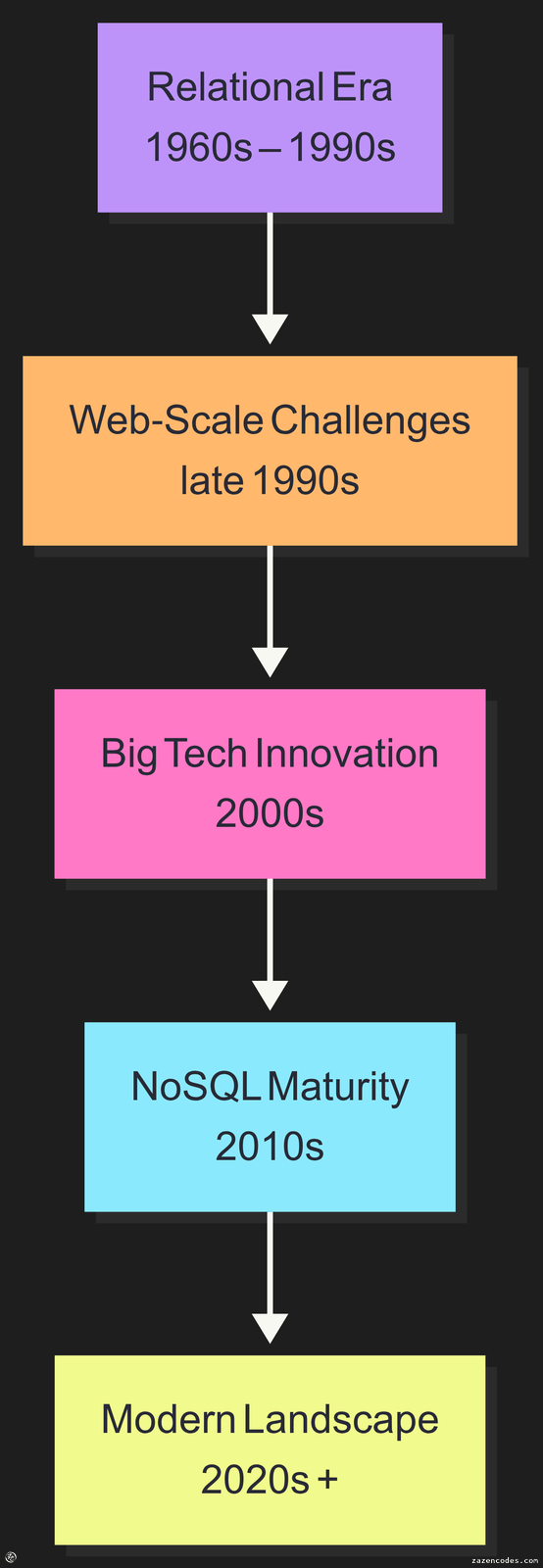
The evolution of NoSQL databases reflects the changing needs of modern computing:
-
1960s-1990s: Relational Era
- Dominated by SQL databases
- Focus on structured, tabular data
- ACID compliance essential
-
Late 1990s: Web Scale Challenges
- Growing internet data volumes
- Need for distributed systems
- Traditional relational databases hitting scaling limits
-
2000s: Big Tech Innovation
- Google’s BigTable (2006)
- Amazon’s Dynamo (2007)
- Birth of modern NoSQL movement
-
2010s: NoSQL Maturity
- MongoDB, Cassandra become mainstream
- Cloud adoption drives distributed systems
- Rise of microservices architecture
-
2020s: Modern Landscape
- Hybrid SQL/NoSQL solutions emerge
- Real-time processing demands
- AI/ML workload optimization
SQL vs. NoSQL
Here’s the SQL-NoSQL comparison in a nutshell:
| Feature | SQL | NoSQL |
|---|---|---|
| Schema | Fixed | Flexible |
| Scalability | Vertical (scale-up) | Horizontal (scale-out) |
| Transaction Type | Strong consistency (ACID) | Eventual consistency |
| Use Case | Structured data, analytics | Unstructured, real-time |
Why NoSQL?
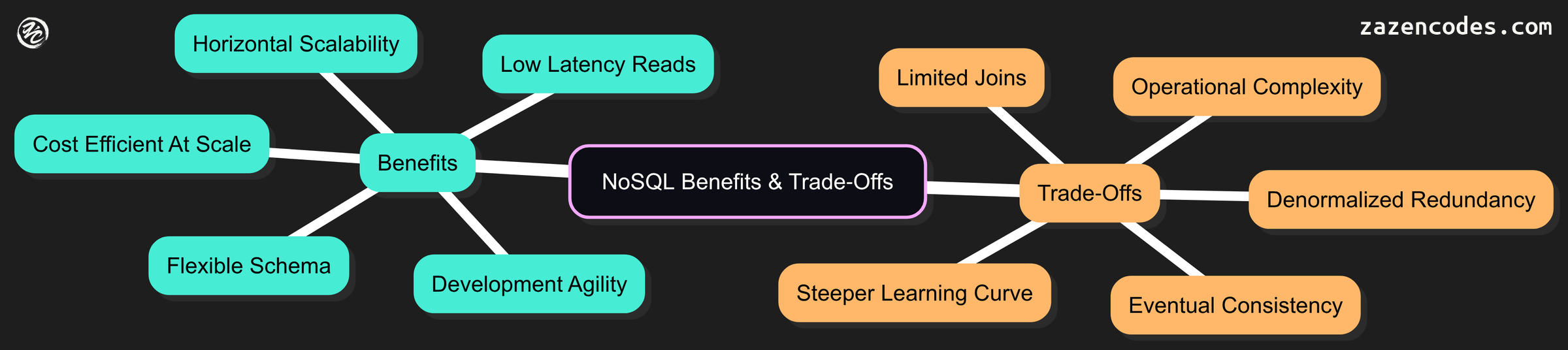
NoSQL databases have flexible (or no) schemas, making them appealing for:
-
Handling Diverse Data Types
- Unstructured data (text, images, logs)
- Semi-structured data (JSON, XML)
- Rapidly changing data structures
-
Scalability Requirements
- High-volume data ingestion
- Horizontal scaling across servers
- Distributed data processing
-
Development Agility
- Faster iterations without schema migrations
- Easy accommodation of new features
- Reduced development overhead
-
Performance Optimization
- Fast read/write operations
- Optimized for specific data patterns
- Reduced latency for specific queries
-
Cost Effectiveness
- Lower operational costs at scale
- Efficient resource utilization
- Reduced licensing costs
-
Use Cases
- Real-time big data applications
- Content management systems
- Social media platforms
- IoT data collection
- Mobile applications
NoSQL Trade-Offs
With all these benefits it might seem like NoSQL is much better than SQL, but all these come with trade-offs, and the devil is in the details[1] - as they say.
For example:
-
Consistency Challenges
- Eventual consistency can lead to data conflicts
- Complex conflict resolution mechanisms needed
- May return stale or inconsistent data
-
Limited Transaction Support
- Lack of ACID guarantees in many cases
- Complex multi-document transactions
- Harder to maintain data integrity
-
Query Flexibility
- Limited JOIN operations
- Complex queries can be inefficient
- No standardized query language
-
Data Redundancy
- Denormalized data structures
- Higher storage requirements
- Data synchronization overhead
-
Learning Curve
- Different paradigms for each NoSQL type
- Complex distributed system concepts
- Requires specialized expertise
-
Maintenance Overhead
- Managing distributed systems
- Backup and recovery complexity
- Monitoring and debugging challenges
-
Maturity and Support
- Fewer tools compared to SQL
- Smaller community for some databases
- Less standardization across platforms
In my personal experience, I’ve found points #3-5 to be the most difficult when using NoSQL.
Key Types of NoSQL Databases
NoSQL databases come in several flavors. In fact, you could argue that each of these sub-types of NoSQL databases (aside from document store, I would say) deserve their own separate classification completely.
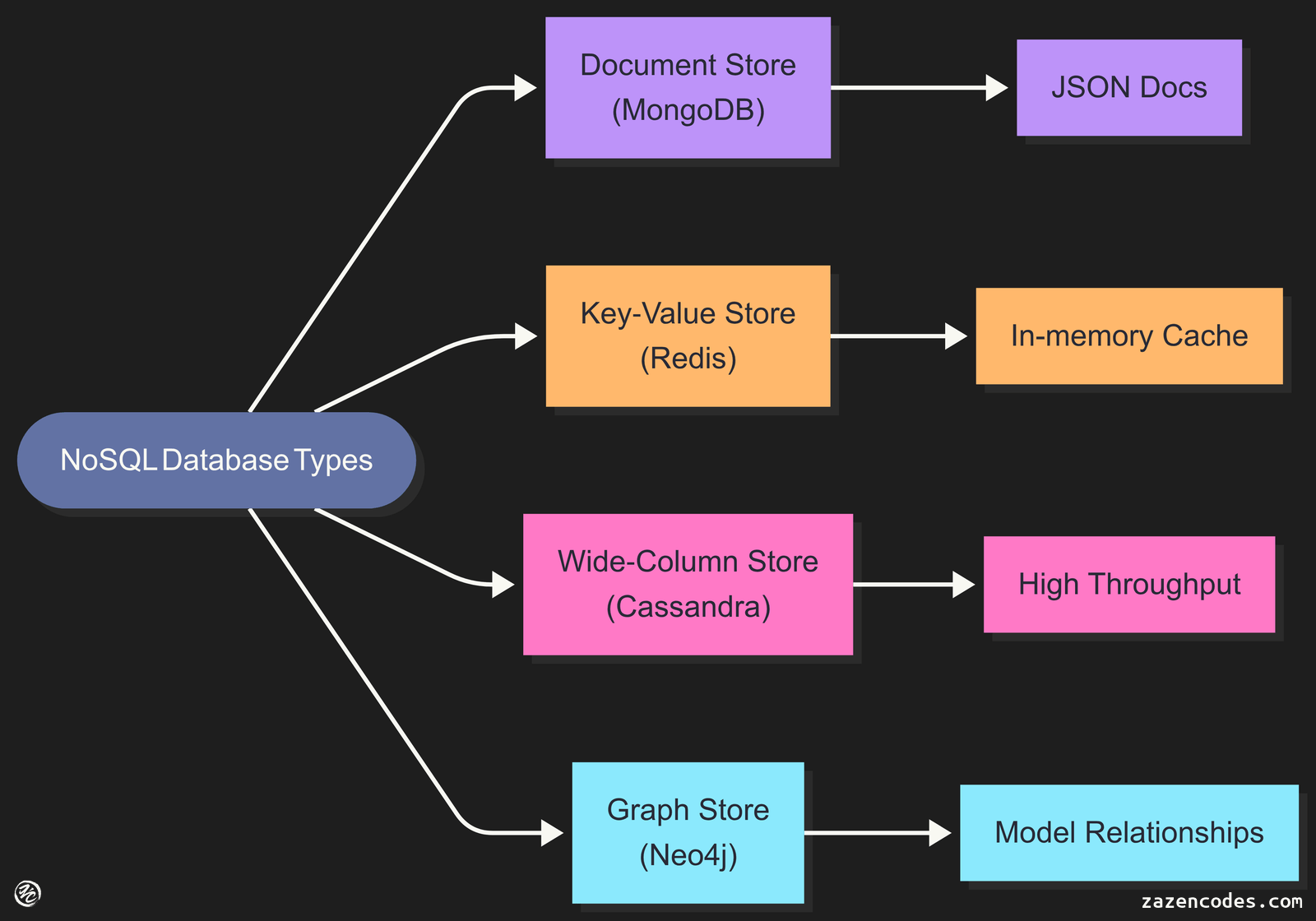
Document Stores
- What They Are: Store data as JSON-like documents with key-value pairs and nested structures.
- Key Feature: Schema-less flexibility—each document can have its own structure.
- Use Cases:
- E-commerce product catalogs.
- Content management systems.
- Popular Example: MongoDB
- Example Document:
{ "id": "123", "name": "AI Engineering Course", "tags": ["AI", "Education", "NoSQL"], "instructor": { "name": "John Doe", "email": "john@example.com" } } - Query Example:
db.courses.find({ tags: "AI" });
- Example Document:
Key-Value Stores
- What They Are: Store data as simple key-value pairs.
- Key Feature: Extremely fast reads and writes.
- Use Cases:
- Caching (e.g., user sessions, page loads).
- Real-time analytics.
- Popular Example: Redis
- Example:
SET "user:1001" "{'name': 'Alice', 'role': 'AI Engineer'}"
GET "user:1001"
- Example:
Wide-Column Stores
- What They Are: Organize data into rows and columns, but each row can have a different set of columns.
- Key Feature: Optimized for large-scale write-heavy workloads.
- Use Cases:
- Time-series data.
- IoT applications.
- Popular Example: Cassandra
- Example Query:
SELECT * FROM sensors WHERE region='north' AND timestamp > '2024-01-01';
- Example Query:
Scalability in NoSQL
Scalability is one of the major selling points of NoSQL databases, primarily due to their distributed architecture:
-
Horizontal Scaling: Unlike most SQL databases that rely on vertical scaling (adding resources to a single machine), NoSQL databases natively support horizontal scaling by distributing data across multiple servers.
- Example: Adding nodes to a MongoDB cluster to handle increased traffic and data storage.
-
Sharding: NoSQL databases are designed to handle sharded data more effectively, enabling seamless partitioning across multiple servers for scalability, which is complex and less native in SQL systems.
- Example: Distributing user data by region in Cassandra.
NoSQL databases are designed with distributed architectures in mind, allowing for load balancing, fault tolerance, and global distribution with lower latency compared to SQL databases.
NoSQL in AI
NoSQL databases are relevant for AI engineering because they are:
- Flexible for Data Ingestion: Handle diverse data types like logs, JSON files, and API responses.
- Real-Time Ready: Support real-time updates for AI use cases like recommendation systems.
- Scalable for Big Data: Accommodate massive datasets, such as sensor data or clickstreams.
Here’s an example workflow that involves multiple touch-points with a NoSQL-like database:
- Use MongoDB to store raw JSON logs from a web application.
- Query the logs to generate input features for a machine learning model.
- Store pre-computed recommendations in Redis for real-time serving.
- Use Cassandra to store time-series metrics and model performance data for monitoring.
Conclusion
I learned a lot about NoSQL myself in writing this lesson. I really love looking at the historical evolution of technologies in order to build up intuition around their purposes and utility.[2]
Key Takeaways
- NoSQL databases offer flexible schemas and horizontal scalability for modern data needs
- Different types (document, key-value, wide-column) serve distinct use cases
- Trade-offs include eventual consistency and complex distributed systems
- Essential for AI applications due to handling diverse data types and real-time processing
Next: Vector Databases
When I started developing this course, I had only planned on covering SQL and NoSQL, but with the rising importance of semantic embeddings, I wanted to include an AI-specialized database in here as well.
So let’s talk about vector databases!
Footnotes
I thought this would be a suitable epigraph for my M.Sc. thesis (due to the hidden complexity of the math and computations). My advisor suggested god is in the details, but it just didn’t have the same ring to it. He let me go with the devil version :) ↩︎
For a historical evolution of Quantum Mechanics I really loved Quantum: Einstein, Bohr, And The Great Debate About (I listened to the audiobook). Yup, I managed to talk about physics in a NoSQL lesson. Sorry I couldn’t help it. ↩︎
Comments (0)
No comments yet.