SQL Databases
A SQL database is a solid go-to solution for modeling data.
As an AI engineer, or any kind of software engineer, we need to be quite familiar with SQL.
This Lesson Will Cover
- 🗄️ ACID Properties in SQL Databases
- ⚖️ OLTP vs OLAP Workloads
- 🚀 Query Optimization Techniques
- 🤖 The Role of SQL in AI Engineering
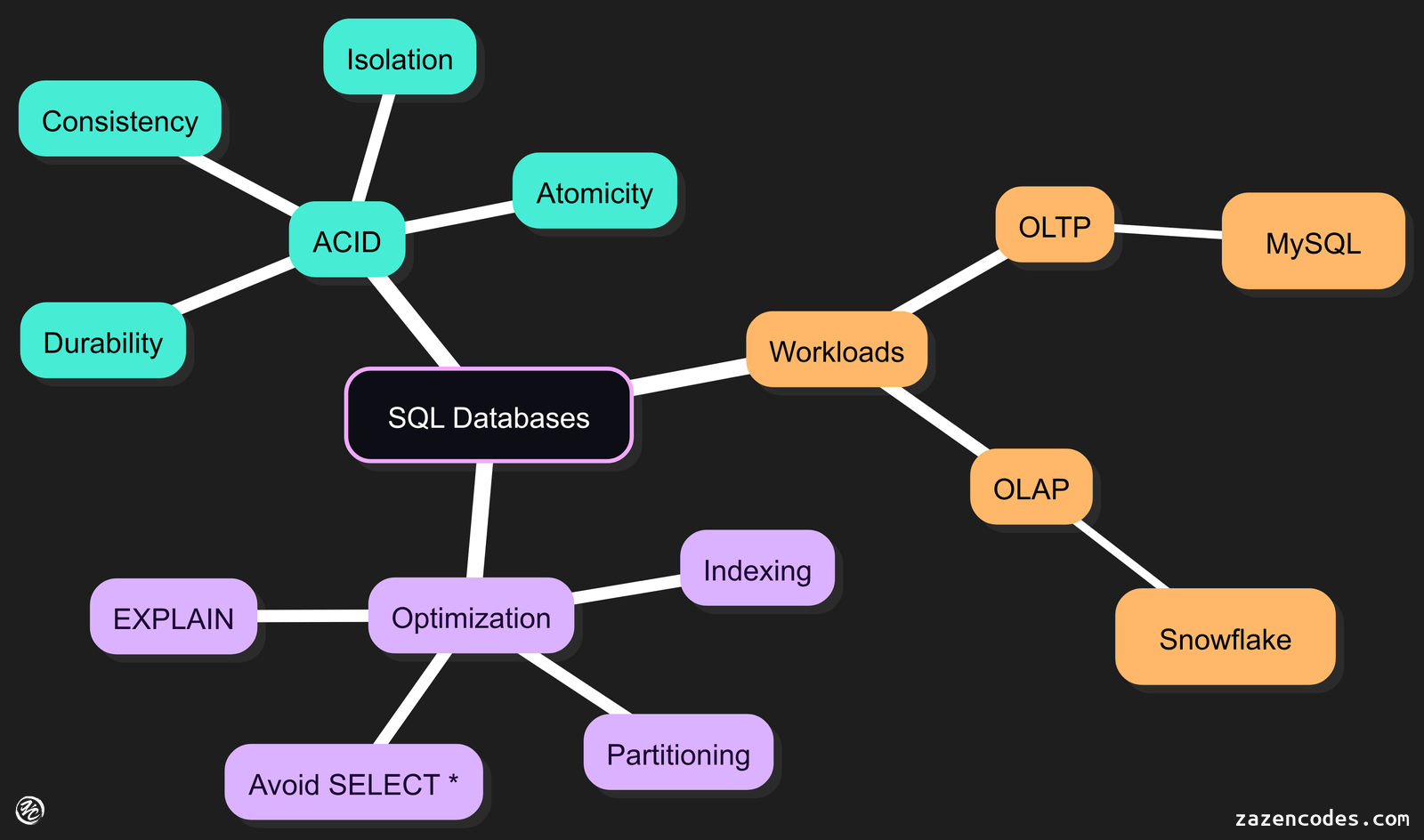
ACID Properties
SQL databases are designed to support ACID characteristics, and most traditional SQL databases (like PostgreSQL, Oracle, MySQL) implement these properties by default, though some SQL-like databases, such as BigQuery and Redshift, relax these guarantees in exchange for performance:
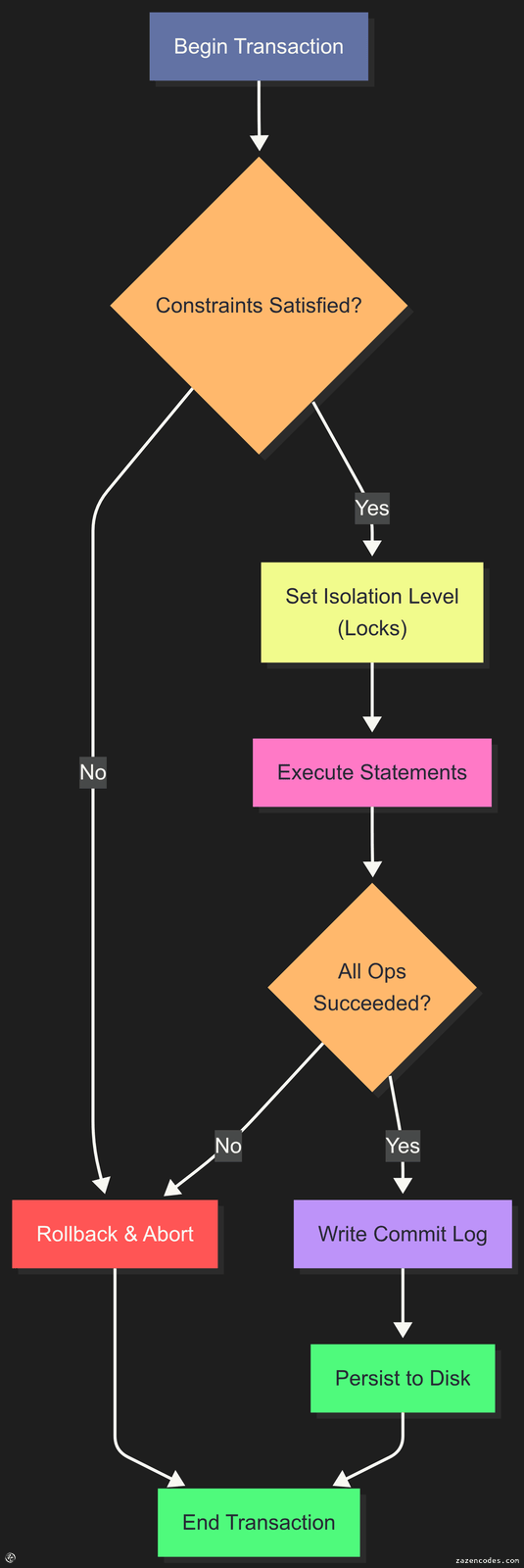
- Atomicity: Each transaction is an all-or-nothing operation. If one part fails, the entire transaction is rolled back.
- Example: If you transfer money between accounts, either both the debit and credit succeed, or neither does.
- Consistency: The database remains in a valid state before and after the transaction.
- Example: No transaction can violate constraints like unique IDs or foreign key relationships.
- Isolation: Transactions are executed independently, ensuring no interference.
- Example: Two users updating the same record won’t overwrite each other’s changes.
- Durability: Once a transaction is committed, it remains so, even in case of a system failure.
- Example: After completing a purchase, the transaction is not lost, even if the system crashes.
Transactional (OLTP) vs Analytical (OLAP) Workloads
SQL databases can support two primary types of workloads:
Transactional Workloads (OLTP)
- Purpose: Handle day-to-day operations.
- Characteristics:
- Frequent, small, and quick transactions (e.g., inserting or updating rows).
- Focus on data integrity.
- Example: A bank processing deposits and withdrawals.
- Popular Databases: MySQL, PostgreSQL, Microsoft SQL Server.
Analytical Workloads (OLAP)
- Purpose: Analyze large datasets for insights.
- Characteristics:
- Complex, large-scale queries (e.g., aggregations, joins).
- Optimized for read-heavy operations.
- Example: A retail company analyzing sales trends.
- Popular Databases: Snowflake, Amazon Redshift.
Here’s a comparison of OLTP vs. OLAP:
| Feature | OLTP | OLAP |
|---|---|---|
| Data Structure | Highly normalized | Denormalized |
| Transaction Size | Small and frequent | Large and infrequent |
| Use Case | Real-time operations | Business intelligence |
Query Optimization
Here are some SQL optimization considerations:
Indexing
- Indexes allow the database to locate rows quickly.
- Use them on columns frequently queried or used in JOIN operations.
- Example: Adding an index to the
emailcolumn in auserstable.
- Example: Adding an index to the
CREATE INDEX idx_email ON users(email);
Partitioning
- Divide a table into smaller, manageable pieces (e.g., by date or region).
- Helps in optimizing query performance for large tables.
- Example: A
salestable partitioned by year.
- Example: A
Avoiding Expensive Operations
- Minimize the use of
SELECT *. Instead, query only the needed columns.- Example:
SELECT name, email FROM users;  -- Efficient
SELECT * FROM users;           -- Inefficient
Query Plan Analysis
- Use
EXPLAINto analyze how the database executes your queries and identify bottlenecks.
EXPLAIN SELECT name, email FROM users WHERE age > 30;
Why AI Engineers Need SQL
Even in the era of NoSQL and specialized AI tools, SQL databases are indispensable for tasks like:
- Data Preprocessing: Cleaning and organizing structured data for ML models.
- Feature Engineering: Aggregating or transforming data for model input.
- Data Pipelines: Integrating OLTP systems with analytics platforms.
Conclusion
I can’t emphasize enough how important SQL is for data jobs.
Every minute spent learning SQL will be worthwhile, ideally solving actual business problems.
And bonus points if you’re working on big data.
Key Takeaways
🗄️ SQL databases provide ACID properties, ensuring reliable data transactions.
🔄 Different SQL databases optimize for either OLTP (transactional) or OLAP (analytical) workloads.
⚡ Query optimization through indexing, partitioning, and careful query writing is crucial for performance.
🤖 SQL remains a fundamental skill for AI engineers, particularly for data preprocessing and feature engineering.
Next: NoSQL Databases
SQL was great for many years. It solved many problems and helped provide an absolutely insane amount of value to the world.
But then, we found something better. And SQL would sink into obscurity. For we had found … NoSQL.
Hehe. Just kidding.
But NoSQL did carve out its own little share of the market. Let’s talk about that next.
Comments (0)
No comments yet.