Vector Databases
Vector databases are an emerging technology specifically designed for storing and querying high-dimensional vector representations, such as those generated by machine learning models.
For AI engineering, vector databases can help us build applications like semantic search engines, recommendation systems, and AI-driven personalization tools.
This Lesson Will Cover
- 📚 Vector Databases and Their Purpose
- 🧩 Vector Embeddings and How They Work
- 🏗️ Vector Database Architecture and Components
- 🎯 Common Use Cases and Applications
- 🔥 Popular Vector Database Solutions
- 🔍 FAISS and Its Role in Vector Search
What Are Vector Databases?
Vector databases specialize in managing vector embeddings - numerical representations of data points in a high-dimensional space.

Key Features
-
Vector Similarity Search:
- Quickly find vectors (e.g., embeddings) most similar to a given query vector.
- Common similarity metrics: cosine similarity, Euclidean distance, dot product.
-
Scalability:
- Handle billions of vectors efficiently for large-scale AI applications.
How Do Vector Embeddings Work?
We’ve defined vector embeddings already (a few time I think) but here goes again:
Vector embeddings are numerical representations of complex data like text, images, or audio.
These embeddings are typically generated by deep learning models such as transformers or CNNs.
Example
- A sentence embedding might look like this:
[0.2, -0.1, 0.9, 0.4, ...] - Embeddings for similar sentences will be close to each other in the vector space.
We’ll look at vector embeddings more closely in the embeddings section of the course (coming up soon). For now let’s focus on the database.
How Do Vector Embedding Databases Work?
Vector databases use specialized indexing structures and algorithms to efficiently store and query high-dimensional vectors.
Here’s some of the ideas in vector databases:
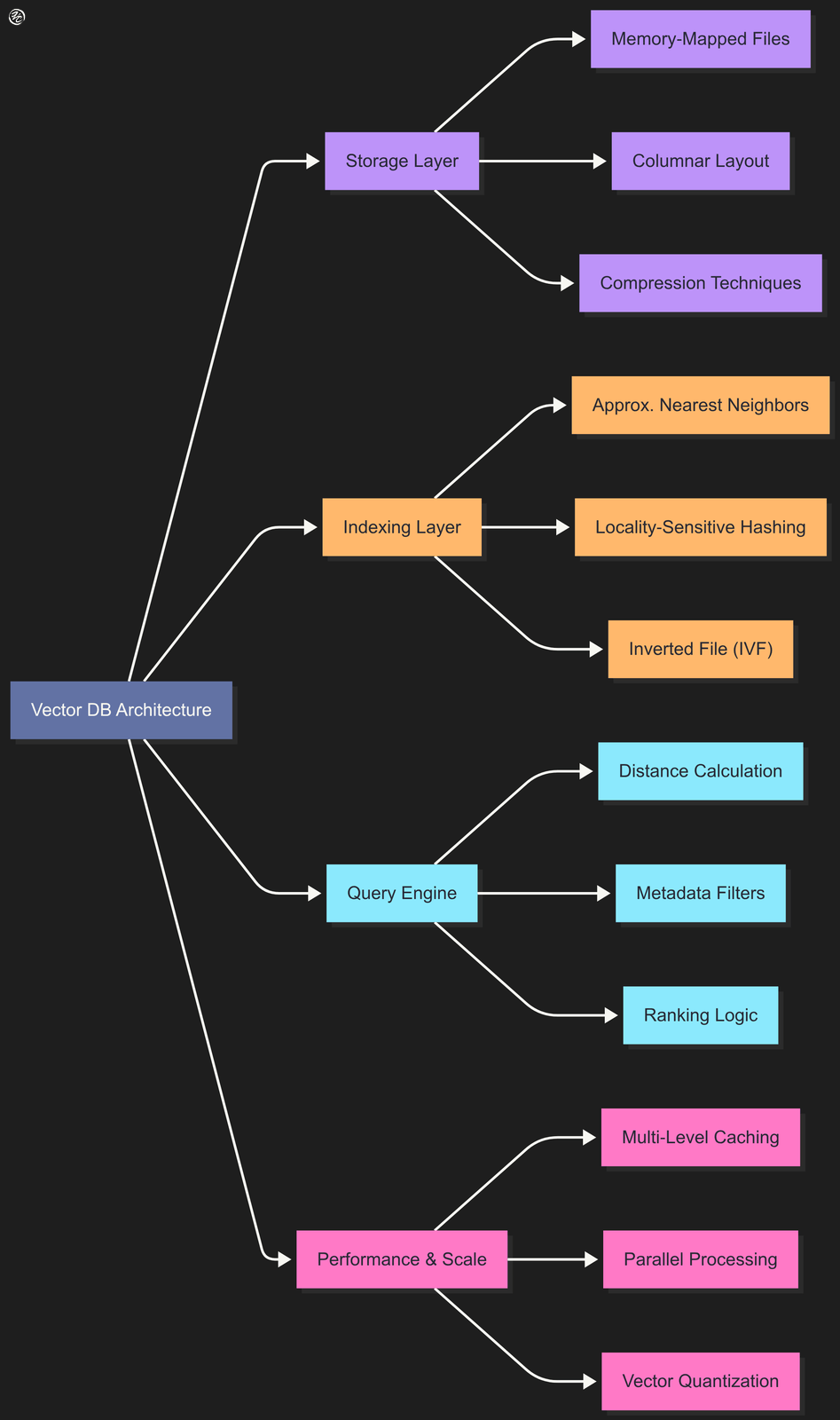
Storage Layer
- Uses Columnar Storage to efficiently store and access vector components
- Memory-Mapped Files enable fast access to vectors on disk
- Metadata is stored in separate tables and linked via unique identifiers
- Compression Techniques reduce storage footprint while maintaining fast access
Indexing
- Uses Approximate Nearest Neighbors (ANN) techniques to organize vectors.
- LSH (Locality-Sensitive Hashing) is an example ANN technique that hashes similar vectors to the same “buckets”, allowing fast approximate similarity search with less granularity.
Query Processing
- When a query vector arrives:
- Index Lookup: Uses optimized data structures to identify relevant partitions
- Distance Calculation: Computes similarity scores using specified metrics
- Result Filtering: Applies additional filters based on metadata
- Ranking: Orders results by similarity score and returns top matches
Performance Optimization
- Vector Quantization: Reduces dimensionality while preserving similarity relationships
- Batch Processing: Groups multiple queries to amortize I/O and computation costs
- Caching: Implements multi-level cache hierarchy for hot vectors
- Parallel Processing: Distributes computations across multiple cores or nodes
These are not hard-and-fast rules that all vector databases follow. Rather, this is meant to provide a general idea of the ways in which vector databases solve the problem of vector storage and retrieval.
Use Cases for Vector Databases
Vector databases help power some of the most exciting applications in AI:
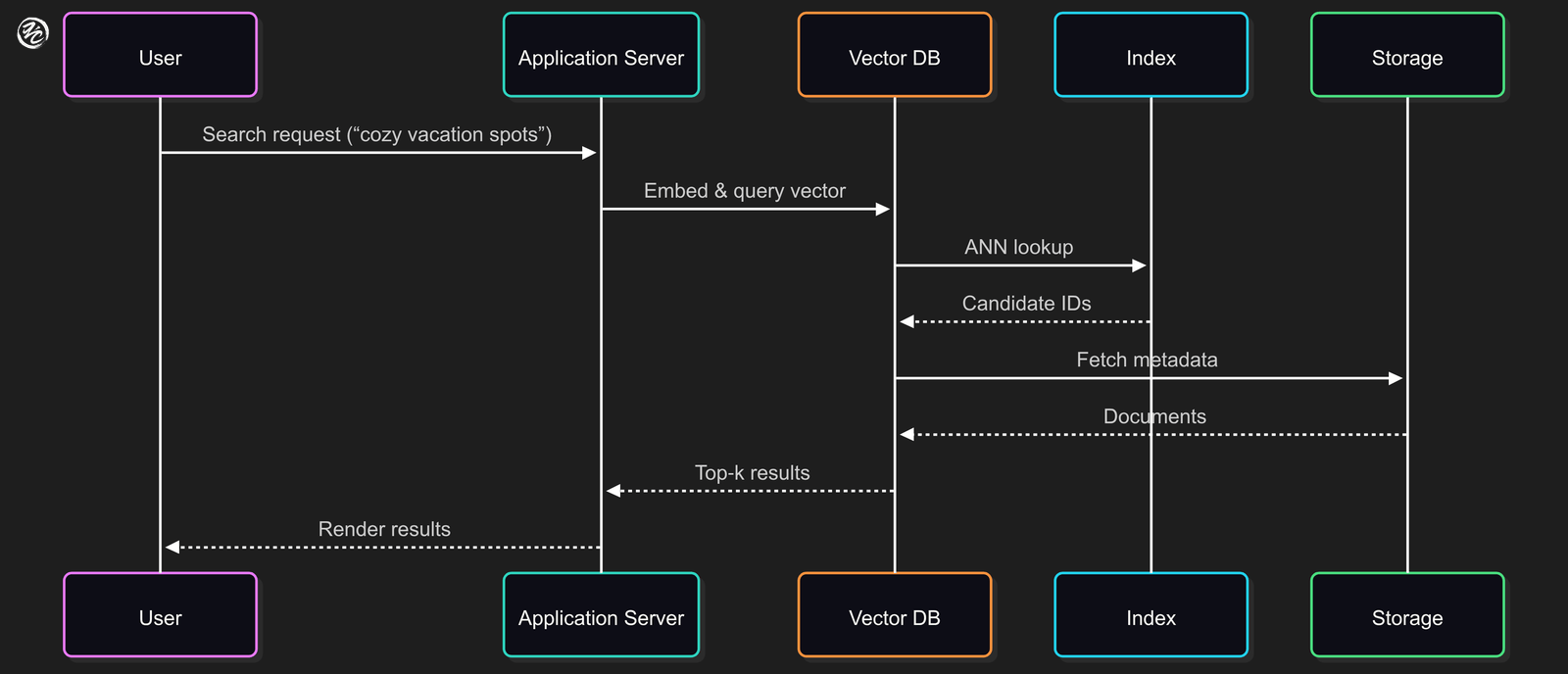
Semantic Search
- Retrieve documents, images, or videos based on meaning rather than exact keyword matches.
- Example: A user searches for “cozy vacation spots,” and the database retrieves results based on semantic similarity, even if the exact words don’t match.
Recommendation Systems
- Recommend similar items (e.g., products, movies) by finding the nearest neighbors of an embedding.
- Example: Finding products visually similar to an uploaded image.
Personalized AI Experiences
- Power chatbots or virtual assistants by retrieving contextually relevant information based on user queries.
Fraud Detection
- Compare user behavior embeddings to identify anomalous patterns.
Popular Vector Databases
Several vector databases have emerged to address the unique challenges of storing and querying embeddings:
Pinecone
- Features:
- Fully managed and cloud-native.
- Scalable storage and fast queries.
- Use Case: Build real-time recommendation systems.
Weaviate
- Features:
- Open-source.
- Supports hybrid search (keyword + vector).
- Use Case: Semantic search for enterprise applications.
Milvus
- Features:
- Distributed architecture for massive datasets.
- Integrates with machine learning frameworks like TensorFlow and PyTorch.
- Use Case: Large-scale vector storage for AI pipelines.
FAISS (Facebook AI Similarity Search)
FAISS (Facebook AI Similarity Search) is a powerful library developed by Facebook Research in 2017 that provides efficient similarity search and clustering of dense vectors (e.g., embeddings).
Since then, it’s been used in large-scale AI applications, such as:
- Image similarity search at Pinterest
- Product recommendations at Walmart
- Content understanding systems at Facebook
While FAISS may be integrated into vector database solutions or used as a building block for custom vector search systems, it is not a database itself. Rather, it’s an in-memory search library that requires vectors to be loaded into RAM for processing.
FAISS has proven particularly valuable for applications requiring real-time similarity search across massive datasets, with documented cases of successfully handling billions of vectors.
Conclusion
Vector databases are pretty neat eh. They are extremely niche for AI use cases, which is of course why we talked about them.
They are a core requirement of production RAG systems. I’ve got a few lessons on RAG that you could have a peek at now if you’re so inclined (“AI Engineering > RAG”).
Key Takeaways
🗂️ Vector databases are specialized systems for storing and querying high-dimensional vector embeddings.
🔍 Key features include vector similarity search, AI model integration, and scalability.
🔢 Vector embeddings are numerical representations of complex data (text, images, audio).
⚡ Vector databases use specialized indexing (ANN, LSH) and storage techniques for efficient operations.
🎯 Common use cases include semantic search, recommendation systems, and personalized AI.
🚀 Popular solutions include Pinecone, Weaviate, Milvus, and FAISS (though FAISS is a search library).
Next: Big Data Tools
Let’s move on to the final section of our Data Engineering topic group, where we’ll talk about some widely adopted technologies for handling data at scale: big data tools.
Comments (0)
No comments yet.