ML and Deep Learning
ML (Machine learning) and DL (Deep Learning) underpin the brains of AI engineering.
This lesson will give you a high-level overview of this subject area, and later in this course, I have an entire section (10+ lessons) dedicated to it.
This Lesson Will Cover
- 📚 The fundamentals of Machine Learning and Deep Learning
- 🔍 Different types of Machine Learning
- 🧠 Key concepts and workflows in Deep Learning
- 🛠️ Popular ML/DL libraries
- 🚀 How to start learning ML and DL
Machine Learning
What is Machine Learning?
Machine learning is the study of algorithms that learn patterns from data to make predictions or decisions. Instead of programming explicit rules, ML models generalize from examples.
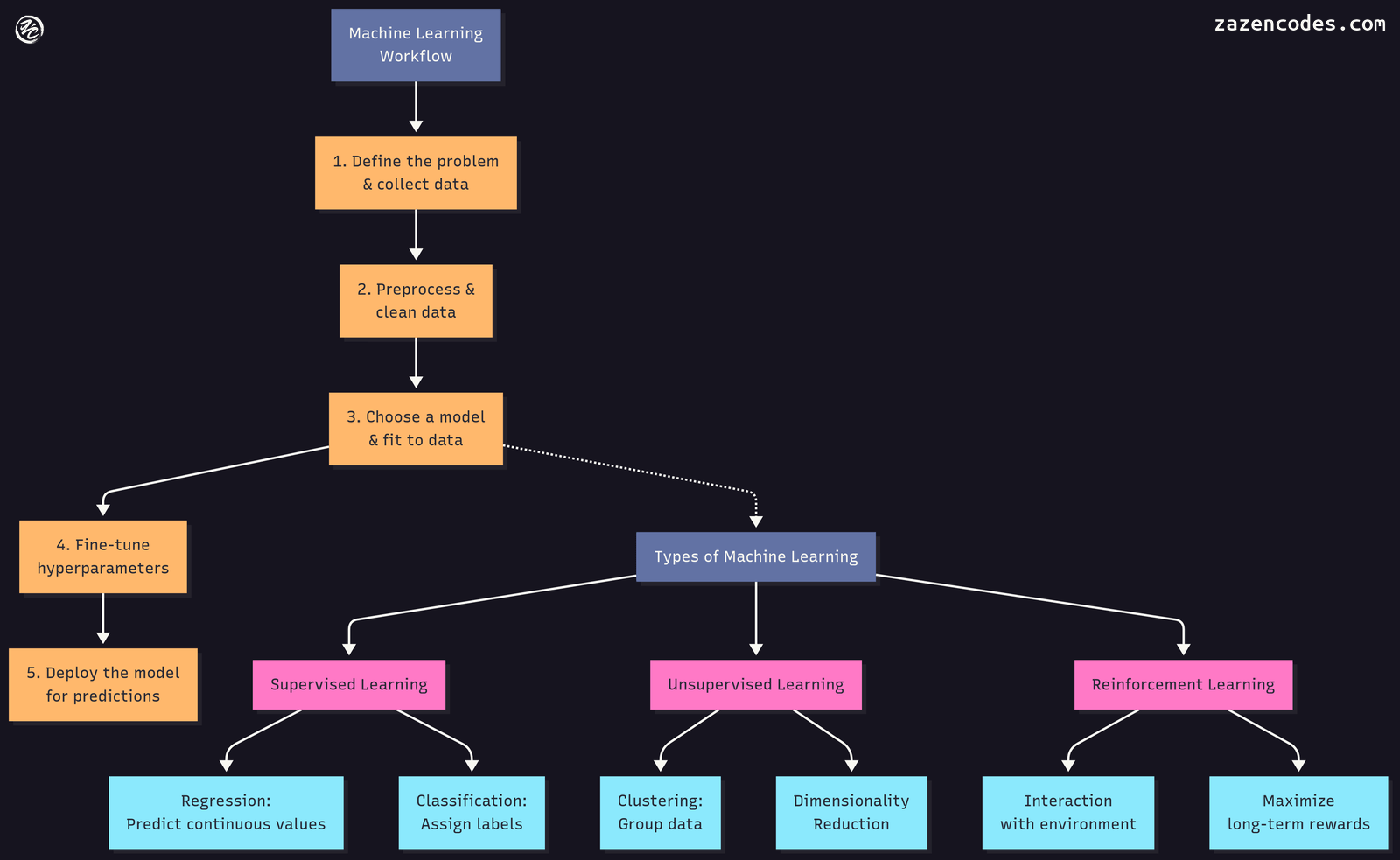
Types of Machine Learning
-
Supervised Learning: Models learn from labeled data.
- Regression: Predicts continuous values (e.g., housing prices).
- Classification: Assigns labels (e.g., spam detection).
-
Unsupervised Learning: Models find patterns in unlabeled data.
- Clustering: Groups similar data points (e.g., customer segmentation).
- Dimensionality Reduction: Simplifies data for visualization or analysis.
-
Reinforcement Learning: Models learn by interacting with an environment to maximize rewards (e.g., game-playing agents).
- Long-term Rewards: Usually optimizes long-term rewards rather than just maximizing rewards at each step.
Machine Learning Workflow
- Define the problem and collect data.
- Preprocess and clean the data.
- Choose a model and fit it to the data.
- Fine-tune hyperparameters to optimize performance.
- Deploy the model to make predictions.
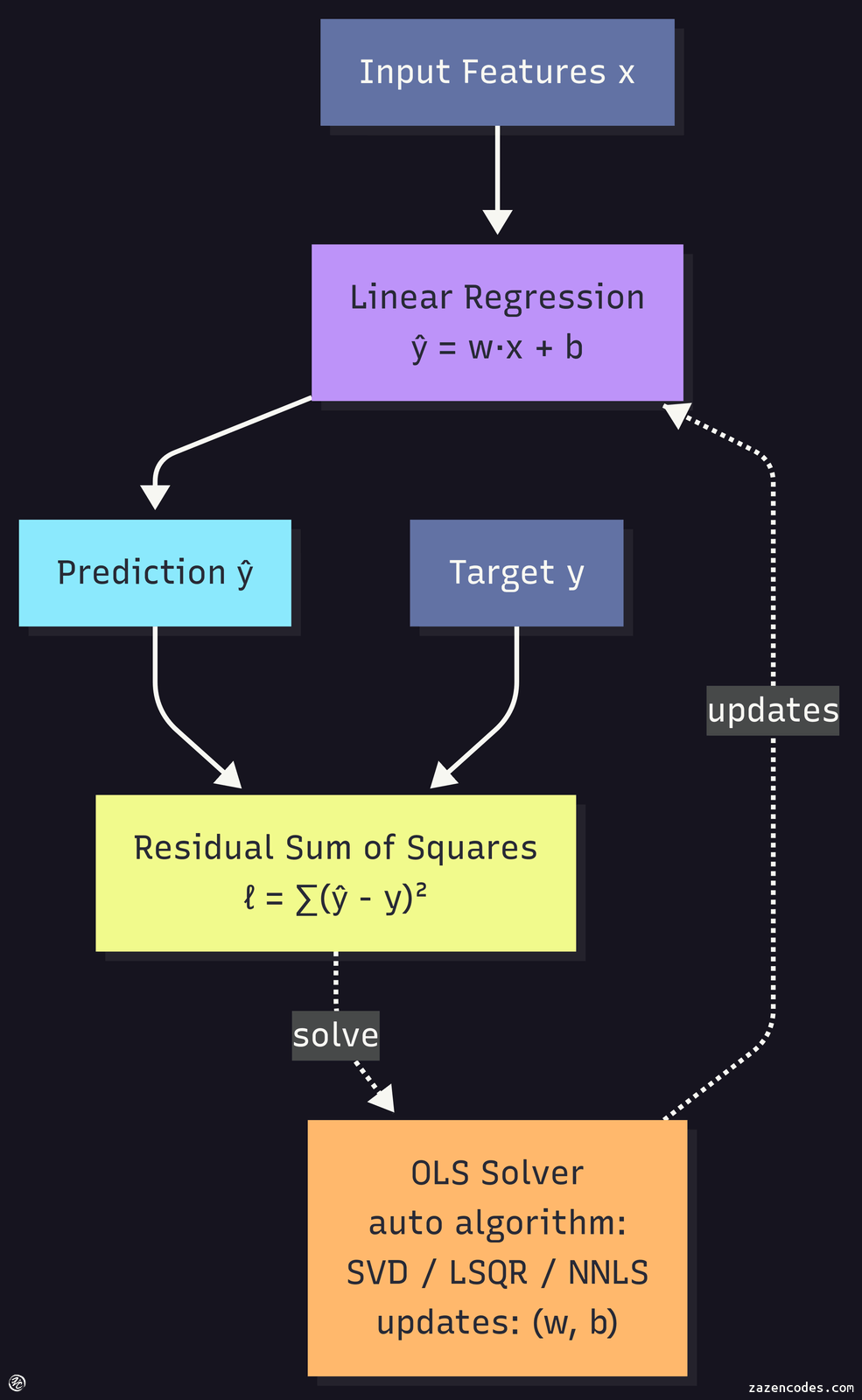
Example: Linear Regression in Python with scikit-learn:
from sklearn.linear_model import LinearRegression

# Sample data
X = [[1], [2], [3]]
y = [2, 4, 6]

# Train a model
model = LinearRegression()
model.fit(X, y)

# Make predictions
print(model.predict([[4]]))

# Output: [8.]
Deep Learning
What is Deep Learning?
Deep learning is a subset of ML that uses neural networks to model complex patterns in data. DL has been highly effective for tasks like image recognition, natural language processing (NLP), and speech synthesis.
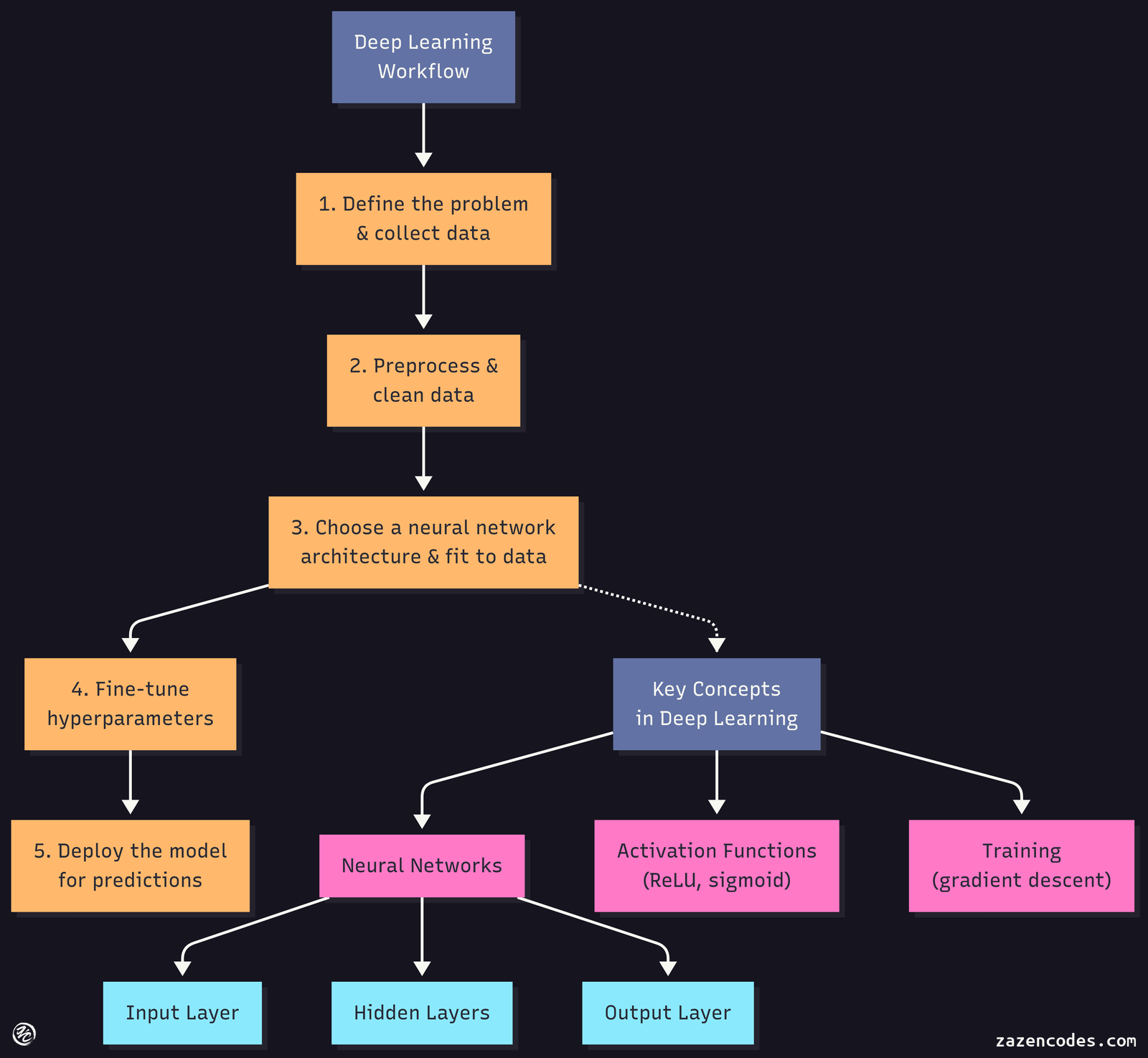
Key Concepts in Deep Learning
-
Neural Networks: Composed of layers of interconnected nodes (neurons) that process data.
- Input Layer: Receives data.
- Hidden Layers: Extract features through transformations.
- Output Layer: Produces predictions.
-
Activation Functions: Introduce non-linearity to the model (e.g., ReLU, sigmoid).
-
Training: Adjusts network weights using algorithms like gradient descent to minimize error.
Deep Learning Workflow
This follows the same steps as ML:
- Define the problem and collect data.
- Preprocess and clean the data.
- Choose a neural network architecture and fit it to the data.
- Fine-tune hyperparameters to optimize performance.
- Deploy the model to make predictions.
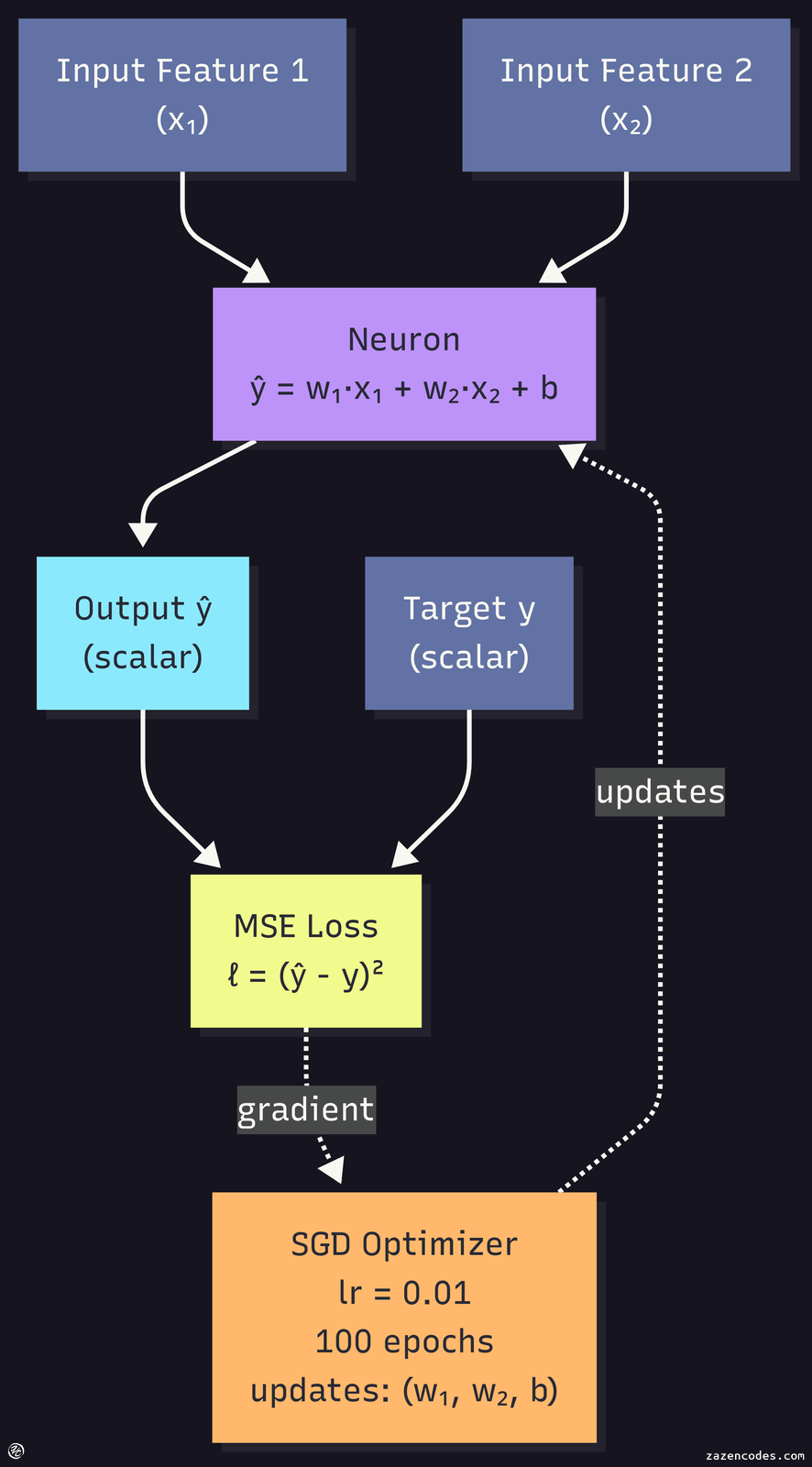
Example: A Simple Neural Network with PyTorch:
import torch
import torch.nn as nn
import torch.optim as optim

# Define the network
class SimpleNN(nn.Module):
    def __init__(self):
        super().__init__()
        self.fc = nn.Linear(2, 1)  # Two inputs, one output

    def forward(self, x):
        return self.fc(x)

# Initialize model, loss, and optimizer
model = SimpleNN()
loss_fn = nn.MSELoss()
optimizer = optim.SGD(model.parameters(), lr=0.01)

# Sample data
inputs = torch.tensor([[1.0, 2.0], [3.0, 4.0]])
targets = torch.tensor([[5.0], [11.0]])

# Training loop
for epoch in range(100):
    optimizer.zero_grad()
    outputs = model(inputs)
    loss = loss_fn(outputs, targets)
    loss.backward()
    optimizer.step()

print("Trained model predictions:")
print(model(inputs).detach().numpy())

# Output:
# Trained model predictions:
# [[ 5.244008]
# [10.885714]]
Key ML/DL Libraries for AI Engineers
- Scikit-learn: Simplifies traditional ML workflows.
- TensorFlow and PyTorch: Leading DL frameworks for neural network modeling.
- Hugging Face: Provides pretrained models for NLP tasks.
How to Start Learning ML and DL
Step 1: Learn the Basics
- Understand key concepts like supervised/unsupervised learning and neural networks.
- Study foundational topics like probability, statistics, and linear algebra.
Step 2: Experiment with Frameworks
- Start with scikit-learn for ML.
- Move to TensorFlow or PyTorch for DL.
Step 3: Build Projects
- Train a classifier on the MNIST dataset.
- Build a chatbot using NLP models.
Step 4: Learn Advanced Topics
- Explore deep reinforcement learning, transfer learning, and generative models.
Conclusion
What did you think of this one? I find it remarkable how we can train such powerful models on our data with just a few lines of code.
Key Takeaways
🤖 Machine Learning (ML) involves training models to learn patterns from data.
🧠 Deep Learning (DL) is a subset of ML that uses neural networks.
📊 Supervised, Unsupervised, and Reinforcement Learning are the three main ML types.
📚 Popular ML/DL libraries include Scikit-learn, TensorFlow, PyTorch, and Hugging Face.
🚀 Learning ML/DL involves theory, experimentation, projects, and advanced topics.
Next: Data Engineering
ML/DL can only provide value by training on “good data.” That’s what data engineering is all about: building and maintaining high-quality datasets.
Comments (0)
No comments yet.