Applications of AI
Here are some examples of how companies are using AI. This is just a small sample of the ways that AI Engineers are adding value in business.[1]
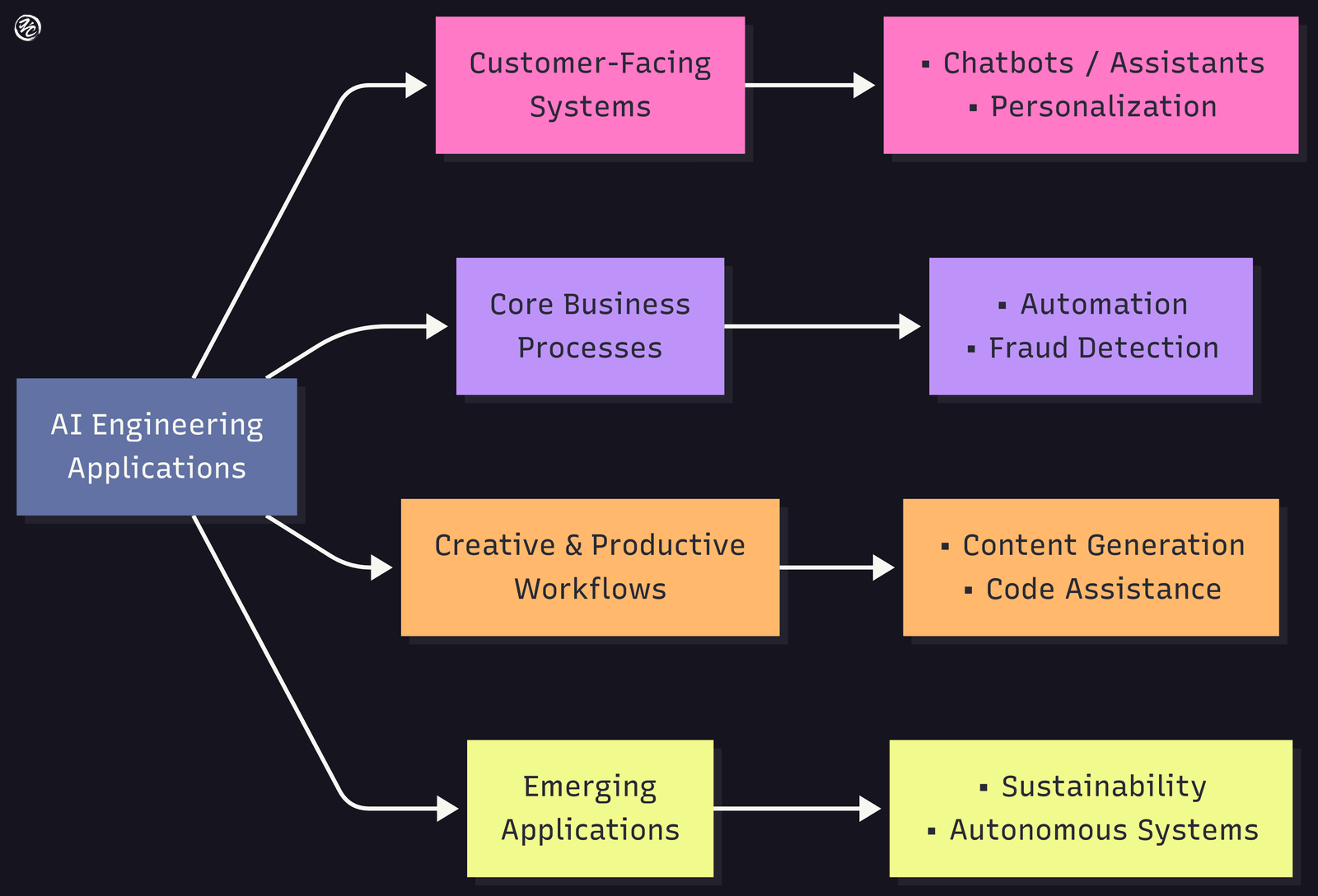
AI for Customer-Facing Systems
Chatbots and Assistants
These systems handle customer queries via text or voice, reducing the need for human agents. Under the hood, they are a combination of NLP (natural language processing), retrieval-based systems, and sometimes generative AI models.
Example
A basic chatbot might use retrieval to answer FAQs, but more advanced ones will integrate generative models (e.g., GPT) to handle ambiguous questions[2]. These systems must also manage fallback scenarios for cases the AI doesn’t understand.
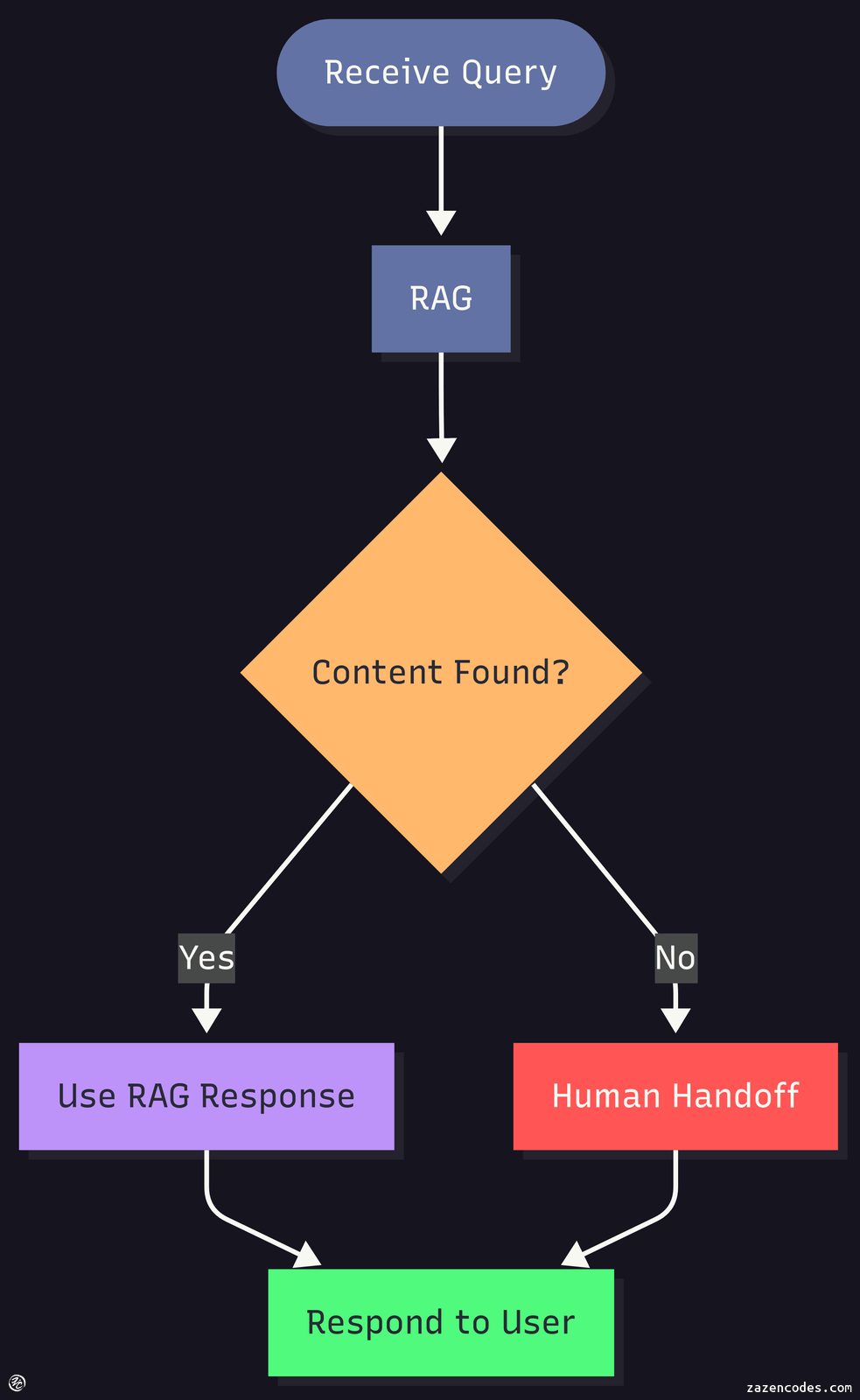
Engineering Considerations
- Balancing speed and model complexity.
- Integration of pre-trained language models.
Personalization Engines
Recommendation systems underpin much of the content that people typically consume, e.g., Netflix, e-commerce, and ads.
Engineering Considerations
- Handling large and incomplete datasets.
- Data cleaning, feature engineering, and optimizing algorithms for speed at scale.
AI in Core Business Processes
Automation
Businesses are automating all sorts of repetitive tasks - things like scheduling, route planning, and document processing, just to throw out a few random ideas. This is often achieved by combining rule-based systems (e.g., heuristics) with machine learning.
Example
An insurance company might use AI to scan and process claims. A document classification model identifies the type of form, while a separate model flags anomalies.
Engineering Considerations
- Dependence on well-annotated data and domain-specific models.
- Significant time spent on data preparation and integrating AI with legacy systems.
Fraud Detection
Fraud detection systems analyze millions of transactions in real time to find anomalies. Many use a mix of supervised and unsupervised learning to flag potentially fraudulent activity, followed by human review.
Example
Credit card companies use clustering and outlier detection to identify strange spending patterns.
Engineering Considerations
- Massively scalable infrastructure requirements.
- Tools like Apache Kafka and Flink for real-time streaming solutions.
AI in Creative and Productive Workflows
Content Generation
As we all know, large language models can effectively generate all sorts of content, from blog posts to source code. Maybe a language model even wrote this exact sentence right here. Maybe this entire course was generated in one shot by an LLM while I kicked back on the beach in Mexico!
Example
A marketing team might use AI to draft ad copy, while an editor refines the results.
Engineering Considerations
- Importance of prompt engineering and human oversight.
- Setting up pipelines for output flagging, review, and correction.
Code Assistance
AI tools like GitHub Copilot or Cursor IDE help developers write code faster. Even simply having access to advanced models like GPT or Claude offers huge productivity gains.
Example
A bank has strict policies on exposing company IP, such as data or software, to external vendor LLMs. A team is tasked with building internal LLM tooling.
Engineering Considerations
- Implementing security measures and ensuring compliance with internal policies.
- Maintaining model performance while protecting sensitive data.
AI in Emerging Applications
Sustainability Efforts
AI models are increasingly being used for resource optimization - reducing energy consumption, forecasting demand, and improving recycling processes. Note that, like most applications of AI, real-world deployment in this field often faces regulatory hurdles.
Example
A grid management company might use AI to predict energy surges and balance supply across regions.
Engineering Considerations
- Real-time IoT sensor data processing.
- Strong safeguards against system failures (e.g., AI mistakenly diverting energy away from a hospital).
Autonomous Systems
Autonomous vehicles and drones rely heavily on reinforcement learning and real-time decision-making systems. These use sensor inputs to navigate environments while avoiding collisions.
Example
A drone delivering packages might use object detection to recognize obstacles and a path-planning algorithm to reroute.
Engineering Considerations
- Real-time systems require lightweight models optimized for edge deployment (e.g., on the drone hardware rather than server-side)
Conclusion
Warning: we may have reached max hype.
Look—I’m not going to sit here and tell you any of this is easy. But it’s all within reach. These ideas are all tangible, but are also going to take a lot of work.
The way I see it, if you’ve found a really difficult problem that needs to be solved, then you’re lucky[3].
That problem can provide for both your mind, giving you the opportunity to solve interesting technical and business problems, as well as your bank account.
Next: A Day in the Life of an AI Engineer
In the next lesson, let’s wrap up out introduction by talking through what a day in the life of an AI Engineer could look like.
Footnotes
This Forbes article on AI use cases in business has more examples of ways that AI is making its way into business. ↩︎
Retrieval + Generation = RAG (Retrieval Augmented Generation). Skip ahead to the AI Engineering > RAG > Architecture Components lesson if you want to learn more about that now. ↩︎
I picked this idea up from Joran Dirk Greef at TigerBeetle, in his TigerStyle (Or How To Design Safer Systems in Less Time) talk on YouTube, from Systems Distributed Conference in 2023. It’s a great talk with many other interesting ideas. ↩︎
Comments (0)
No comments yet.