Course Welcome
Hi, I’m Alex. Welcome to my AI Engineer Roadmap.
About me
I’m an AI Engineer with a Master’s degree in Physics, and I’m teaching AI Engineering over on YouTube.
Why take this course?
You want an introductory guide to the new and incredibly fun field of AI Engineering. And you want to learn from me—a real dude who is actually working in the industry.
I am very bullish on AI Engineering, and I believe this job has the potential to outpace other AI-related jobs like Data Scientist and ML Engineer over the next decade.
Okay, but why take this course?
I have a vision of what being an AI Engineer is all about and what it takes to get there. So the goal of this course is to provide a complete roadmap to the core skills that you will need.
There’s a lot of bad information out there—like blog and social media posts written by LLMs, perpetuating the same echo chamber of bull***t about what you need to “Become an AI Engineer in 2025!” So instead, I wanted to make you something real.
Now, there’s also a ton of incredible information out there that needs to be acknowledged. The trouble is that it can be difficult to find. Oftentimes, the people providing the best information have the worst marketing.
Here are a few computer scientists who are creating great content:
- Andrej Karpathy: YouTube tutorials on how LLMs work, e.g., “Intro to Large Language Models” (2024)
- Chip Huyen: O’Reilly books, e.g., “AI Engineering” (2025)[1]
- Jeremy Howard: Fast.ai’s “Practical Deep Learning for Coders” course
What is AI Engineering?
We’ll break this down in the next lesson. For now, there’s one thing you should know:
The roles and responsibilities of an AI Engineer are not well scoped.
This is similar to other data jobs. If you picked out five different Data Engineers, they might all be doing very different things, and they would all have different skills and experience accordingly.
The same would be true for any technical data profession, including Data Science, ML Engineering, and—of course - AI Engineering.
However, unlike other data jobs, there isn’t a clear consensus yet on what being an AI Engineer even means. It’s too early to know. The technology is changing too fast, and we’re trying to figure out the playbook on the fly.
But you know what? It doesn’t really matter. The stuff that we’ll be learning in this course is relevant for all technical data professions, no matter what your job title ends up becoming.
Structure
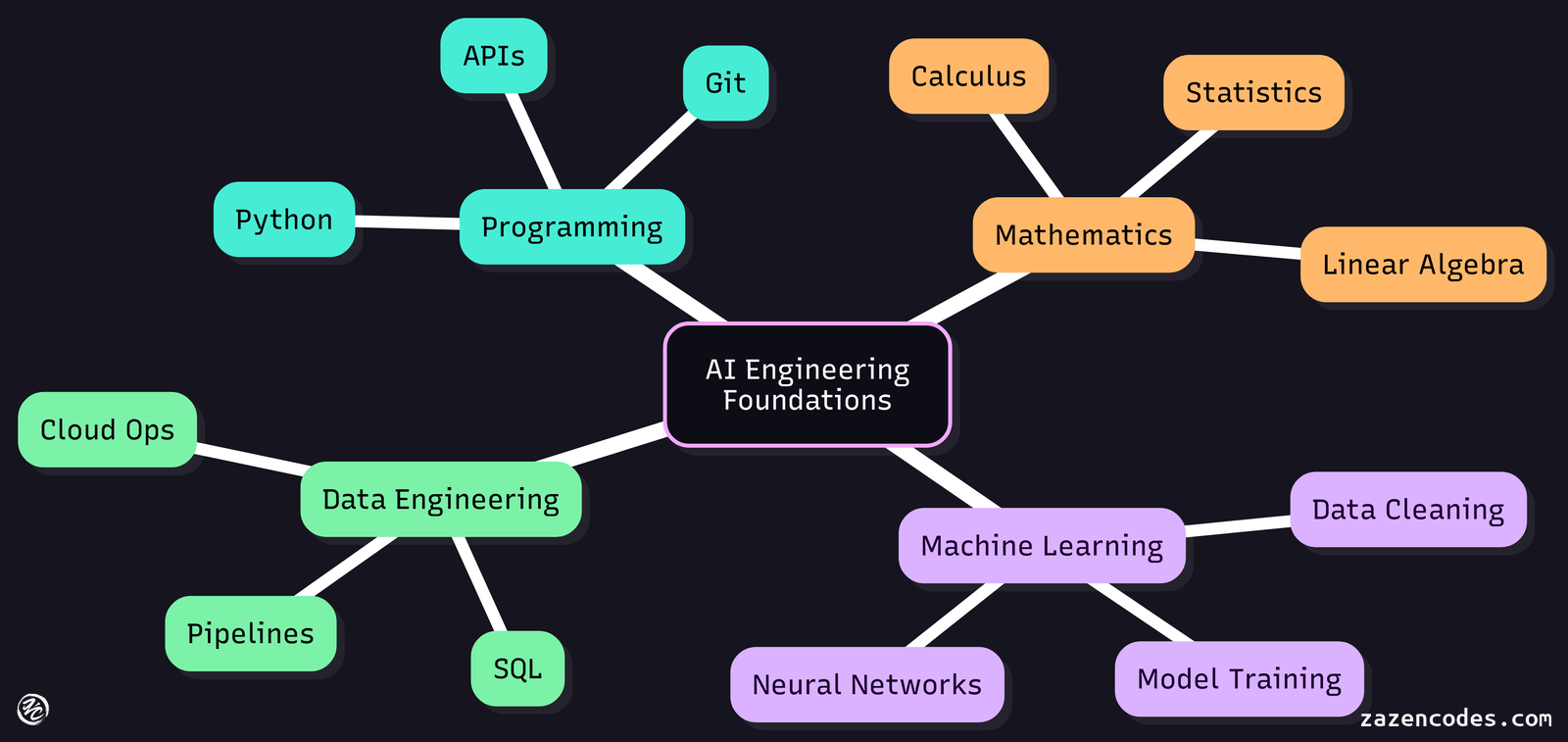
I’ve developed this roadmap from core principles underpinning AI Engineering:
- Programming
- Mathematics
- Machine Learning
- Data Engineering
We’ll have exposure to an extremely wide range of technical topics, from linear algebra and eigenvectors to cloud platforms and data lakes. And, of course, we’ll see that sexy AI stuff: RAG, multimodal embeddings, agents, etc.
How to approach this course
We can’t possibly learn all of this in a single course. Therefore, the idea is to provide a conceptual and practical introduction to all of these concepts so that you have some basis to work from as you continue your learning journey outside of this course.
The secret of being a technical data professional is that we’re always learning. There are too many technologies out there to ever achieve a complete understanding of them all, and there’s also a constant stream of new (and quite important) things to learn as well. We accept this but commit to pushing our knowledge as far as it can go through daily improvement.
This is especially relevant in AI Engineering. Learning, adapting, and continually improving need to be among our “superpowers” to be successful here. I have more on this topic at the very end of the course when we talk about career development.
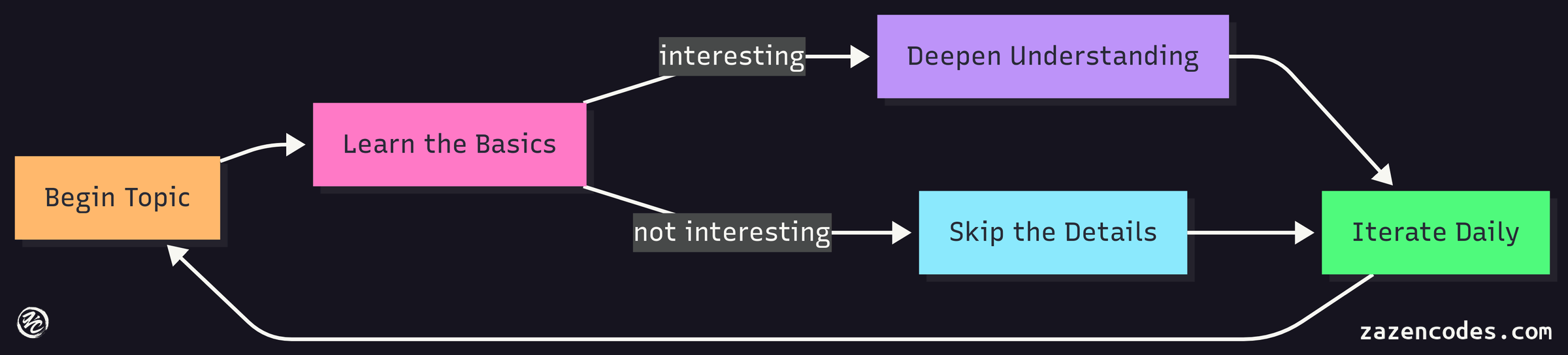
With all that in mind, I recommend approaching this course as follows:
-
Notice what topics are most challenging
- These are your blind spots
- Dig in here to ensure you have a strong foundation
-
Notice what topics are most interesting
- These are your passions
- Dig in here to gain expertise in that as a specialty
In both cases, what I’m describing goes beyond the scope of the course. But that’s the whole idea. No course that you take will make you an AI Engineer - you have to do that for yourself.
Information in this course
This is an opinionated course - in particular, my opinion. I will present you with factual information to the best of my ability, but keep in mind that everything I’m telling you stems from my beliefs[2].
It’s important to learn from a wide variety of sources, which is why I’ve included references to other helpful learning materials throughout this roadmap.
It’s also important to learn by doing. You will have plenty of opportunities to pop open a Jupyter Notebook and test out the code snippets or experiment with the concepts we’re learning about in this course.
Conclusion
It’s good to have you on board. Are you excited to start checking off these lessons? One down!
Next: The Emerging Field of AI Engineering
Next, let’s discuss what AI Engineering looks like right now.
Footnotes
I read Chip’s Designing Machine Learning Systems and enjoyed it. There’s not much code—it’s more about practical considerations around ML systems for business. I expect that her new AI Engineering book is quite good as well. ↩︎
On the topic of beliefs, Derek Sivers has a new book called Useful Not True. Derek speaks on podcasts and has a lot of very interesting ideas. ↩︎
Comments (0)
No comments yet.