Optimization in Practice
This is where s*** gets real.
Let’s look at SGD (Stochastic Gradient Descent) and Adam (Adaptive Moment Estimation) to handle optimization at scale.
This Lesson Will Cover
- 🔄 Stochastic Gradient Descent (SGD)
- 📉 Learning Rate and Its Impact
- 📆 Learning Rate Schedules
- ⚡ Adam Optimization Algorithm
- 🎯 Key Takeaways from Optimization Techniques
Stochastic Gradient Descent (SGD)
Gradient descent becomes impractical for large datasets because computing the gradient over millions or billions of examples at each step requires enormous computational resources and memory.
SGD (Stochastic Gradient Descent) offers a solution by updating parameters using only a subset of the data at each step.
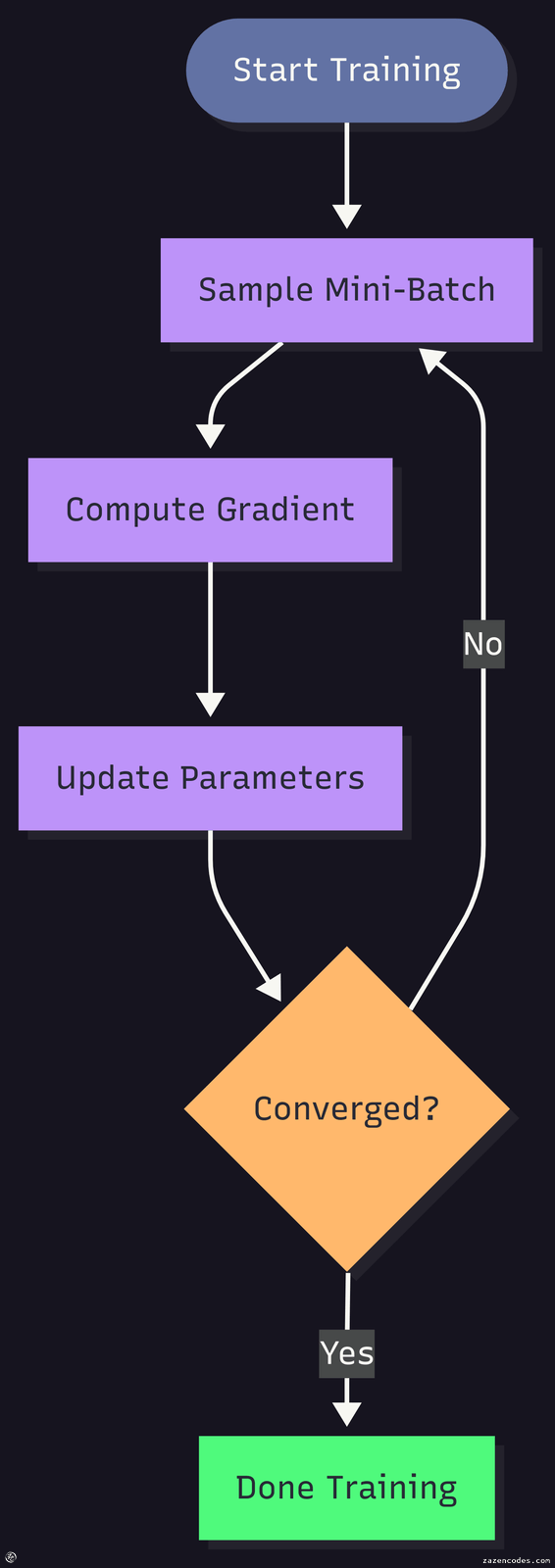
How Does SGD Work?
-
Random Sampling
Instead of using the entire dataset, SGD selects a random mini-batch of samples. -
Compute Gradient
Compute the gradient of the loss function using only the selected mini-batch. -
Update Parameters
Adjust parameters using the mini-batch gradient. -
Repeat
Iterate over multiple mini-batches until the loss converges.
Advantages of SGD
-
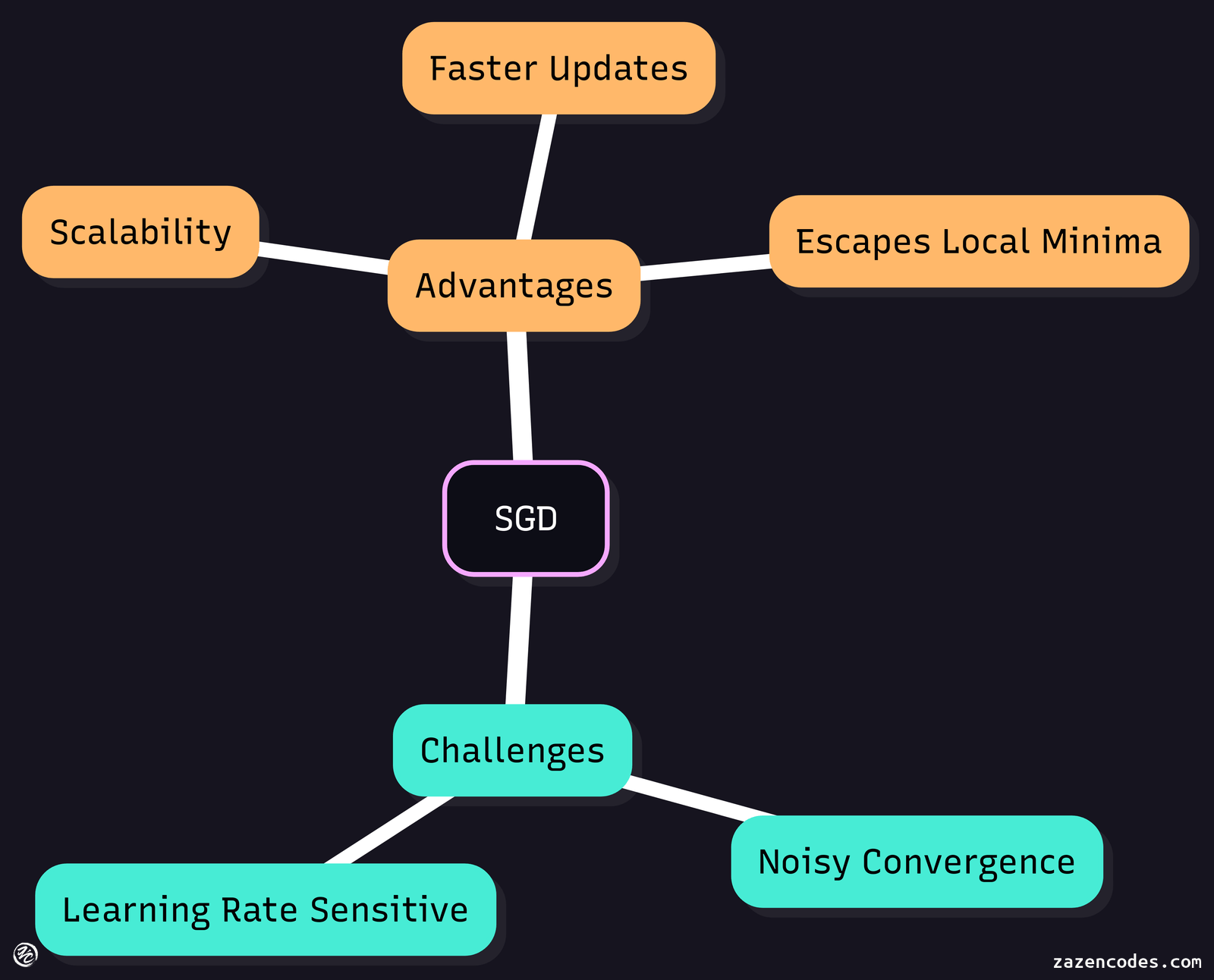
Scalability
This is the big one. It plays nicely with large datasets since only a portion is processed at a time. -
Faster Training
Updates are made more frequently, leading to **faster convergence. -
Exploration of the Loss Surface
The noise introduced by mini-batches helps escape local minima, potentially leading to a better solution.
Challenges with SGD
-
Noisy Convergence
The randomness of mini-batches can cause fluctuations in the loss, making it harder to reach the exact minimum. -
Learning Rate Sensitivity
Gradient descent is sensitive to the learning rate in general, but SGD is especially prone to instability due to the added noise.
Learning Rate
The learning rate (α) is a hyperparameter that determines how large each optimization step should be.
We’ve seen it a few times now, but we haven’t talked about it much.
Impact of Learning Rate
-
Too Large
- Can cause divergence or oscillation
- Model may fail to converge or “bounce” around the minimum
- Loss may increase instead of decrease
-
Too Small
- Training becomes very slow
- May get stuck in local minima
- Risk of early convergence to suboptimal solutions
Learning Rate Schedules
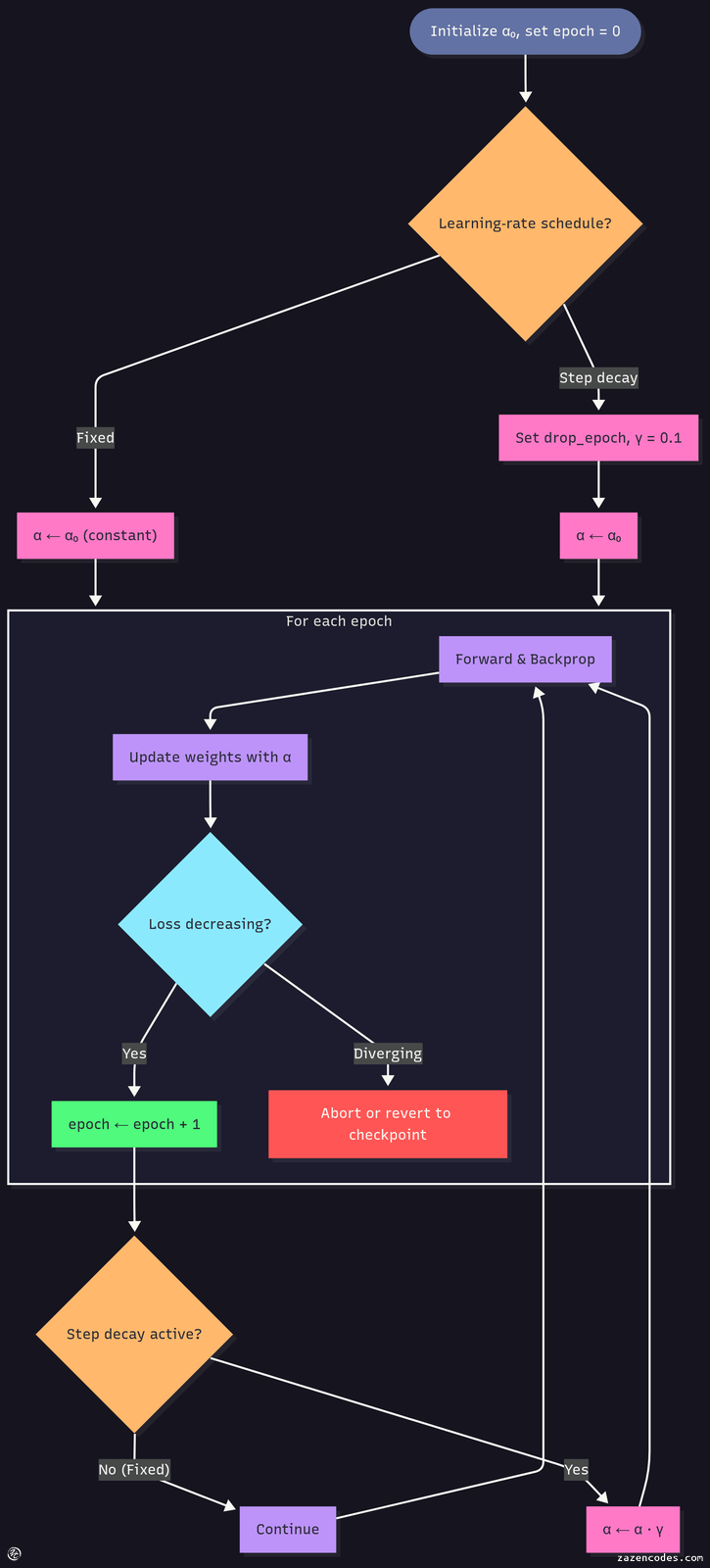
Rather than using a fixed learning rate, we can use a learning rate schedule to change its value over time.
For example, we can use step decay to reduce the learning rate by a factor after a fixed number of epochs:
Where:
- α is the current learning rate
- α₀ is the initial learning rate
- epoch is the current epoch number
- drop_epoch is the number of epochs after which to reduce the learning rate
Adam (Adaptive Moment Estimation)
Adam is an optimization algorithm that builds upon SGD by incorporating adaptive learning rates for each parameter in order to improve convergence.
The Adam Algorithm:
- Tracks both the average gradient and average squared gradient for each parameter.
- Uses these averages to adapt the learning rate individually:
- Parameters with larger gradients get smaller learning rates.
- Parameters with smaller gradients get larger learning rates.
- Includes a momentum term that helps accelerate training in the right direction.
- Automatically dampens oscillations and noise in the gradient updates.
This adaptive behavior makes Adam more robust than basic SGD since it can:
- Handle parameters that need different scales of updates.
- Work well even with noisy or sparse gradients.
- Often converge faster with less manual tuning.
Conclusion
That closes out Calculus and Optimization, and in fact, we’ve also reached the very end of the Mathematics section. What a ride!
Key Takeaways
🚀 SGD scales well for large datasets but introduces noise in optimization.
⚖️ Learning rate choice significantly impacts optimization speed and stability.
📉 Learning rate schedules help adapt step sizes for better convergence.
🔄 Adam combines momentum and adaptive learning rates, making it a powerful alternative to basic SGD.
Next: ML Fundamentals
Next up is ML fundamentals, which might seem a bit strange, given that we seem to have been talking about ML fundamentals for quite some time.
But in this next section, we’ll see the vibe gradually shift away from math (like we’ve been seeing here) and back to programming*.
Comments (0)
No comments yet.