Data Orchestration
Data orchestration makes the world go round. Let’s talk about how it’s done.
This Lesson Will Cover
- 🔄 Data Orchestration Fundamentals
- 🚀 Apache Airflow Overview and Examples
- 🌍 Real-World Use Cases in AI Engineering
- ⚖️ Comparison of Orchestration Tools
- ☁️ Cloud-Based Orchestration Solutions
What is Data Orchestration?
Data orchestration refers to the automated scheduling, monitoring, and execution of interconnected tasks in a data pipeline.
It ensures that each workflow is executed in the proper environment, and that tasks are executed at the right time, in the right order.
In the ML space, data orchestration tools are used to process data for model training, evaluation, and deployment. There are specific MLOps orchestration tools, and we’ve already talked about in this course, but this section will focus on more general data orchestration tools.
Apache Airflow
Apache Airflow is an open-source platform designed to programmatically author, schedule, and monitor workflows. It uses DAGs (Directed Acyclic Graphs) to represent workflows as a series of tasks with dependencies.
Key Features of Airflow
- DAG-Based Workflows: Define workflows as Python scripts for full flexibility.
- Extensibility: Supports custom operators and integrations with popular tools like AWS, Google Cloud, and Hadoop.
- Monitoring and Logging: Provides a web interface for tracking job progress and logs.
Example: Creating a DAG in Airflow
from airflow import DAG
from airflow.operators.python import PythonOperator
from datetime import datetime

# Define a Python function for a task
def extract_data():
    print("Extracting data...")

def process_data():
    print("Processing data...")

# Create the DAG
default_args = {
    "owner": "airflow",
    "start_date": datetime(2023, 1, 1),
    "retries": 1
}

with DAG(
    "example_pipeline",
    default_args=default_args,
    schedule_interval="0 1 * * *" # Every day at 1am
) as dag:
    extract_task = PythonOperator(
        task_id="extract_data",
        python_callable=extract_data
    )
    process_task = PythonOperator(
        task_id="process_data",
        python_callable=process_data
    )

    # Set task dependencies
    extract_task >> process_task
Real-World Use Cases for Airflow in AI Engineering
Here are some common scenarios AI engineers might want to use Airflow:
-
Data Preprocessing Pipelines:
- Extract data from databases or APIs.
- Clean, transform, and save the data to a data warehouse or distributed storage.
-
Model Training and Retraining:
- Schedule periodic retraining of machine learning models using new data.
- Automate the evaluation and deployment of models.
-
Monitoring and Alerting:
- Trigger alerts when a task fails or specific conditions are met.
- Ensure workflows complete successfully and on time.
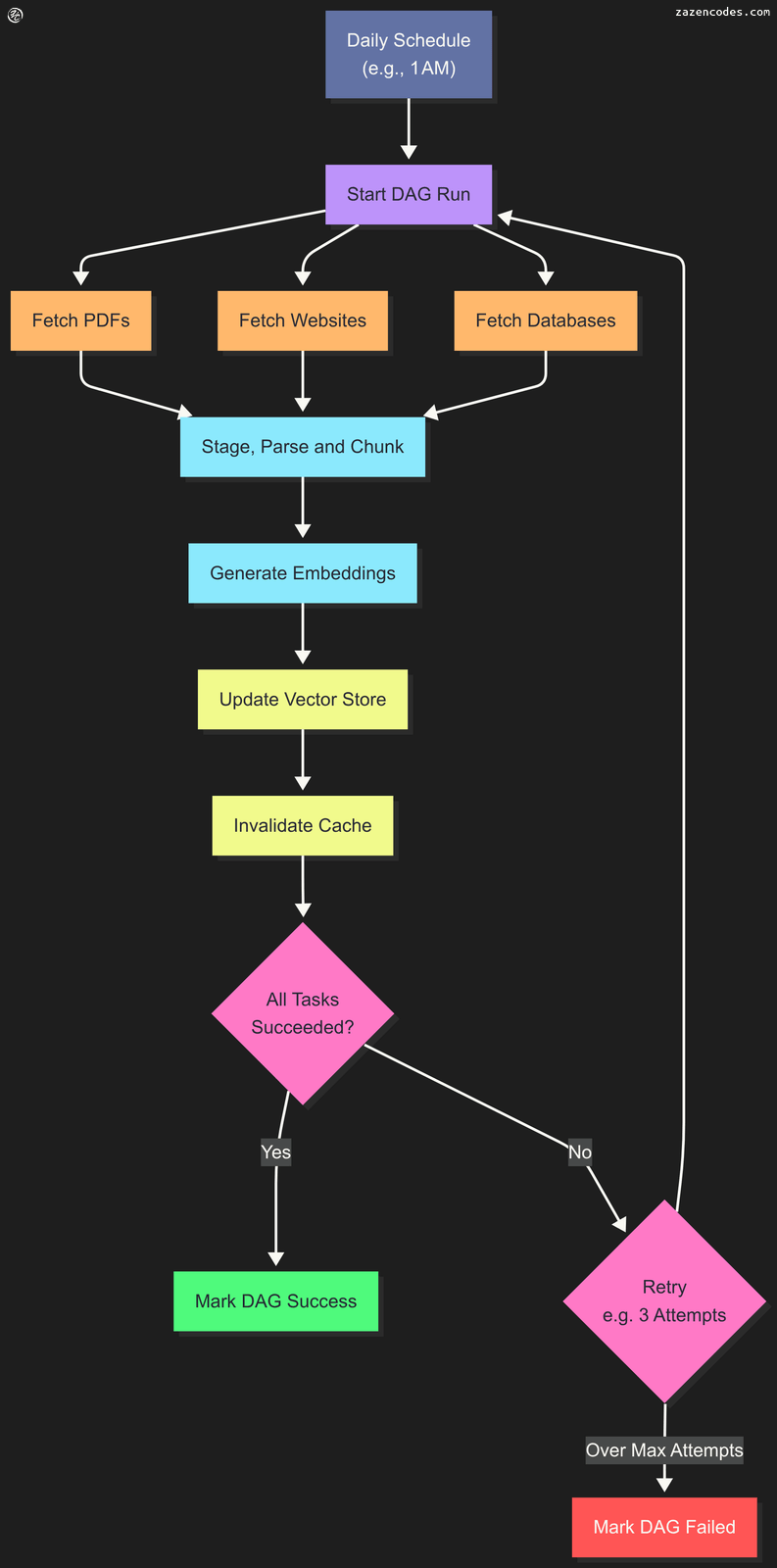
Example: Automating RAG Pipeline with Airflow
Imagine you need to update your RAG system daily. Your Airflow pipeline might include:
- Fetching new documents from various sources (PDFs, websites, databases).
- Processing documents into embeddings and chunks.
- Updating the vector store with new embeddings.
- Invalidating the retrieval system production cache.
A DAG for this workflow can ensure that all tasks are executed in the right order, with retries if a task fails.
Airflow vs. Other Open-Source Orchestration Tools
Prefect is a modern workflow orchestration tool that’s comparable with Airflow.
It aims to simplify data pipeline development with a focus on expressing workflows in a Pythonic way and handling errors gracefully.
Here’s a rough (and quite over-simplified) comparison between the two:
| Feature | Apache Airflow | Prefect |
|---|---|---|
| Architecture | DAG-based workflows | Task-based workflows with dynamic mapping |
| Language | Python | Python |
| Error Handling | Basic retry mechanism | Advanced error handling with state handlers |
| Learning Curve | Steeper learning curve | More intuitive for Python developers |
| Community | Large, mature community | Growing, active community |
| Deployment | Self-hosted or cloud (e.g. GCP) | Self-hosted or cloud (Prefect Cloud) |
| Data Context | Limited data context | Rich data context and parameterization |
Cloud Orchestration Tools
Major cloud providers offer their own orchestration solutions, which are serverless and easy to manage, reducing operational overhead and security concerns of self-hosted open-source tools (for a cost).
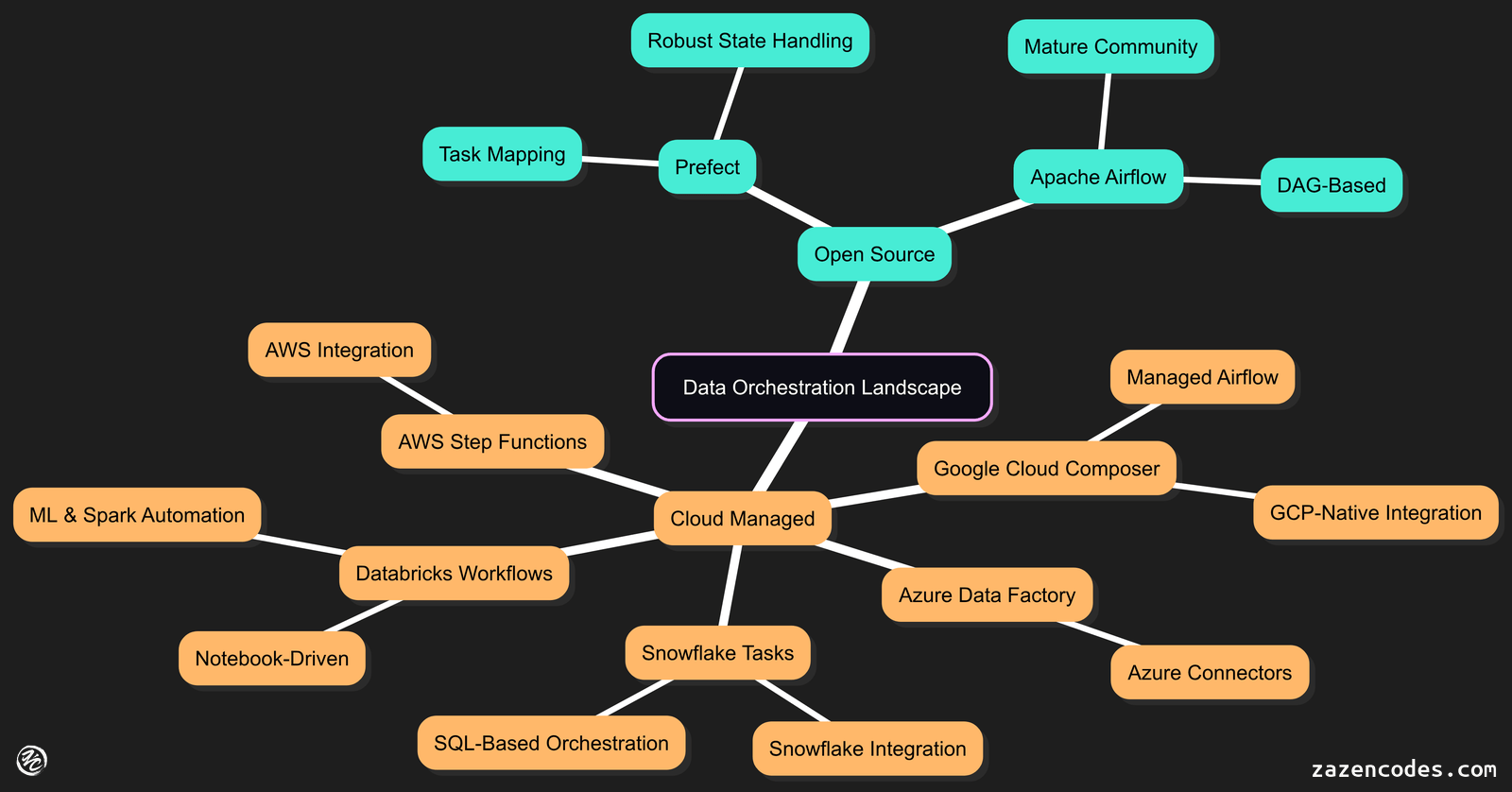
| Comparison Point | AWS Step Functions | Azure Data Factory | Google Cloud Composer | Databricks Workflows | Snowflake Tasks |
|---|---|---|---|---|---|
| Provider | Amazon | Microsoft | Databricks | Snowflake | |
| Primary Use Case | Serverless orchestration | ETL and data integration | Managed Airflow service | ML workflow automation | Data pipeline automation |
| Interface | Visual workflow designer | Visual pipeline builder | Airflow UI | Notebook & UI based | SQL based |
| Integration Focus | AWS services | Multi-cloud, on-prem | GCP services | Delta Lake, Spark | Snowflake ecosystem |
| Key Strength | Serverless scalability | Extensive connectors (90+) | Airflow compatibility | ML lifecycle support | SQL simplicity |
| Best For | AWS-centric workflows | Complex data integration | GCP & Airflow users | ML teams using Spark | Data teams using Snowflake |
| Cost Model | Pay-per-execution | Pay-per-activity | Instance-based | Platform subscription | Usage-based |
Conclusion
When I was starting out in the world of data and analytics, the concepts of distributed computing, data warehousing, and data orchestration were something of a mystery.
If you find yourself in (or around) that boat as well, then I hope this has helped demystify them.
Key Takeaways
🤖 Data orchestration automates and manages complex data pipelines and workflows.
🌬️ Apache Airflow is a popular open-source tool using DAGs to define workflows.
🔄 Key orchestration use cases include data preprocessing, model training, and monitoring.
☁️ Cloud providers offer managed orchestration services with different strengths.
🛠️ Choice of orchestration tool depends on your tech stack, use case, and team expertise.
Next: AI Engineering Concepts
Up next, we’re finally at the moment that we’ve all been waiting for.
It’s time to talk about AI engineering.
Comments (0)
No comments yet.