MLOps
As machine learning becomes a core business investment, and as ML production systems become more complicated, it turns out that maintaining models, experiments, and pipelines has become a full-time job.
Enter: MLOps (Machine Learning Operations)[1].
This Lesson Will Cover
- 🏗️ Introduction to MLOps Engineering and common tasks
- 📊 MLflow for experiment tracking and model management
- 🖼️ Weights & Biases for visualization and experiment monitoring
- ⚖️ Comparison of MLOps tools and their use cases
Introduction to MLOps Engineering
Given that we’re in the Tools and Frameworks section, we’ll be talking here about MLOps tooling.
First though, let’s have a quick look at what MLOps itself is all about.
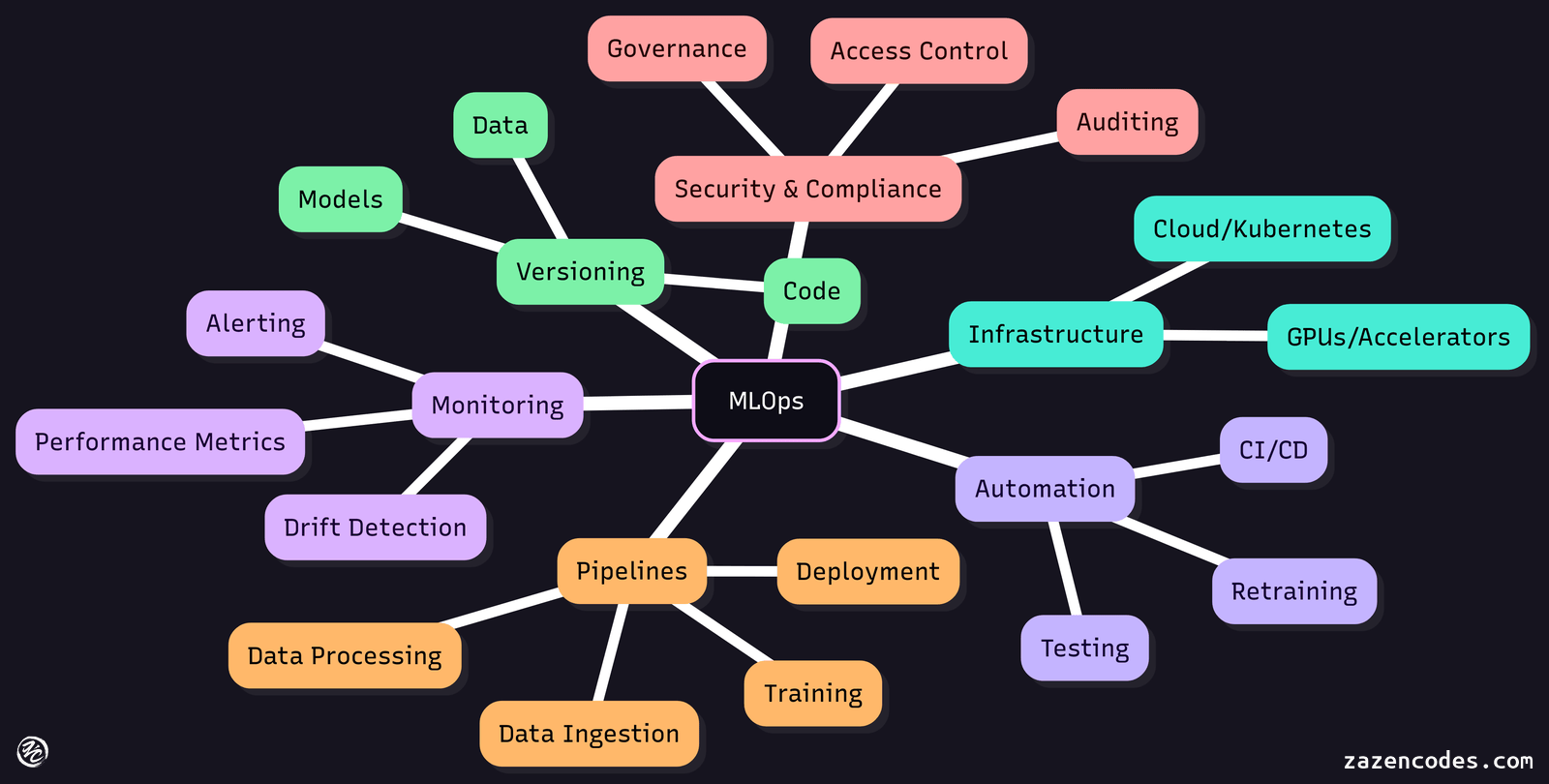
Here are some roles, responsibilities, and tasks that fall under the MLOps umbrella:
| Role | Responsibilities |
|---|---|
| Infrastructure Management | Setting up and maintaining ML infrastructure, cloud resources, and deployment platforms |
| Pipeline Development | Creating automated workflows for data processing, model training, and deployment |
| Model Monitoring | Tracking model performance, detecting drift, and ensuring reliability |
| Version Control | Managing code, data, and model versions across the ML lifecycle |
| Security & Compliance | Implementing security best practices and ensuring regulatory compliance |
| Automation | Building automated testing, deployment, and monitoring systems |
Common MLOps Tasks:
- Setting up continuous integration/continuous deployment (CI/CD) pipelines for ML models
- Implementing automated model retraining workflows
- Monitoring model performance metrics in production
- Managing cloud computing resources and costs
- Creating reproducible development environments
- Implementing A/B testing frameworks for model deployment
- Setting up feature stores and data versioning systems
- Developing model serving APIs and scaling solutions
- Implementing logging and alerting systems
- Creating documentation and maintaining operational runbooks
- Optimizing model inference for production environments
- Managing container orchestration for distributed training
MLflow
What is MLflow?
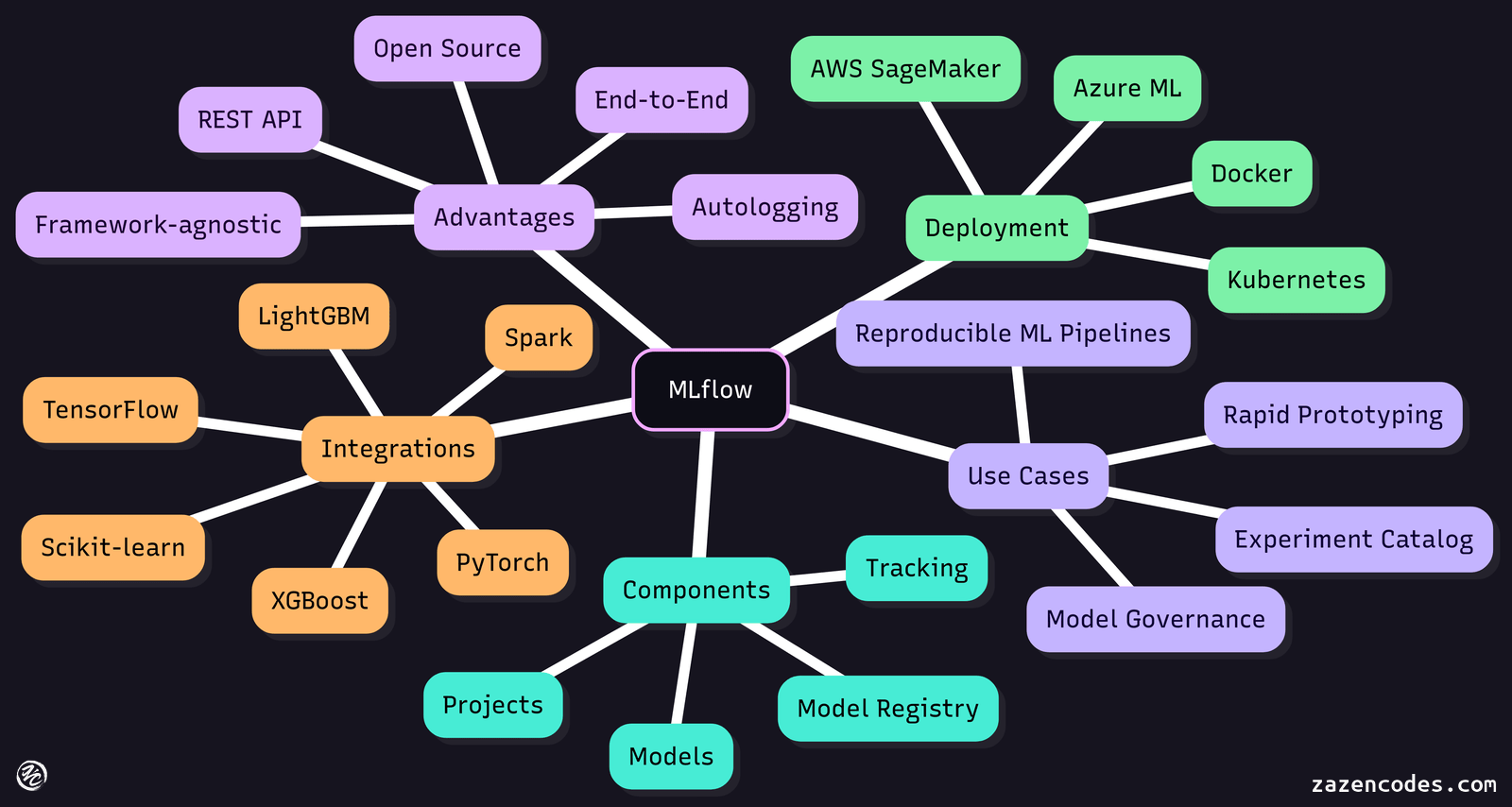
MLflow is an open-source platform to manage the end-to-end machine learning lifecycle.
It tracks experiments, manages models, and supports deployment pipelines.
Key components of MLflow include:
- Tracking: Logs parameters, metrics, and artifacts for reproducibility.
- Projects: Organizes reusable ML code.
- Models: Standardizes model packaging.
- Model Registry: Facilitates model versioning and deployment.
Why use MLflow?
- Simplifies tracking of multiple experiments.
- Provides a standardized framework for model management.
- Integrates with popular ML libraries like TensorFlow, PyTorch, and Scikit-learn.
Example: Tracking Experiments with MLflow
Below is an example of logging an experiment using MLflow:
import mlflow
import mlflow.sklearn
from sklearn.ensemble import RandomForestClassifier
from sklearn.datasets import load_iris
from sklearn.model_selection import train_test_split

# Load dataset
data = load_iris()
X_train, X_test, y_train, y_test = train_test_split(data.data, data.target, test_size=0.3)

# Start an MLflow experiment
with mlflow.start_run():
    # Train a model
    clf = RandomForestClassifier(n_estimators=100)
    clf.fit(X_train, y_train)

    # Log metrics and model
    accuracy = clf.score(X_test, y_test)
    mlflow.log_metric("accuracy", accuracy)
    mlflow.sklearn.log_model(clf, "model")

    print(f"Model logged with accuracy: {accuracy:.2f}")

# Outputs:
# Model logged with accuracy: 0.91
Weights & Biases
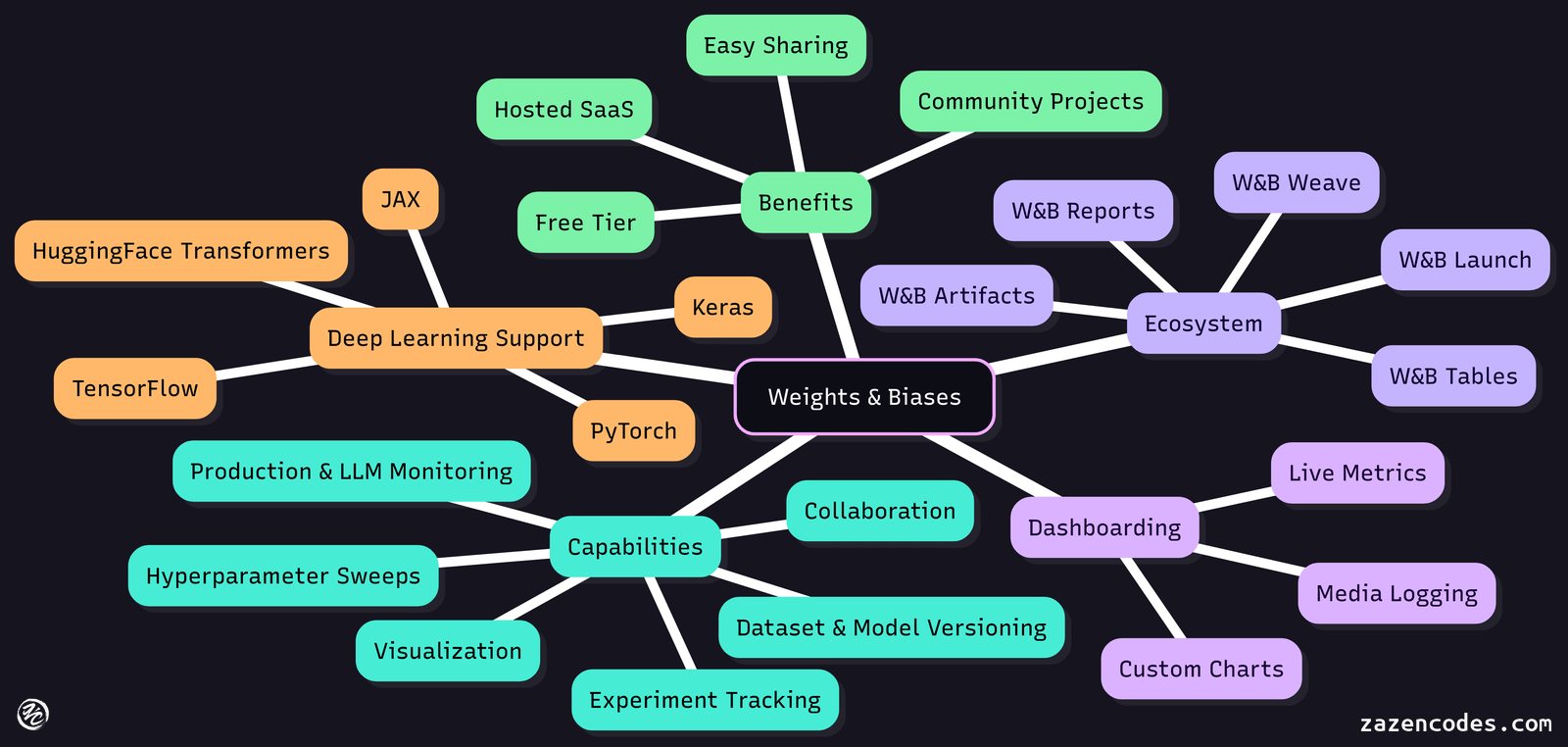
W&B (Weights & Biases) is another MLOps platform for tracking experiments.
It’s widely adopted in both research and industry for deep learning workflows.
Whereas MLflow focuses on the complete ML lifecycle management, W&B specializes in experiment tracking and visualization with more sophisticated dashboarding capabilities.
Why use W&B?
- Live Tracking: Visualize metrics, losses, and predictions in real-time.
- Hyperparameter Tuning: Perform efficient sweeps to find optimal configurations.
- Collaboration: Share experiment results with teammates or the community.
Example: Using W&B for Experiment Tracking
Below is an example of integrating W&B with PyTorch:
import wandb
import torch
import torch.nn as nn
import torch.optim as optim

# Initialize a W&B run
wandb.init(project="mlops-example")

# Define a simple model
class SimpleModel(nn.Module):
    def __init__(self):
        super(SimpleModel, self).__init__()
        self.fc1 = nn.Linear(784, 128)
        self.fc2 = nn.Linear(128, 10)

    def forward(self, x):
        x = torch.relu(self.fc1(x))
        return torch.softmax(self.fc2(x), dim=1)

model = SimpleModel()

# Log hyperparameters
config = {"learning_rate": 0.001, "epochs": 5}
wandb.config.update(config)

# Define loss and optimizer
criterion = nn.CrossEntropyLoss()
optimizer = optim.Adam(model.parameters(), lr=config["learning_rate"])

# Example training loop (dummy data required)
# for epoch in range(config["epochs"]):
#     loss = ...
#     wandb.log({"epoch": epoch, "loss": loss})
Comparison: MLflow vs. Weights & Biases
| Feature | MLflow | Weights & Biases |
|---|---|---|
| Primary Use Case | Experiment tracking, model management | Experiment tracking, visualization |
| Ease of Use | User-friendly for end-to-end workflows | Intuitive for detailed tracking |
| Deployment | Model serving and pipelines | Visualization and collaboration |
| Integration | Extensive library support | Strong deep learning support |
Conclusion
If you think MLOps is cool, wait until you see LLMOps. And no—I’m not joking! You can hop over to AI Deployment > LLM Integration Patterns > API Integrations to see what that’s all about.
Key Takeaways
⚙️ MLOps is essential for managing machine learning systems in production environments.
🏗️ MLflow provides comprehensive lifecycle management with experiment tracking, model packaging, and deployment.
📊 Weights & Biases excels in visualization and real-time experiment monitoring.
🎯 Different MLOps tools serve different purposes—choose based on your specific needs.
🔄 Key MLOps tasks include CI/CD, monitoring, resource management, and automation.
Next: Model Serving
Up next, to round out the ML Fundamentals section of this course, we’ll look at model serving.
Footnotes
The motivation and ideas behind MLOps were first published in a research paper: Hidden Technical Debts in the Machine Learning System, which highlights common problems when using machine learning for business applications. ↩︎
Comments (0)
No comments yet.