Data Engineering
If ML/DL is the brain of AI systems, then data is the food. You are what you eat!
This Lesson Will Cover
- 📊 What is Data Engineering?
- 🛠️ Key Responsibilities in Data Engineering
- 📚 Essential Data Engineering Concepts
- 🔄 ETL Pipelines and Distributed Computing
- 🗄️ Data Storage Solutions
What is Data Engineering?
Data engineering focuses on building systems to collect, store, and process data at scale.
It ensures that data pipelines are reliable and that data is accessible for machine learning and analytics workflows.
Key Responsibilities in Data Engineering
- Data Ingestion: Collecting data from diverse sources (APIs, databases, web scraping).
- Data Transformation: Cleaning, filtering, and formatting raw data into usable forms.
- Data Storage: Storing data in databases, data lakes, or data warehouses.
- Data Pipelines: Automating workflows for continuous data flow and updates.
Essential Data Engineering Concepts
Data Formats
AI engineers work with various data formats. Common ones include:
- Structured Data: Tabular data stored in SQL databases.
- Semi-Structured Data: JSON, XML, or CSV files with flexible schemas.
- Unstructured Data: Images, videos, and text data requiring specialized processing.
ETL Pipelines
ETL stands for Extract, Transform, Load:
- Extract: Retrieve data from sources like APIs, sensors, or databases.
- Transform: Clean, filter and otherwise change data (e.g., handle missing values, standardize formats).
- Load: Save the transformed data to a target system, such as a database or data lake.
Example: Using Python’s pandas library for a simple ETL task
import pandas as pd

# Extract
data = pd.read_csv("raw_data.csv")

# Transform
data = data.dropna()  # Remove missing values
data['price'] = data['price'].apply(lambda x: x * 1.1)  # Apply a transformation

print(data)

# Load
data.to_csv("cleaned_data.csv", index=False)

# Output
#           item  price
# 0        apple   2.75
# 1         kale   3.30
# 2    olive oil  20.46
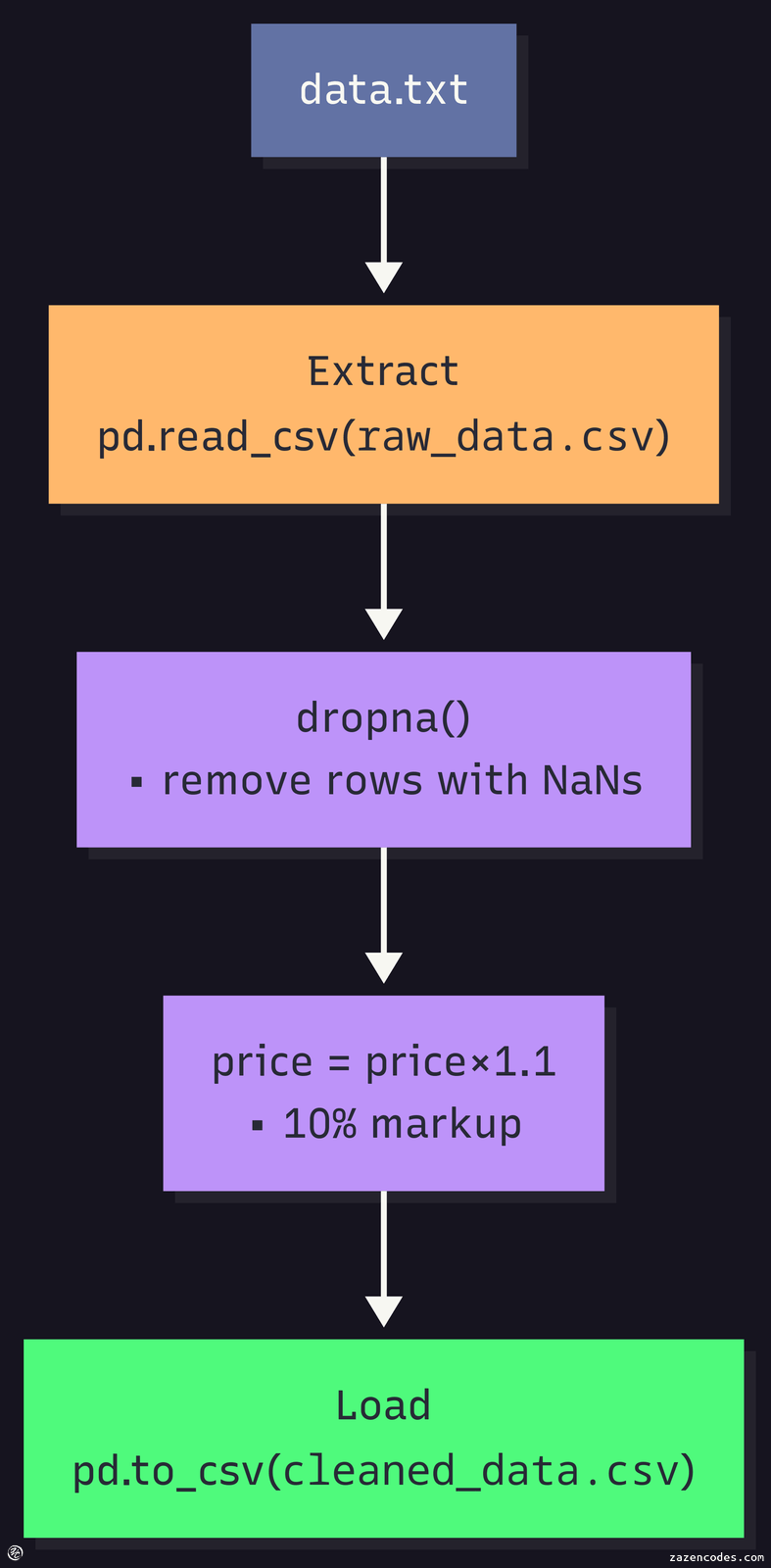
Here, we load and write data to and from local files.
A real ETL process might instead extract from a transactional database like PostgreSQL and load to a data warehouse like Redshift.
There’s also ELT[1], but we’ll get to that later in the course.
Distributed Computing
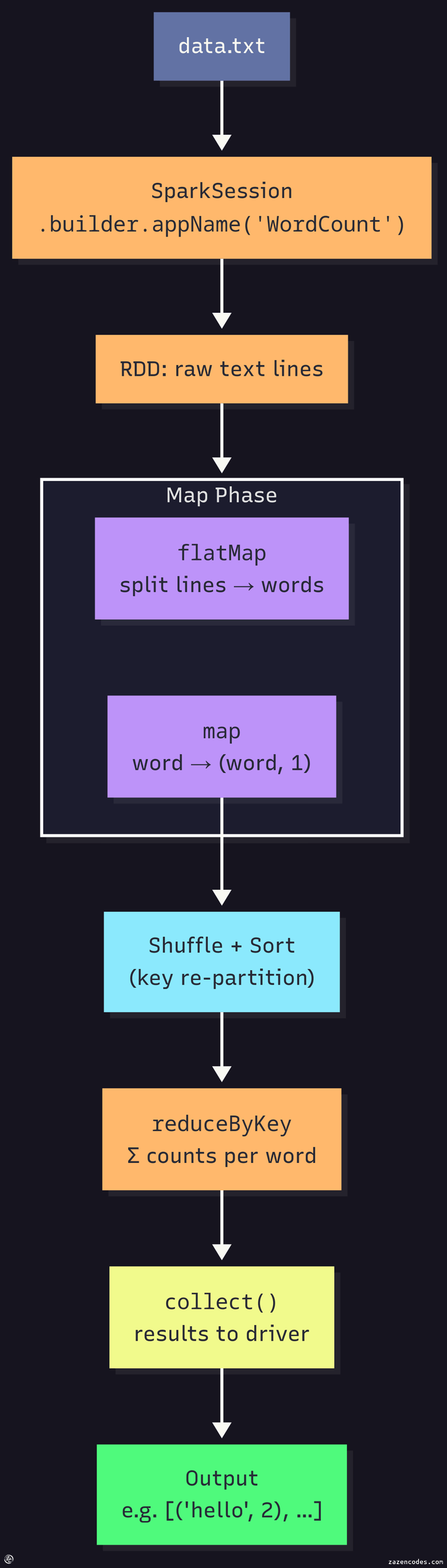
Big data often exceeds the capabilities of a single machine. Distributed systems like Apache Spark and Hadoop process data across multiple nodes.
Example: Running a Spark job for word count
from pyspark.sql import SparkSession

spark = SparkSession.builder.appName("WordCount").getOrCreate()
data = spark.read.text("data.txt")

word_counts = (
    data.rdd.flatMap(lambda line: line.split())
    .map(lambda word: (word, 1))
    .reduceByKey(lambda a, b: a + b)
)

print(word_counts.collect())

# Output (example data): [('hello', 2), ('world', 1), ('spark', 3), ('python', 1)]
Data Storage Solutions
Choosing the right storage solution depends on the data type and use case:
- Relational Databases (SQL): Best for structured data (e.g., MySQL, PostgreSQL).
- NoSQL Databases: Handle unstructured or semi-structured data (e.g., MongoDB).
- Data Lakes: Store raw data in its original format (e.g., AWS S3).
- Data Warehouses: Optimized for analytics (e.g., Redshift, BigQuery).
Conclusion
Since Data Engineering is so important, we’ll talk more about it later in the course. In fact, I’ve got another 10+ lessons waiting for you on this subject!
As ChatGPT would say: “Having good data is crucial.”
Key Takeaways
🛠️ Data engineering ensures that ML/DL models have clean, structured, and accessible data.
🔄 ETL pipelines are a foundational concept for data processing.
⚙️ Distributed computing allows large-scale data processing across multiple nodes.
🗄️ Choosing the right storage solution depends on the type and structure of data.
🏛️ SQL and NoSQL databases, data lakes, and data warehouses each serve different use cases.
Next: Cloud and Deployment
None of this stuff matters if we can’t deploy it. And none of this stuff even works without the cloud. So let’s talk about that.
Footnotes
We talk about ELT (Extract, Load, Transform) in the Data Engineering section of the source. You can check out the Data Engineering > Data Pipelines > Modern Data Pipelines lesson if you want to learn more about that now. ↩︎
Comments (0)
No comments yet.