AI Engineer vs ML Engineer
Understanding the Roles
In this lesson, we’ll look at the differences and similarities between AI Engineers, Data Scientists, and ML Engineers.
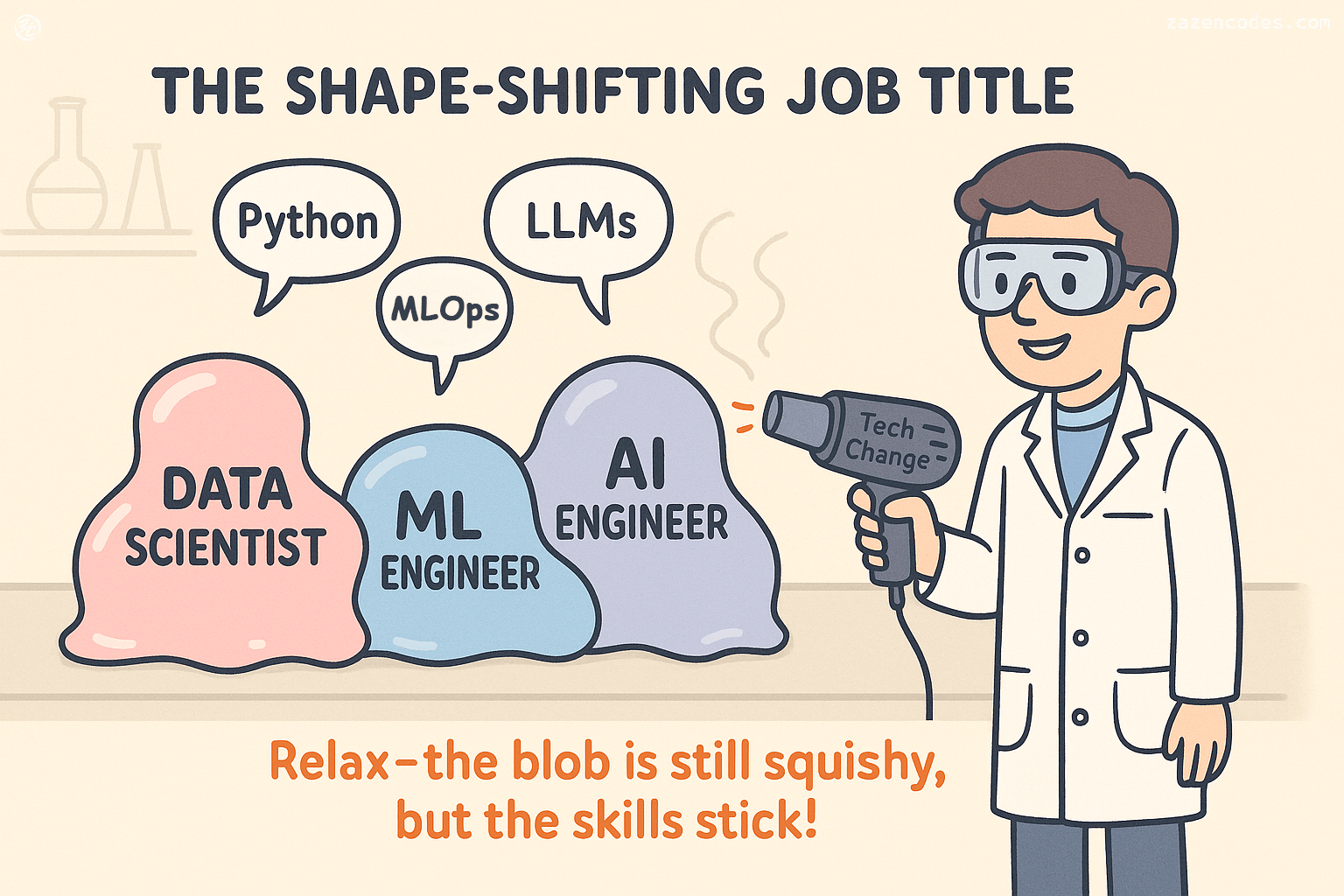
There’s clearly a lot of overlap between these fields, and I don’t believe that classifying and distinguishing them precisely is very useful. The question of “what is your job title?” is far less important and interesting than the question of “what value do you provide?”
On the other hand, it’s good to have a general idea of what a business is typically looking for when they post a job for an AI Engineer vs. Data Scientist vs. ML Engineer:
| Aspect | AI Engineer | Data Scientist | ML Engineer |
|---|---|---|---|
| Scope | Product-focused AI applications | Data analysis and modeling | Building and deploying ML models |
| Tools | Pre-trained models, APIs | Statistical libraries, visualization tools | Frameworks for model training and MLOps |
| Output | User-facing applications | Business insights and reports | Deployed models |
| Expertise | System integration, programming | Data manipulation, statistical analysis | Model optimization, software engineering |
If this table “vibes” with you, then feel free to move on to the next section. Otherwise, you can continue reading to get a deeper understanding of each role.[1]
Keep in mind that the difference between AI Engineers and ML Engineers in the industry is still quite unclear. A lot of what I’m describing in this lesson and in this course is a projection of what I expect to see in the coming years.
AI Engineer
Focus: Applying pre-trained AI models and tools to create user-focused products.
AI Engineers specialize in integrating existing AI capabilities into real-world applications. They don’t usually build AI models from scratch but instead work with APIs, fine-tune pre-trained models, and design systems that make AI accessible to users.
- Primary Tools: Pre-trained models (e.g., GPT-4), AI libraries (e.g., LangChain), and frameworks for deployment.
- Skillset: Software engineering, systems integration, and an understanding of AI capabilities.
- Example Tasks: Building a chatbot, implementing a recommendation system, or creating a generative design tool.
Data Scientist
Focus: Extracting insights from data to guide business decisions.
Data Scientists use statistical methods, machine learning, and data visualization to analyze data and build predictive models. Their work often informs decision-making but is not necessarily integrated into production systems.
- Primary Tools: Python, R, SQL, and libraries like pandas, NumPy, and scikit-learn.
- Skillset: Data analysis, visualization, and machine learning.
- Example Tasks: Creating dashboards, analyzing customer behavior, or building churn prediction models.
Machine Learning Engineer
Focus: Designing, training, and deploying machine learning models.
ML Engineers focus on creating and optimizing models that learn from data. They sometimes handle the end-to-end pipeline, from data preprocessing to integrating models into production environments.
- Primary Tools: TensorFlow, PyTorch, Kubernetes, and MLflow.
- Skillset: Model development, software engineering, and MLOps (Machine Learning Operations)[2].
- Example Tasks: Building a fraud detection model, training a custom computer vision system, or managing large-scale data pipelines.
Conclusion
Imagine for a second that these jobs are Pokémon. Now imagine you’re battling Professor Oak. Who do you send out?! Be real with yourself.
Ummm yeah, so… These conclusions are going to get a bit weird. You’ve been warned.
Next: Applications of AI in 2025
In the next lesson, we’ll talk about some applications of AI in 2025.
Footnotes
MLOps is awesome. Skip ahead to the AI Deployment > DevOps > MLOps lesson if you want to learn more about that now. ↩︎
Comments (0)
No comments yet.